

Literature meeting 1
Ultee Chapter 2
2.1 The problem of order
Hobbes’ problem: ‘How is it possible that people live together peacefully?’ Hobbes’s
answer: ‘Only a sovereign state will avert a war of all against all.’
However, when such states exist, three other types of violence are possible: states may
oppress their subjects, people may rebel against the state, and states may wager war
against each other.
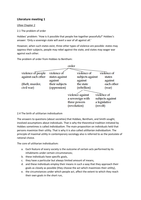
The problem of order from Hobbes to Bentham:
2.4 The birth of utilitarian individualism
The answers to questions (about societies) that Hobbes, Bentham, and Smith sought,
involved assumptions about individuals. That is why the theoretical tradition initiated by
Hobbes sometimes is called individualism. The main proposition on individuals held that
persons maximize their utility. That is why it is also called utilitarian individualism. The
principle of maximal utility in contemporary sociology also is referred to as the postulate of
rational choice.
The core of utilitarian individualism:
a. Each feature of every society is the outcome of certain acts performed by its
inhabitants under certain circumstances;
b. these individuals have specific goals,
c. they have a particular but always limited amount of means,
d. and these individuals employ their means in such a way that they approach their
goals as closely as possible (they choose the act which maximizes their utility),
e. the circumstances under which people act, affect the extent to which they reach
their own goals in the short run,
Ultee Chapter 2
2.1 The problem of order
Hobbes’ problem: ‘How is it possible that people live together peacefully?’ Hobbes’s
answer: ‘Only a sovereign state will avert a war of all against all.’
However, when such states exist, three other types of violence are possible: states may
oppress their subjects, people may rebel against the state, and states may wager war
against each other.
The problem of order from Hobbes to Bentham:
2.4 The birth of utilitarian individualism
The answers to questions (about societies) that Hobbes, Bentham, and Smith sought,
involved assumptions about individuals. That is why the theoretical tradition initiated by
Hobbes sometimes is called individualism. The main proposition on individuals held that
persons maximize their utility. That is why it is also called utilitarian individualism. The
principle of maximal utility in contemporary sociology also is referred to as the postulate of
rational choice.
The core of utilitarian individualism:
a. Each feature of every society is the outcome of certain acts performed by its
inhabitants under certain circumstances;
b. these individuals have specific goals,
c. they have a particular but always limited amount of means,
d. and these individuals employ their means in such a way that they approach their
goals as closely as possible (they choose the act which maximizes their utility),
e. the circumstances under which people act, affect the extent to which they reach
their own goals in the short run,


