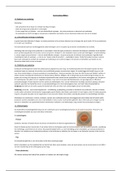
Year 9 Final Exam
Microscope:
Eye piece
Arm Tube
Objective
lenses
Coarse Stage clips
focus
Stage
Fine focus Light
Base
Magnification Calculation
Image size
Magnification Actual Image
Animal Cell:
Ribosomes
, .:. . :..
…:::::
Plant Cell: Ribsomes
::::::..
Parts of cell:
Nucleus – Controls the cell, contains DNA
Cell Membrane – Controls what goes in and out of the cell
Cell Wall – Protects the cell
,Cytoplasm – For chemical reaction
Chloroplast – To absorb sunlight for photosynthesis
Mitochondria – For anaerobic respiration
Vacuole – Contains sugar and solutions
Ribosomes – To synthesis protein
Eukaryotic Prokaryotic
Membrane bound
Organelles (nucleus) Not membrane bound
Size 5µm-100µm 0.2µm-2.0µm
-Cell membrane -Cell membrane
Layers of cell -Cell wall for fungi/plants -Cell wall
-Slimy capsule
-Flagellum
Cytoplasm Cytoplasm
Cell contents Mitochondria Ribosomes
Ribosomes No mito/chloro
Chloroplasts
DNA- 1 molecule
Genetic material DNA in nucleus Free in cytoplasm
DNA found plasmids
Type of cell division Mitosis Binary Fission
Eukaryotic and Prokaryotic cells
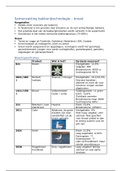
-Carry out -On top of leaf
Palisade Cell photosynthesis
-Tall and long
-Make plants food surface area, catch
sunlight
-Packed with
chloroplasts
, Red blood cell - Carries oxygen to -Large surface
body area
Carries carbon -Contains
dioxide back to hemoglobin
lungs
Ciliated cell -Stop lungs -In all the air
damage passages down to
the lungs
-Hairs sweep
mucus with -Tiny hairs called
trapped dust and cilia
bacteria
Nerve cell -To carry nerve -Extremely
impulses around elongated
your body
-Many branches
at the end
- Long axis
covered
Root hair cell -Absorbs minerals -Large surface
and water from soil area to absorb lots
of water
-Thin cell walls
allow
Sperm cell -To carry the -Really long tail
father’s DNA to the
mother -Enzymes in the
head
Egg cell Carries the -Contains yolk as
mother’s DNA food source for
developing embryo
(baby) when
fertilized
-Much larger than
other animal cells
Specialized cells: Name Function Adaptions
Diffusion- the movement of molecules from a higher
concentration to a lower concentration
- Passive process
- Continues till equilibrium is reached/equally spread
- Goes down the concentration gradient
Microscope:
Eye piece
Arm Tube
Objective
lenses
Coarse Stage clips
focus
Stage
Fine focus Light
Base
Magnification Calculation
Image size
Magnification Actual Image
Animal Cell:
Ribosomes
, .:. . :..
…:::::
Plant Cell: Ribsomes
::::::..
Parts of cell:
Nucleus – Controls the cell, contains DNA
Cell Membrane – Controls what goes in and out of the cell
Cell Wall – Protects the cell
,Cytoplasm – For chemical reaction
Chloroplast – To absorb sunlight for photosynthesis
Mitochondria – For anaerobic respiration
Vacuole – Contains sugar and solutions
Ribosomes – To synthesis protein
Eukaryotic Prokaryotic
Membrane bound
Organelles (nucleus) Not membrane bound
Size 5µm-100µm 0.2µm-2.0µm
-Cell membrane -Cell membrane
Layers of cell -Cell wall for fungi/plants -Cell wall
-Slimy capsule
-Flagellum
Cytoplasm Cytoplasm
Cell contents Mitochondria Ribosomes
Ribosomes No mito/chloro
Chloroplasts
DNA- 1 molecule
Genetic material DNA in nucleus Free in cytoplasm
DNA found plasmids
Type of cell division Mitosis Binary Fission
Eukaryotic and Prokaryotic cells
-Carry out -On top of leaf
Palisade Cell photosynthesis
-Tall and long
-Make plants food surface area, catch
sunlight
-Packed with
chloroplasts
, Red blood cell - Carries oxygen to -Large surface
body area
Carries carbon -Contains
dioxide back to hemoglobin
lungs
Ciliated cell -Stop lungs -In all the air
damage passages down to
the lungs
-Hairs sweep
mucus with -Tiny hairs called
trapped dust and cilia
bacteria
Nerve cell -To carry nerve -Extremely
impulses around elongated
your body
-Many branches
at the end
- Long axis
covered
Root hair cell -Absorbs minerals -Large surface
and water from soil area to absorb lots
of water
-Thin cell walls
allow
Sperm cell -To carry the -Really long tail
father’s DNA to the
mother -Enzymes in the
head
Egg cell Carries the -Contains yolk as
mother’s DNA food source for
developing embryo
(baby) when
fertilized
-Much larger than
other animal cells
Specialized cells: Name Function Adaptions
Diffusion- the movement of molecules from a higher
concentration to a lower concentration
- Passive process
- Continues till equilibrium is reached/equally spread
- Goes down the concentration gradient