Practical 4
Enzyme Concentration:
To investigate the effect of substrate concentration on the rate of reactivity of the enzyme catalase
Hypothesis:
As the concentration of hydrogen peroxide increases so will the rate of reaction.
Enzymes are biological catalysts made up of a polypeptide chain of amino acids that speed up the
rate of reaction by lowering the activation energy. The substrate locks into the enzyme's active site,
where it is then broken down into smaller molecules.
Hydrogen peroxide, produced via the mitochondria, is broken down by catalase into oxygen and
water. This means that the higher the concentration of hydrogen peroxide, the higher amount of
oxygen that will be produced.[1]
In the presence of an enzyme, the rate of reaction increases as the substrate concentration increases
until a limiting rate is reached, after which further increases in the substrate concentration will produce
no significant change in the reaction rate. At this point, so much substrate is present that essentially
all of the enzyme active sites have substrate bound to them.[2]
Equipment:
● Potato
● Conical flask
● 6 Boiling Tubes
● Glass syringe
● Rubber tube and cork
● Beaker
● Scale
● Measuring Cylinder
● 20% Volume Hydrogen Peroxide
● Distilled water
● Stop Clock
● Thermometer
● Scalpel
Variables:
● Dependent- Rate of Enzyme Activity
● Independent-Concentration of Substrate
● Control-Temperature of Concentrations- 50℃
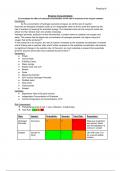
Risk Assessment;
➔ Probability/severity of risk: 1-Low, 2-Medium, 3-High/Likely
➔ Total Risk: 1, 2,3, 4, 6, 9
Risk: Hazard: Probability: Severity: Total Risk: Precaution:
Hydrogen Corrosive 3 3 6 Wear eye protection
Peroxide and gloves; Wash
skin immediately if it
comes in contact
Scalpel Injuries to 1 2 3 Use with care; Cut
hand on a secure,stable
surface
Enzyme Concentration:
To investigate the effect of substrate concentration on the rate of reactivity of the enzyme catalase
Hypothesis:
As the concentration of hydrogen peroxide increases so will the rate of reaction.
Enzymes are biological catalysts made up of a polypeptide chain of amino acids that speed up the
rate of reaction by lowering the activation energy. The substrate locks into the enzyme's active site,
where it is then broken down into smaller molecules.
Hydrogen peroxide, produced via the mitochondria, is broken down by catalase into oxygen and
water. This means that the higher the concentration of hydrogen peroxide, the higher amount of
oxygen that will be produced.[1]
In the presence of an enzyme, the rate of reaction increases as the substrate concentration increases
until a limiting rate is reached, after which further increases in the substrate concentration will produce
no significant change in the reaction rate. At this point, so much substrate is present that essentially
all of the enzyme active sites have substrate bound to them.[2]
Equipment:
● Potato
● Conical flask
● 6 Boiling Tubes
● Glass syringe
● Rubber tube and cork
● Beaker
● Scale
● Measuring Cylinder
● 20% Volume Hydrogen Peroxide
● Distilled water
● Stop Clock
● Thermometer
● Scalpel
Variables:
● Dependent- Rate of Enzyme Activity
● Independent-Concentration of Substrate
● Control-Temperature of Concentrations- 50℃
Risk Assessment;
➔ Probability/severity of risk: 1-Low, 2-Medium, 3-High/Likely
➔ Total Risk: 1, 2,3, 4, 6, 9
Risk: Hazard: Probability: Severity: Total Risk: Precaution:
Hydrogen Corrosive 3 3 6 Wear eye protection
Peroxide and gloves; Wash
skin immediately if it
comes in contact
Scalpel Injuries to 1 2 3 Use with care; Cut
hand on a secure,stable
surface