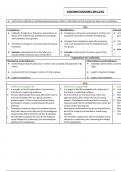
● Conformity is defined as ‘yielding to group pressure’. Refers to the influence that a group can have over an individual.
AO1:
Compliance: Identification: Internal
● Publically changing our behaviour and opinions to ● Changing our behaviour and opinions to those of a ● A tru
those of the majority but privately not accepting group but only whilst a member of that group. grou
their behaviour and opinions.
● Stronger than compliance, generally temporary ● The
● A temporary change; it only exists when the group and is not maintained once the individual leaves cont
is present. the group.
● Exam
● Example: pretending to like a film when you ● Example: conforming to the dress sense of the
actually dislike it because your friends like it. group.
Explanations for conformity
Normative social influence: Informational social influence:
● Conforming to majority behaviour in order to be accepted and approved of by ● Looking to others when unsure fo
others. ‘right’.
● Involves short term change in order to fit into a group. ● Leads to long term change.
● Leads to compliance. ● Leads to internalisation.
AO3:
Evidence to support ISI Evidence to support NSI Rea
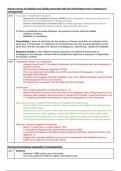
P A strength of the ISI explanation of conformity is P A strength of the NSI explanation of conformity is P A str
that there is supporting evidence. that there is supporting evidence. worl
E Jenness asked people how many jelly beans were in E Asch found that on 12 critical trials, there was E Rese
a jar first privately, then as a group, and then approximately a 37% conformity rate to wrong influ
privately again. In their second private estimate, answers. Participants conformed to the incorrect E Desp
participants’ answers moved towards the group responses given by the confederates even when the the b
estimate. correct answer was obvious. stron
E Participants looked to others for answers because E Participants conformed because they wanted to be they
they had a desire to be right and in this ambiguous part of the majority and wanted to ‘avoid being L This
situation they didn’t know the answer themselves. rejected’. to in
L This therefore supports the role of informational L This therefore supports the role of normative social
social influence in conformity, thus increasing the influence in conformity, thus increasing the validity
validity of this explanation. of this explanation.
AO1:
Compliance: Identification: Internal
● Publically changing our behaviour and opinions to ● Changing our behaviour and opinions to those of a ● A tru
those of the majority but privately not accepting group but only whilst a member of that group. grou
their behaviour and opinions.
● Stronger than compliance, generally temporary ● The
● A temporary change; it only exists when the group and is not maintained once the individual leaves cont
is present. the group.
● Exam
● Example: pretending to like a film when you ● Example: conforming to the dress sense of the
actually dislike it because your friends like it. group.
Explanations for conformity
Normative social influence: Informational social influence:
● Conforming to majority behaviour in order to be accepted and approved of by ● Looking to others when unsure fo
others. ‘right’.
● Involves short term change in order to fit into a group. ● Leads to long term change.
● Leads to compliance. ● Leads to internalisation.
AO3:
Evidence to support ISI Evidence to support NSI Rea
P A strength of the ISI explanation of conformity is P A strength of the NSI explanation of conformity is P A str
that there is supporting evidence. that there is supporting evidence. worl
E Jenness asked people how many jelly beans were in E Asch found that on 12 critical trials, there was E Rese
a jar first privately, then as a group, and then approximately a 37% conformity rate to wrong influ
privately again. In their second private estimate, answers. Participants conformed to the incorrect E Desp
participants’ answers moved towards the group responses given by the confederates even when the the b
estimate. correct answer was obvious. stron
E Participants looked to others for answers because E Participants conformed because they wanted to be they
they had a desire to be right and in this ambiguous part of the majority and wanted to ‘avoid being L This
situation they didn’t know the answer themselves. rejected’. to in
L This therefore supports the role of informational L This therefore supports the role of normative social
social influence in conformity, thus increasing the influence in conformity, thus increasing the validity
validity of this explanation. of this explanation.