USMLE Step 1 High Yield Exam Questions & Answers Correct 100%
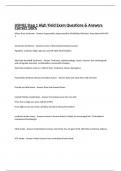
Klüver Bucy syndrome - Answer Hyperorality, hypersexuality, disinhibited behavior. Associated with HSV-1 Gerstmann Syndrome - Answer Lesion of the parietal-temporal cortex. Agraphia, acalculia, finger agnosia, and left-right disorientation. Wernicke-Korsakoff Syndrome - Answer Confusion, ophtalmoplegia, ataxia, memory loss (anterograde and retrograde amnesia), confabulation, personality changes. Wernicke problems come in a CAN of beer: Confusion, Ataxia, Nystagmus. Paramedian pontine reticular formation lesion. - Answer Eyes look away from side of lesion Frontal eye field lesion - Answer Eyes look toward lesion Central Pontine myelinolysis - Answer Correcting serum Na+ too fast: From low to high your pons will die (CPM). From high to low your brain will blow (cerebral edema/herniation) Lenticulo-striate artery - Answer Lesion in lacunar infracts 2ndary to unmanaged htn. Contralateral hemiparesis/hemiplegia MCA stroke - Answer Contralateral sensory and motor loss of upper limb. Wernicke and broca aphasia. ACA stroke - Answer Motor/sensory loss contralateral lower limb. Anterior spinal artery (ASA) stroke - Answer Contralateral hemiparesis upper and lower limbs. Decr. Contralateral propioception. Ipsilateral hypoglossal dysfunction (tongue deviates ipsilaterally). PICA stroke (Wallenberg syndrome) - Answer Vomiting, vertigo, nystagmus, decr. Pain and temp. Sensation from ipsilateral face and contralateral body. Dysphagia, hoarseness, decr. Gag reflex. Ipsilateral horner syndrome, ataxia and dysmetria. "Don't pick a (PICA) horse (hoarseness) that can't eat (dysphagia)". AICA stroke - Answer Vomiting, vertigo, nystagmus, decr. Pain and temp. Paralysis of the face decr. Lacrimation, salivation, decr. Taste from Anterior 2/3 of the tongue, decr. Corneal reflex. Face decr. Pain and temp. Ipsilateral decr. hearing. Ipsilateral horner syndrome, ataxia and dysmetria. "Facial droop means AICA's pooped". Pcomm stroke - Answer CN III palsy- eye is down and out with ptosis and pupil dilation. Charcot-Bouchard microaneurysm - Answer Associated with chronic htn; affects small vessels eg. Basal ganglia and thalamus Spinal muscular atrophy (werdnig-hoffmann disease) - Answer Congenital degeneration of anterior horns of spinal cord lead to LMN lesion. Floppy baby syndrome. Histologic changes after a MI - Answer 0-4 hours: minimal change or Normal. 4-12 hours: early coagulation, necrosis, edema, hemorrhage, wavy fibers. 12-24 hours: coagulation necrosis and marginal contraction band necrosis. 1-5 days: coagulation necrosis and neutrophillic infiltrate. 5-10 days: macrophage phagocytosis of dead cells. 10-14 days: granulation tissue and neovascularization. > 2 weeks: collage (type 1) deposits/ scar formation. MCC of dead after a MI - Answer 0-24 hours: arrythmia (Vfib), HF, cardiogenic shock. 3-14 days: free wall rupture > cardiac tamponade. > 2 weeks: Dressler syndrome: autoimmune attack to healed tissue. Pulsus Paradoxus - Answer decrease in amplitude of systolic blood pressure by >10 mmHg during inspiration. seen in cardiac tamponade, asthma, obstructive sleep dyspnea, pericarditis, and croup. FROM JANE (Bacterial Endocarditis) - Answer Fever Roth spots Olser Nodes Mumur Janeway lesions Anemia Nail-Bed hemorrhage Emboli PDA (close w indometacin, keep open w prostaglandins) - Answer continous machine like murmur. loudest at S2. often due to congenital rubella or prematurity. Best heard at left infraclavicular area. Mitral Stenosis - Answer follows opening snap, decrease interval between S2 and OS correlates w increase severity. Often occurs secondary to rheumatic fever. Enhanced by maneuvers that increase LA return (expiration). Aortic Regurgitation - Answer decrescendo diastolic murmur con present with bounding pulses and head bobbing. increase murmur with hand grip and vasodilators decrease murmurs. Mitral valve prolapse - Answer Late systolic crescendo murmur with midsystolic click. most frequent valve lesion best heard over the apex. can predispose to infective endocarditis. best heard with maneuvers that decrease venous return (standing, valsalva) Ventricular Septal Defect - Answer holosystolic murmur loudest at tricuspid area, accentuated with hand grip maneuver due to increase after load. Aortic Stenosis - Answer crescendo-decrscendo systolic ejection murmur. loudest at base radiates to carotids. "Pulsus parvus et tardus" pulses are weak with delayed peak. Can lead to Syncope, Angina, Dyspnea often to age related calcification or bicuspid valve (turner) Mitral Regurgitation - Answer holosystolic murmur. loudest at the apex radiates to axilla. enhanced by maneuvers that increase TPR (squatting, handgrip) Tricuspid Regurgitation - Answer Holosystolic murmur. loudest at tricuspid area radiated to right sternal border. enhanced by maneuvers that increase right atrium return (inspiration) C. diphtheria - Answer Inactive EF-2 (intracellular ribosylation). Pharyngitis with pseudomembranes in throat and severe lymphadenopathy. P. aeruginosa - Answer Exotoxin A. inactivates EF-2 (intracellular ribosylation). host cell death Shiguella - Answer Inactivate 60S ribosome by removing adenine from rRNA. enhances cytokine release causing HUS
Written for
- Institution
- USMLE
- Course
- USMLE
Document information
- Uploaded on
- August 25, 2023
- Number of pages
- 15
- Written in
- 2023/2024
- Type
- Exam (elaborations)
- Contains
- Questions & answers
Subjects
- usmle
-
usmle step 1 high yield exam stuvia
-
usmle step 1 high yield exam questions answers c
-
klüver bucy syndrome hyperorality hypersexuality
-
gerstmann syndrome lesion of the parietal temporal

Also available in package deal