Dental Hygiene Test Questions with Correct Solutions
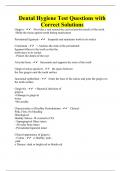
Gingiva - -Provides a seal around the cervical portion (neck) of the tooth -Holds the tissue against tooth during mastication Periodontal ligament - Suspends and maintains tooth in its socket Cementum - = Anchors the ends of the periodontal ligament fibers to the tooth so that the tooth stays in its socket - Protect the dentin of the root Alveolar bone - Surrounds and supports the roots of the tooth Gingival sulcus (pocket) - the space between the free gingiva and the tooth surface Junctional epithelium - forms the base of the sulcus and joins the gingiva to the tooth surface Gingivitis - • Bacterial infection of gingiva • Damage to gingival tissue • Reversible Characteristics of Healthy Periodontium - Clinical: Pink, Firm, No bleeding Histological: Healthy Sulcus- JE coronal to CEJ - Supragingival fibers intact - Alveolar bone intact - Periodontal ligament intact Clinical appearance of gingiva - Colour - o Healthy: pale - pink o Disease: dark or bright red or bluish red Clinical appearance of gingiva: - Contour (shape) - o Healthy • margin knife-edged • Interdental papillae (IP) - pointed o Disease • Margin rounded, rolled • IP - blunted, flattened, bulbous, cratered Clinical appearance of gingiva: - Consistency - o Healthy - firm o Disease - soft, spongy Clinical appearance of gingiva: - Texture - o Healthy - stippling o Disease • loss of stippling • smooth, shiny surfaces Clinical appearance of gingiva: - Bleeding on Probing - o Clinical examination o Healthy - not present o Disease • bleeding present • sign of gingival inflammation/disease Bleeding on dental probing - Early sign of gingival inflammation • Precedes colour changes, enlargement of gingival tissues • Principle - healthy tissue does not bleed Gingival Stippling - The surface of the attached gingva may have a dimpled appearance known as gingival stippling ** Wipe soft tissue with gauze Characteristics of Gingivitis - Clinical: Red, Swollen, Bleeding likely Histological: Gingival pocket-> JE at CEJ - Supragingival fiber destruction - Alveolar bone intact - Periodontal ligament intact Interdental gingiva - - the interdental tissue fills the area between two adjacent teeth. Gingival Bleeding Indices - 1) Indices: - - Purpose to record presence or absence of gingival inflammation as determined by bleeding from interproximal gingival sulcus 1) - Ginigval bleeding Index (GBI) o Use floss - Eastman interdental bleeding index (EIBI) o Wooden interdental cleaners - Gingival Index o Mouth mirror and periodontal probe Gingival Inflammation - Descriptive terms - - "Localized marginal inflammation in the mandibular anterior sextant" - "Localized papillary inflammation on the maxillary right canine" - "Generalized marginal inflammation" - "Generalized diffuse inflammation" Gingival Inflammation - Extent terms: Localized - Inflammation confined to the tissue of a single tooth or a group of teeth Gingival Inflammation - Extent terms: *Generalized - Inflammation of the gingival tissue of all or most of the mouth Gingival Inflammation - Distribution terms: * Papillary - Inflammation of the interdental papilla only Gingival Inflammation - Distribution terms: * Marginal - Inflammation of the gingival margin and papilla Gingival Inflammation - Distribution terms: * Diffuse - Inflammation of the gingival margin, papilla, and attached gingiva Severity of Gingival Inflammation is described as: - Slight, Moderate or severe The two Major Subdivisions of Gingival Diseases: - 1) Dental plaque-induced gingival diseases: - Plaque induced gingivitis 1) on a periodontium with no attachment loss 2) on a reduced but stable periodontium - gingival diseases modified by SYSTEMIC factors, MEDICATIONS, and MALNUTRITION 2) Non-plaque-induced gingival lesions: - Gingival diseases of SPECIFIC BACTERIAL ORIGIN, VIRAL ORIGIN, FUNGAL ORIGIN, GENETIC ORIGIN - Gingival manifestations of Systemic conditions - TRaumatic Lesions - Foreign body reactions Etiology of Periodontal Disease - Primary risk factor - Dental plaque biofilm Etiology of Periodontal Disease - Local contributing factors (Predisposing factors) - Increases plaque retention and pathogenicity Etiology of Periodontal Disease - Systemic contributing factors (risk factors) - Conditions, habits (smoking), diseases that increase susceptibility to periodontal infections (diabetes) Etiology of Periodontal Disease - Host response to biofilm bacteria (susceptibility) - body's response to an infection immune system Characteristics of Periodontitis - Clinical: Pink or Purplish, Swollen or fibrotic, Bleeding Histological: Periodontal Pocket-> JE on cementum - Supragingival fiber destruction - Alveolar bone destruction - Periodontal ligament destruction ** Irreversible destruction of periodontal tissues Clinical signs of Periodontal Disease - • Periodontal pockets • Alveolar bone loss • Loss of attachment • Recession of gingiva • Furcation involvement • Mobility
Written for
- Institution
- Dental Hygiene
- Course
- Dental Hygiene
Document information
- Uploaded on
- August 25, 2023
- Number of pages
- 36
- Written in
- 2023/2024
- Type
- Exam (elaborations)
- Contains
- Questions & answers
Subjects
-
dental hygiene test questions with correct solutio

Also available in package deal