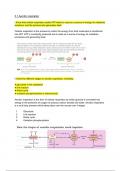
5.1 Aerobic respiration
i Know that cellular respiration yields ATP which is used as a source of energy for metabolic
reactions, and the process also generates heat.
Cellular respiration is the process by which the energy from food molecules is transferred
into ATP. ATP is constantly produced and is used as a source of energy for metabolic
processes and generating heat.
ii Know the different stages in aerobic respiration, including:
● glycolysis in the cytoplasm
● link reaction
● Krebs cycle
● oxidative phosphorylation in mitochondria.
Aerobic respiration is the form of cellular respiration by which glucose is converted into
energy in the presence of oxygen to produce carbon dioxide and water. Aerobic respiration
is a multi step process which takes place over the course over 4 stages
1. Glycolysis
2. Link reaction
3. Krebs cycle
4. Oxidative phosphorylation
, 5.2 Glycolysis
i Understand the conversion of monosaccharides to pyruvate during glycolysis in the
cytoplasm, including:
● the phosphorylation of hexose molecules by ATP
● breakdown to glycerate 3-phosphate (GP)
● production of reduced coenzyme (NADH) and ATP (details of intermediate compounds
and other reactions are not required).
Glycolysis is the first stage of aerobic cellular respiration and occurs in the cytoplasm of the
cell converting monosaccharides to pyruvate
1. The first step is phosphorylation in which two molecules of ATP are used to add a
phosphate group to glucose. This makes the sugar more reactive and unable to pass
through the cell membrane.
2. The phosphorylated sugar is then split to give 2 carbon-3 sugars known as
glycerate-3 phosphate (GP). This is then converted by several steps into a molecule
of pyruvic acid
3. During this process coenzyme NAD is reduced to NADH by removing hydrogen
atoms from the GP. from the two pyruvate molecules a total of 4 ATP molecules are
produced giving us a net of 2 ATP
In summary
Glucose is phosphorylated then broken down into two molecules of GP. GP is then oxidised
and the coenzyme NAD is reduced to NADH the result is two molecules of pyruvate.
2 molecules of ATP (4 molecules of ATP are produced, but two were used up in the initial
phosphorylation of glucose and so the net increase is two molecules).Two molecules of
reduced NAD (these have the potential to provide energy to produce more ATP).Two
molecules of pyruvate.
5.3 Link reaction and Krebs cycle
i Know that cellular respiration yields ATP which is used as a source of energy for metabolic
reactions, and the process also generates heat.
Cellular respiration is the process by which the energy from food molecules is transferred
into ATP. ATP is constantly produced and is used as a source of energy for metabolic
processes and generating heat.
ii Know the different stages in aerobic respiration, including:
● glycolysis in the cytoplasm
● link reaction
● Krebs cycle
● oxidative phosphorylation in mitochondria.
Aerobic respiration is the form of cellular respiration by which glucose is converted into
energy in the presence of oxygen to produce carbon dioxide and water. Aerobic respiration
is a multi step process which takes place over the course over 4 stages
1. Glycolysis
2. Link reaction
3. Krebs cycle
4. Oxidative phosphorylation
, 5.2 Glycolysis
i Understand the conversion of monosaccharides to pyruvate during glycolysis in the
cytoplasm, including:
● the phosphorylation of hexose molecules by ATP
● breakdown to glycerate 3-phosphate (GP)
● production of reduced coenzyme (NADH) and ATP (details of intermediate compounds
and other reactions are not required).
Glycolysis is the first stage of aerobic cellular respiration and occurs in the cytoplasm of the
cell converting monosaccharides to pyruvate
1. The first step is phosphorylation in which two molecules of ATP are used to add a
phosphate group to glucose. This makes the sugar more reactive and unable to pass
through the cell membrane.
2. The phosphorylated sugar is then split to give 2 carbon-3 sugars known as
glycerate-3 phosphate (GP). This is then converted by several steps into a molecule
of pyruvic acid
3. During this process coenzyme NAD is reduced to NADH by removing hydrogen
atoms from the GP. from the two pyruvate molecules a total of 4 ATP molecules are
produced giving us a net of 2 ATP
In summary
Glucose is phosphorylated then broken down into two molecules of GP. GP is then oxidised
and the coenzyme NAD is reduced to NADH the result is two molecules of pyruvate.
2 molecules of ATP (4 molecules of ATP are produced, but two were used up in the initial
phosphorylation of glucose and so the net increase is two molecules).Two molecules of
reduced NAD (these have the potential to provide energy to produce more ATP).Two
molecules of pyruvate.
5.3 Link reaction and Krebs cycle