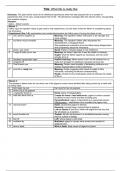
Title: What life is really like
Summary: The poet relives some of her childhood experiences when her dad exposed her to a number of
experiences that, in his view, would prepare her for life. His demeanour changes after she returns home, recuperating
from invasive surgery.
Analysis:
* italics – father’s words
Stanza 1:
Father says the speaker needs to get used to real experiences, but she sees it that her father is complaining about
her innocence
Enjambment (line 1-6): emphasizes how insistent/persuasive her father was in forcing his ideas on her
1* You need to toughen up Meaning: The speaker's father instruction to be stronger and
more resilient.
2 my father would complain Meaning: The speaker's father often expressed his
dissatisfaction or disappointment.
She experiences instruction to be her father being disappointed
and complaining about her innocence.
3 when I was small Small: Father’s remarks began in her childhood.
4* I ought to take you to see Meaning: he doesn’t take her to see the death of chickens.
Ought: what the father regards as necessary, but has never
actually done it.
5* chickens having their head Implied meaning: father seems cruel, but he protects her, to
6* chopped off. make her stronger for adulthood, because he loves her.
7* That’d teach you Meaning: Father views brutality of beheading chickens as a
realistic representation of life's harshness.
8* what life is really like. Meaning: Father suggests child needs to adapt to life's
intricacies, indicating insufficient understanding.
Really: printed in bold, emphasises what he believes the reality
of life is.
Stanza 2:
The speaker’s father looks for her when one of his pigeons comes home terrified after being hunted by a hawk with
its sharp beak.
9 He’d seek me out He’s look for her on purpose.
10 when one of his pigeons
11 - crazed for home or Home: place of refuge/safety.
12 mad with terror from a Crazed for home / mad with terror: pigeon’s actions caused
by desire to return home and fear of being prey.
Personification: pigeon is described as a crazy/mad person.
Effectiveness – emphasises how unsettled the pigeon was.
13 roaming hawk – Hawk: caused the pigeon’s distress.
Roaming: moving freely; posing threat to pigeons
Link to stanza 5: just like a hawk will target and eat any bird,
life will attack us at random.
14 would tumble into Tumble: fall into loft because it is terrified/exhausted coming
back to a place of refuge.
15 the loft Loft: where pigeons were kept.
16 mutilated by Mutilated: pigeon's injuries were severe and resulted in
disfigurement.
17 wire or beak. Wire or beak: likely cause of pigeon's injuries
Summary: The poet relives some of her childhood experiences when her dad exposed her to a number of
experiences that, in his view, would prepare her for life. His demeanour changes after she returns home, recuperating
from invasive surgery.
Analysis:
* italics – father’s words
Stanza 1:
Father says the speaker needs to get used to real experiences, but she sees it that her father is complaining about
her innocence
Enjambment (line 1-6): emphasizes how insistent/persuasive her father was in forcing his ideas on her
1* You need to toughen up Meaning: The speaker's father instruction to be stronger and
more resilient.
2 my father would complain Meaning: The speaker's father often expressed his
dissatisfaction or disappointment.
She experiences instruction to be her father being disappointed
and complaining about her innocence.
3 when I was small Small: Father’s remarks began in her childhood.
4* I ought to take you to see Meaning: he doesn’t take her to see the death of chickens.
Ought: what the father regards as necessary, but has never
actually done it.
5* chickens having their head Implied meaning: father seems cruel, but he protects her, to
6* chopped off. make her stronger for adulthood, because he loves her.
7* That’d teach you Meaning: Father views brutality of beheading chickens as a
realistic representation of life's harshness.
8* what life is really like. Meaning: Father suggests child needs to adapt to life's
intricacies, indicating insufficient understanding.
Really: printed in bold, emphasises what he believes the reality
of life is.
Stanza 2:
The speaker’s father looks for her when one of his pigeons comes home terrified after being hunted by a hawk with
its sharp beak.
9 He’d seek me out He’s look for her on purpose.
10 when one of his pigeons
11 - crazed for home or Home: place of refuge/safety.
12 mad with terror from a Crazed for home / mad with terror: pigeon’s actions caused
by desire to return home and fear of being prey.
Personification: pigeon is described as a crazy/mad person.
Effectiveness – emphasises how unsettled the pigeon was.
13 roaming hawk – Hawk: caused the pigeon’s distress.
Roaming: moving freely; posing threat to pigeons
Link to stanza 5: just like a hawk will target and eat any bird,
life will attack us at random.
14 would tumble into Tumble: fall into loft because it is terrified/exhausted coming
back to a place of refuge.
15 the loft Loft: where pigeons were kept.
16 mutilated by Mutilated: pigeon's injuries were severe and resulted in
disfigurement.
17 wire or beak. Wire or beak: likely cause of pigeon's injuries