

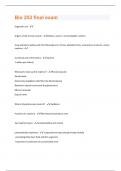
Bio 253 final exam Organelles are - ✔✔ Organs of the Urinary system - ✔✔kidneys, ureters, urinary bladder, urethra draw and label a kidney with the following terms: Cortex, Medulla, Pelvi s, renal artery, renal vein, ureter, nephron - ✔✔ functional unit of the kidney - ✔✔nephron 1 million per kidney! What parts make up the nephron? - ✔✔Renal corpuscle Renal tubule Glomerulus (capillaries that filter the blood plasma) Bowman's capsule (surrounds the glomerulus) Efferent arteriole loop of henle What is the glomerulus made of? - ✔✔capillaries Function of a nephron - ✔✔filter blood and produce urine Two nephron type s - ✔✔juxtamedullary and cortical juxtamedullary nephrons - ✔✔-Long nephron loops deeply invade medulla -Ascending limbs have thick and thin segments -Important in production of concentrated urine -found at the boundary of the cortex and medulla cortica l nephrons - ✔✔-85% of all nephrons -short nephron loops -efferent arterioles branch into peritubular capillaries around PCT and DCT How is urine made in the kidney? - ✔✔1.)Reabsorption - moving substances with tubule into the blood. 2.)filtration - occur s in the glomerulus or renal corpuscle 3.)secretion 4.)filtration driving force for filtration - ✔✔hydrostatic pressure or BP What fluid comes out of the glomerulus? - ✔✔filtrate What is filtrate? - ✔✔mostly water, electrolytes, nutrients, and waste products. Glucose is normal in filtrate. -similar to blood plasma Reabsorption in the Nephron Loop - ✔✔Only water is absorbed in the descending limb. Na+ chloride is absorbed in the a scending limb (no water). Status of water coming out of nephron loop? - ✔✔@ Lowest concentration (diluted) Process taking place in nephron loop? - ✔✔Countercurrent mechanism (dilutes the urine). Can also create concentrated urine from the Na+ absorbed in the ascending limb. tubular secretion - ✔✔-selectively moves substances from blood to filtrate in renal tubules and collecting ducts -From blood to tubular -Usually in the distal tubule -K+, H+, Uric acid, Penicillin are secreted Hormones that regulate kidney function - ✔✔directly : ADH Aldosterone ANH indirectly : Renin (created by kidney) Angiotensin Aldosterone function - ✔✔-decreases sodium and water loss in urine by returning sodium and water to the blood Aldosterone: Target Cells - ✔✔kidneys ANH function - ✔✔Tells kidneys that blood volume is too high, so dumps out H20 and Na+ Effects of ADH - ✔✔increases reabsorption of water from urine back into plasma and therefore, decreases the volume of water that is excreted -secreted by posterior pituitary gland -when a person is dehydrated, hypothalamus makes them thirsty and retains more water because of the ADH flow of urine through kidney - ✔✔Glomerulus Bowmans Capsule Proximal convoluted tubule Loop of Henle Distal conv oluted tubule
Exam (elaborations)
Bio 253 final Exam 195 Questions With Complete Solutions.
Rating
Sold
17
Pages
19
Grade
A+
Uploaded on
24-08-2023
Written in
2023/2024
Organelles are - Organs of the Urinary system - kidneys, ureters, urinary bladder, urethra draw and label a kidney with the following terms: Cortex, Medulla, Pelvis, renal artery, renal vein, ureter, nephron - functional unit of the kidney - nephron 1 million per kidney! What parts make up the nephron? - Renal corpuscle Renal tubule Glomerulus (capillaries that filter the blood plasma) Bowman's capsule (surrounds the glomerulus) Efferent arteriole loop of henle What is the glomerulus made of? - capillaries Function of a nephron - filter blood and produce urine Two nephron types - juxtamedullary and cortical juxtamedullary nephrons - -Long nephron loops deeply invade medulla -Ascending limbs have thick and thin segments -Important in production of concentrated urine-found at the boundary of the cortex and medulla cortical nephrons - -85% of all nephrons -short nephron loops -efferent arterioles branch into peritubular capillaries around PCT and DCT How is urine made in the kidney? - 1.)Reabsorption - moving substances with tubule into the blood. 2.)filtration - occurs in the glomerulus or renal corpuscle 3.)secretion 4.)filtration driving force for filtration - hydrostatic pressure or BP What fluid comes out of the glomerulus? - filtrate What is filtrate? - mostly water, electrolytes, nutrients, and waste products. Glucose is normal in filtrate. -similar to blood plasma Reabsorption in the Nephron Loop - Only water is absorbed in the descending limb. Na+ chloride is absorbed in the ascending limb (no water).
Show more
Read less
Institution
Bio 253
Course
Bio 253
Whoops! We can’t load your doc right now. Try again or contact support.
Written for
- Institution
- Bio 253
- Course
- Bio 253
Document information
- Uploaded on
- August 24, 2023
- Number of pages
- 19
- Written in
- 2023/2024
- Type
- Exam (elaborations)
- Contains
- Questions & answers
Subjects
Content preview
$8.49
Get access to the full document:
100% satisfaction guarantee
Immediately available after payment
Both online and in PDF
No strings attached

Also available in package deal
Package deal
Hondros BIO 253 Bundled Exams with complete solution
2
7
2023
$ 36.93
More info
