Question 1
Not yet answered
Marked out of 1.00
Flag question
Question text
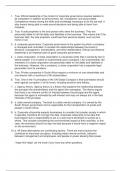
The three types of institutional isomorphism are _____.
a.
Practices, laws, comparisons
b.
Corporate social responsibility
c.
Environment, society and governance
d.
Normative, coercive and mimetic
e.
Policies, rules, imitations
The answer is (d). Normative, coercive and mimetic.
The three types of institutional isomorphism are:
Normative isomorphism is the pressure to conform to professional norms and standards. This can be
exerted by professional associations, educational institutions, or the state. For example, doctors are
expected to conform to a certain set of ethical standards, and lawyers are expected to follow the
rules of professional conduct.
,Coercive isomorphism is the pressure to conform to legal or regulatory requirements. This can be
exerted by the government, regulatory agencies, or other powerful organizations. For example,
businesses are required to comply with environmental regulations, and hospitals are required to
meet certain safety standards.
Mimetic isomorphism is the pressure to imitate other organizations that are perceived to be
successful. This can happen because organizations are uncertain about what to do, or because they
want to avoid being seen as incompetent. For example, if a new restaurant opens up in town and is
very successful, other restaurants may start to imitate its menu and decor.
The three types of institutional isomorphism are not mutually exclusive. In fact, they often overlap.
For example, a business may be required by law to adopt certain ethical standards (coercive
isomorphism), and it may also do so because it wants to be seen as a responsible corporate citizen
(normative isomorphism).
The concept of institutional isomorphism was developed by Paul DiMaggio and Walter Powell in
their 1983 paper "The Iron Cage Revisited: Institutional Isomorphism and Collective Rationality in
Organizational Fields". They argued that organizations are not simply rational actors that make
decisions based on their own self-interest. Instead, they are also influenced by the institutional
environment in which they operate. The three types of institutional isomorphism are a way of
understanding how this environmental influence can shape organizational behavior.
Here are some examples of institutional isomorphism:
Hospitals adopting the same medical practices because they are considered to be the best practices.
Schools adopting the same curriculum because it is required by the state.
Businesses adopting the same corporate social responsibility initiatives because they are seen as
good for business.
Institutional isomorphism can have both positive and negative consequences. On the positive side, it
can help to ensure that organizations are meeting certain standards of quality or ethics. On the
negative side, it can lead to a lack of innovation and diversity.
Overall, institutional isomorphism is a complex concept that has important implications for
understanding how organizations operate.
profile picture
Question 2
Not yet answered
Marked out of 1.00
,Flag question
Question text
One enabling acumen of a competent professional is ____.
a.
Integration
b.
Integrity
c.
Professional
d.
Relational
e.
Creativity
The answer is (b). Integrity.
Integrity is the quality of being honest and having strong moral principles. It is one of the most
important enabling acumens for a competent professional. A professional with integrity is someone
who can be trusted to do the right thing, even when it is difficult. They are also someone who is fair
and impartial, and who will not let their personal biases or interests influence their decisions.
Other enabling acumens for a competent professional include:
Critical thinking: The ability to think clearly and rationally, and to evaluate information objectively.
Problem-solving: The ability to identify and solve problems effectively.
Communication: The ability to communicate effectively, both verbally and in writing.
Teamwork: The ability to work effectively with others towards a common goal.
, Leadership: The ability to lead and motivate others.
These are just a few of the enabling acumens that are important for a competent professional. By
developing these skills, professionals can be more effective in their work and make a positive impact
on the world.
The other options are not incorrect, but they are not as important as integrity. Integration is the
ability to bring different pieces of information together to form a whole. Professionalism is the
commitment to high standards of conduct and behavior. Relational acumen is the ability to build and
maintain relationships with others. Creativity is the ability to generate new and original ideas. While
all of these qualities are important for a competent professional, integrity is the most essential.
I hope this helps!
profile picture
Question 3
Not yet answered
Marked out of 1.00
Flag question
Question text
The nominations committee oversees the process of ______.
a.
Remunerating all levels of staff of the organisation
b.
Appointing and evaluating governing body members
c.
Maintaining ethical corporate citizenship, sustainable development and stakeholder relations
d.
Identifying and managing risks in the organisation
Not yet answered
Marked out of 1.00
Flag question
Question text
The three types of institutional isomorphism are _____.
a.
Practices, laws, comparisons
b.
Corporate social responsibility
c.
Environment, society and governance
d.
Normative, coercive and mimetic
e.
Policies, rules, imitations
The answer is (d). Normative, coercive and mimetic.
The three types of institutional isomorphism are:
Normative isomorphism is the pressure to conform to professional norms and standards. This can be
exerted by professional associations, educational institutions, or the state. For example, doctors are
expected to conform to a certain set of ethical standards, and lawyers are expected to follow the
rules of professional conduct.
,Coercive isomorphism is the pressure to conform to legal or regulatory requirements. This can be
exerted by the government, regulatory agencies, or other powerful organizations. For example,
businesses are required to comply with environmental regulations, and hospitals are required to
meet certain safety standards.
Mimetic isomorphism is the pressure to imitate other organizations that are perceived to be
successful. This can happen because organizations are uncertain about what to do, or because they
want to avoid being seen as incompetent. For example, if a new restaurant opens up in town and is
very successful, other restaurants may start to imitate its menu and decor.
The three types of institutional isomorphism are not mutually exclusive. In fact, they often overlap.
For example, a business may be required by law to adopt certain ethical standards (coercive
isomorphism), and it may also do so because it wants to be seen as a responsible corporate citizen
(normative isomorphism).
The concept of institutional isomorphism was developed by Paul DiMaggio and Walter Powell in
their 1983 paper "The Iron Cage Revisited: Institutional Isomorphism and Collective Rationality in
Organizational Fields". They argued that organizations are not simply rational actors that make
decisions based on their own self-interest. Instead, they are also influenced by the institutional
environment in which they operate. The three types of institutional isomorphism are a way of
understanding how this environmental influence can shape organizational behavior.
Here are some examples of institutional isomorphism:
Hospitals adopting the same medical practices because they are considered to be the best practices.
Schools adopting the same curriculum because it is required by the state.
Businesses adopting the same corporate social responsibility initiatives because they are seen as
good for business.
Institutional isomorphism can have both positive and negative consequences. On the positive side, it
can help to ensure that organizations are meeting certain standards of quality or ethics. On the
negative side, it can lead to a lack of innovation and diversity.
Overall, institutional isomorphism is a complex concept that has important implications for
understanding how organizations operate.
profile picture
Question 2
Not yet answered
Marked out of 1.00
,Flag question
Question text
One enabling acumen of a competent professional is ____.
a.
Integration
b.
Integrity
c.
Professional
d.
Relational
e.
Creativity
The answer is (b). Integrity.
Integrity is the quality of being honest and having strong moral principles. It is one of the most
important enabling acumens for a competent professional. A professional with integrity is someone
who can be trusted to do the right thing, even when it is difficult. They are also someone who is fair
and impartial, and who will not let their personal biases or interests influence their decisions.
Other enabling acumens for a competent professional include:
Critical thinking: The ability to think clearly and rationally, and to evaluate information objectively.
Problem-solving: The ability to identify and solve problems effectively.
Communication: The ability to communicate effectively, both verbally and in writing.
Teamwork: The ability to work effectively with others towards a common goal.
, Leadership: The ability to lead and motivate others.
These are just a few of the enabling acumens that are important for a competent professional. By
developing these skills, professionals can be more effective in their work and make a positive impact
on the world.
The other options are not incorrect, but they are not as important as integrity. Integration is the
ability to bring different pieces of information together to form a whole. Professionalism is the
commitment to high standards of conduct and behavior. Relational acumen is the ability to build and
maintain relationships with others. Creativity is the ability to generate new and original ideas. While
all of these qualities are important for a competent professional, integrity is the most essential.
I hope this helps!
profile picture
Question 3
Not yet answered
Marked out of 1.00
Flag question
Question text
The nominations committee oversees the process of ______.
a.
Remunerating all levels of staff of the organisation
b.
Appointing and evaluating governing body members
c.
Maintaining ethical corporate citizenship, sustainable development and stakeholder relations
d.
Identifying and managing risks in the organisation