Aviation Law questions and answers 100% verified.
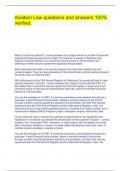
Aviation Law questions and answers 100% verified. What is a security interest? - correct answers.It is a legal interest in an item of personal property that secures payment of a debt. For instance, a person or business may acquire a security interest in an aircraft by loaning money to the purchaser and obtaining a written security agreement signed by the purchaser. What right does the holder of a security interest have that other creditors do not? - correct answers.They can take possession of the aircraft even without judicial process if the owner does not pay the debt. Will a title search at the FAA Aircraft Registry in Oklahoma City reveal all kinds of valid security interests in aircraft? - correct answers.No. Unless it is filed with the FAA. If a lien holder fails to record the security agreement with the registry, a buyer who is not otherwise aware of that security interest takes clear title, and the lienholder's security interest is unenforceable. You are the manager of an FBO. A customer purchases a new airplane through your business. A bank finances that purchase, obtains a security interest in the aircraft through a written security agreement signed by the purchaser, and files that security agreement with the FAA Aircraft Registry and the International Registry. Later, the customer has your shop install upgraded avionics, including a full "glass cockpit" set of multifunction displays (MFD) integrating flight, navigation, engine, and sensor data. Do you have the right to require the customer to pay the bill for the equipment and installation in full before you release the aircraft back to the customer? Explain. - correct answers.Yes, the prudent FBO, mechanic, or repair station will not release an aircraft after it has been worked on, stored, or fueled unless first paid by credit card, cash, or certified funds (a certified or cashier's check). You are the manager of an FBO. A customer purchases a new airplane through your business. A bank finances that purchase, obtain a security interest in the aircraft through a written security agreement signed by the purchaser, and files that security agreement with the FAA Aircraft Registry and the International Registry. Later, the customer has your shop install upgraded avionics, including a full "glass cockpit" set of multifunction displays (MFD) integrating flight, navigation, engine, and sensor data. If the aircraft owner went bankrupt at that point (when the work has been done, the bill has not been paid, and the FBO still has the aircraft), who will be paid first from the sale of the aircraft, the FBO or the bank? Why? - correct answers.The person having possession of the aircraft under possessory lien for parts, labor, materials, or services has first priority and is entitled to be paid in full from the proceeds of the sale before any other lienholder. This is an example of the old adage "possession in nine-tenths of the law." You are the manager of an FBO. A customer purchases a new airplane through your business. A bank finances that purchase, obtain a security interest in the aircraft through a written security agreement signed by the purchaser, and files that security agreement with the FAA Aircraft Registry and the International Registry. Later, the customer has your shop install upgraded avionics, including a full "glass cockpit" set of multifunction displays (MFD) integrating flight, navigation, engine, and sensor data. In initial discussions over the price of the equipment and installation, the customer indicates that she wants to buy the unit and have your shop install it, but she would like to pay the price for the equipment and installation in three equal monthly payments, rather than all at once. This is acceptable to you. Is there anything you can require as a condition of releasing the aircraft back to its owner before the debt is paid in full to protect the FBO's security interest in the aircraft for this installation? If so, describe. - correct answers.However, if for some reason the business wishes (as to accommodate a long-time good customer claiming a temporary cash shortage), it may have the aircraft owner sign a promissory note for the amount due, secured interest in the aircraft. Those documents should then be immediately filed with the FAA Aircraft Registry. It the aircraft is released without these, the lien is extinguished, but by following this procedure, the lien is preserved (although at a lower priority, behind other previously recorded security interest). You are the manager of an FBO. A customer purchases a new airplane through your business. A bank finances that purchase, obtains a security interest in the aircraft through a written security agreement signed by the purchaser, and files that security agreement with the FAA Aircraft Registry and the International Registry. Later, the customer has your shop install upgraded avionics, including a full "glass cockpit" set of multifunction displays (MFD) integrating flight, navigation, engine, and sensor data. After the transaction described in c, above, your shop installs the equipment in the aircraft and releases it to the owner. Before the bill is paid, the aircraft owner files bankruptcy. Now who is in the superior position to be paid first out of the proceeds of the sale of the aircraft: the FBO or the bank? Explain. - correct answers.The bank, because the FBO does not have the aircraft in hand so the bank must repossess the plane and sell it therefore they have priority. You are an aircraft broker specializing in airline-size jets. A customer contacts you, indicating that he is the chief executive officer of an international cattle-breeding operation based in Texas. He advises you that neither he nor anyone on his staff knows much about large airplanes, but they need to purchase an aircraft capable of transporting 100 bulls weighing an average of 1,600 pounds each, each in a 150-pound shipping cage measuring 5 feet wide by 8 feet long by 6 feet high. He states that the aircraft will also need to be capable of carrying that load from Dallas to Buenos Aires, Argentina, nonstop. If you sell an aircraft to this customer for that purpose, what warranties will you be making to the buyer? - correct answers.You will be making an implied warranty of fitness for a particular purpose and implied warranty of merchantability. You are a co-owner of a business that has a dealership for a major manufacturer of general aviation aircraft. The aircraft typically arrive at your dealership from the factory ready for delivery to the customer, and your company does not usually perform any inspection or other work on the aircraft prior to sale and delivery to a buyer. A new aircraft your company recently sold to a customer has crashed, killing everyone aboard. It appears that the crash was caused by a design or manufacturing defect. Is your business exposed to any risk of being found liable? Explain. - correct answers.Strict liability - in chain of commerce. Yes, seller has risk You are a co-owner of a business that has a dealership for a major manufacturer of general aviation aircraft. The aircraft typically arrive at your dealership from the factory ready for delivery to the customer, and your company does not usually perform any inspection or other work on the aircraft prior to sale and delivery to a buyer. A new aircraft your company recently sold to a customer has crashed, killing everyone aboard. It appears that the crash was caused by a design or manufacturing defect. If such liability is found, will it make any difference to you whether your company was organized as a partnership or a corporation? Explain - correct answers.Yes. If partnership, they are personally liable. If corporation, they are not personally liable. What is the difference between a lease and a leaseback? - correct answers.A lease is an agreement, a contract that permits someone else to use an owner's aircraft. It is only where, as a part of the same "wraparound" business deal, the buyer purchases the aircraft from the seller then turns around and leases it back to the seller for the seller's use, that the lease portion of this deal is correctly referred to as a leaseback. Not all leases are leasebacks; in fact, leasebacks represent the minority. Distinguish the primary motivation of the lessee in a lease ("lease forward") from that of the seller-lessee in a sale with leaseback. - correct answers.The Lessor wants To earn income from the aircraft and the lessees primary motive is to obtain the use of the aircraft without having to make the capital investment required to purchase one. Also, with leasebacks, the primary motive of the lessee is to sell the aircraft.
Written for
- Institution
- Aviation Law
- Course
- Aviation Law
Document information
- Uploaded on
- August 23, 2023
- Number of pages
- 14
- Written in
- 2023/2024
- Type
- Exam (elaborations)
- Contains
- Questions & answers
Subjects

Also available in package deal