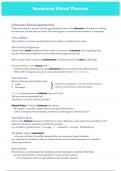
Normative Ethical Theories
Character-Based Approaches
Character-based or person-centred approaches focus on the character of the person making
the decision, not the decision itself. The moral agent’s motivation and intention is important.
Virtue Ethics
Virtue ethics is a person-centred approach to ethics. It rejects a priori laws.
The Function Argument
Something is arête (excellent) when it fulfils its function in harmony with something else.
e.g. the heart cannot fulfil its function without the lungs functioning
When things work in harmony eudaemonia is achieved; this is the telos of all things.
Human Function = use reason well
- humans achieve goddess by using phronesis (practical wisdom) to make decisions
- ‘Moral skill is chipped away by an over-reliance from rules’ Barry Schwartz
Moral Virtues
Moral virtues are achieved through:
1. Habit
2. Phronesis } Virtues are acquired -> no one is born virtuous,
virtue is not intrinsic to human nature
Aristotle emphasised the habitual nature of virtue
‘We are what we repeatedly do’
‘Excellence is not the act but the habit’
Shared Virtue = living in harmony with others
- We ought to consider others when making moral decisions
- Link to example of heart working in harmony with lungs to fulfil its function
The Golden Mean
Virtue is the balance between 2 extremes or vices: deficiency and excess. For something to be
arête it must lack in extremity and fulfil its purpose.
e.g. a soldier’s golden mean = courage -> cowardice - courage - foolhardiness
The golden mean is situational
- vices are not fixed, they differ between the role one plays in each situation
e.g. rashness is needed to make an instant decision, but would be extreme in a situation
requiring prudence
Role Models
Moral virtues are developed by celebrating moral exemplars e.g Nelson Mandela.
- people should follow moral exemplars’ virtues not their actions
- moral decisions must be appropriate to the situation at hand
Character-Based Approaches
Character-based or person-centred approaches focus on the character of the person making
the decision, not the decision itself. The moral agent’s motivation and intention is important.
Virtue Ethics
Virtue ethics is a person-centred approach to ethics. It rejects a priori laws.
The Function Argument
Something is arête (excellent) when it fulfils its function in harmony with something else.
e.g. the heart cannot fulfil its function without the lungs functioning
When things work in harmony eudaemonia is achieved; this is the telos of all things.
Human Function = use reason well
- humans achieve goddess by using phronesis (practical wisdom) to make decisions
- ‘Moral skill is chipped away by an over-reliance from rules’ Barry Schwartz
Moral Virtues
Moral virtues are achieved through:
1. Habit
2. Phronesis } Virtues are acquired -> no one is born virtuous,
virtue is not intrinsic to human nature
Aristotle emphasised the habitual nature of virtue
‘We are what we repeatedly do’
‘Excellence is not the act but the habit’
Shared Virtue = living in harmony with others
- We ought to consider others when making moral decisions
- Link to example of heart working in harmony with lungs to fulfil its function
The Golden Mean
Virtue is the balance between 2 extremes or vices: deficiency and excess. For something to be
arête it must lack in extremity and fulfil its purpose.
e.g. a soldier’s golden mean = courage -> cowardice - courage - foolhardiness
The golden mean is situational
- vices are not fixed, they differ between the role one plays in each situation
e.g. rashness is needed to make an instant decision, but would be extreme in a situation
requiring prudence
Role Models
Moral virtues are developed by celebrating moral exemplars e.g Nelson Mandela.
- people should follow moral exemplars’ virtues not their actions
- moral decisions must be appropriate to the situation at hand