D265 - WGU - Critical Thinking - Reason and Evidence |98 Questions and Answers(A+ Solution guide)
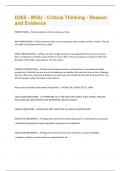
PROPOSITIONS - Are statements that can be true or false NON-PROPOSITONS - Are sentences that are not statements about matters of fact or fiction. They do not make a claim that can be true or false. SIMPLE PROPOSITIONS - Have no internal logic structure, meaning whether they are true or false does not depend on whether a part of them is true or false. They are simply true or false on their own. (Example: Harry Potter wears glasses. The sky is blue.) COMPLEX PROPOSITIONS - Have internal logic structure, meaning they are composed of simple propositions. Whether they are true or false depends on whether their parts are true or false. (Example: The sky is blue, but it does not look blue to me right now. The cat ate the food, but he did not like it. The GDP of Canada is either $3 trillion or $12 trillion.) Words used to identify Independent Propositions - AND, OR, EITHER, BUT, IF, THEN. CONCLUSION INDICATORS - THEREFORE, SO, IT FOLLOWS THAT, HENCE, THUS, ENTAILS THAT, WE MAY CONCLUDE THAT, IMPLIES THAT, WHEREFORE, AND AS A RESULT. PREMISE INDICATORS - BECAUSE, FOR, GIVEN THAT, AS, SINCE, AS INDICATED BY. DEDUCTIVE ARGUMENTS - Arguments where the premises guarantee or necessitate the conclusion. -mathematical arguments, logical arguments, arguments from definition. INDUCTION ARGUMENTS - Arguments where the premises make the conclusion probable. -analogies, authority, causal inferences, extrapolations, etc.INFERENCE TO THE BEST EXPLANATION OR ABDUCTION - Arguments where the best available explanation is chosen as the correct explanation.
Written for
- Institution
- D265 - WGU - Critical Thinking - Reason and Eviden
- Course
- D265 - WGU - Critical Thinking - Reason and Eviden
Document information
- Uploaded on
- August 21, 2023
- Number of pages
- 11
- Written in
- 2023/2024
- Type
- Exam (elaborations)
- Contains
- Questions & answers
Subjects
-
d265 wgu critical thinking reason and eviden

Also available in package deal