CELTA
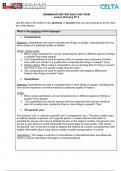
GRAMMAR/FUNCTION ANALYSIS FORM
Lesson Planning TP 4
Use this side of the sheet for any grammar or function that you are focusing on as the main
aim of the lesson:
What is the meaning of the language?
Comparatives:
Meaning: Comparatives are used to compare two things or people, indicating that one has
more or less of a particular quality or feature.
CCQs: choose some
1. When using comparatives, are we comparing the same or different aspects of things
or people? (the same aspect)
2. Can comparatives be used to express both an increase and a decrease (rise/fall –
show with your hands) in a quality when comparing two things or people? (Yes)
3. Simple variant: When using a comparative, are we showing that one thing or person
has more or less of a specific quality than the other?
4. Can comparatives be used to express both positive and negative differences
between two things or people? (yes)
Superlatives:
Meaning: Superlatives are used to compare three or more things or people, indicating that
one has the maximum or minimum level of a particular quality or feature.
CCQs:
1. When using superlatives, are we comparing one or different aspects of things or
people? (One aspect)
2. Can superlatives be used to express both the maximum level and the minimum
level of a quality when comparing three or more things or people? (Yes)
The general ‘you’:
The pronoun "you" is used as a general "you" or impersonal "you." This form is often used
to address people in general, not a specific person. It means that the information is
provided for anyone who may be reading the text. In the lesson’s context, the general "you"
serves to give advice or share information that would apply to most people. That means -
the general "you" in the text is used to address the readers as a whole, providing them with
helpful information about using various modes of public transportation in London.
Appropriacy: This usage is common in instructional or informational texts and allows the
writer to convey information that apply to a broad audience.
GRAMMAR/FUNCTION ANALYSIS FORM
Lesson Planning TP 4
Use this side of the sheet for any grammar or function that you are focusing on as the main
aim of the lesson:
What is the meaning of the language?
Comparatives:
Meaning: Comparatives are used to compare two things or people, indicating that one has
more or less of a particular quality or feature.
CCQs: choose some
1. When using comparatives, are we comparing the same or different aspects of things
or people? (the same aspect)
2. Can comparatives be used to express both an increase and a decrease (rise/fall –
show with your hands) in a quality when comparing two things or people? (Yes)
3. Simple variant: When using a comparative, are we showing that one thing or person
has more or less of a specific quality than the other?
4. Can comparatives be used to express both positive and negative differences
between two things or people? (yes)
Superlatives:
Meaning: Superlatives are used to compare three or more things or people, indicating that
one has the maximum or minimum level of a particular quality or feature.
CCQs:
1. When using superlatives, are we comparing one or different aspects of things or
people? (One aspect)
2. Can superlatives be used to express both the maximum level and the minimum
level of a quality when comparing three or more things or people? (Yes)
The general ‘you’:
The pronoun "you" is used as a general "you" or impersonal "you." This form is often used
to address people in general, not a specific person. It means that the information is
provided for anyone who may be reading the text. In the lesson’s context, the general "you"
serves to give advice or share information that would apply to most people. That means -
the general "you" in the text is used to address the readers as a whole, providing them with
helpful information about using various modes of public transportation in London.
Appropriacy: This usage is common in instructional or informational texts and allows the
writer to convey information that apply to a broad audience.