W6 CH 5 - Genetics and the Development of the Human Brain
The Genetic Bases of Behavior
From Genome to Trait
- Genotype - The genetic composition of an individual organism.
- Phenotype - The observable appearance of an individual organism.
- Gene - A functional hereditary unit made up of DNA that occupies a fixed location on a
chromosome.
- Gene expression - The translation of the genotype into the phenotype of an organism.
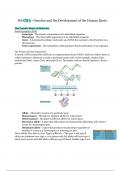
The Process of Gene Expression:
A strand of DNA transcribes itself into a complementary chain of RNA. Each set of three bases (a
codon) instructs a ribosome to make a particular amino acid: in this example, alanine (Ala),
methionine (Met), valine (Val), and lysine (Lys). The amino acids are linked together to form a
protein.
- Allele - Alternative version of a particular gene.
- Homozygous - Having two identical alleles for a given gene.
- Heterozygous - Having two different alleles for a given gene.
- Recessive allele - A gene that will produce its characteristic phenotype only when it
occurs in a homozygous pair.
- Dominant allele - A gene that produces its phenotype regardless of
whether it occurs in a heterozygous or homozygous pair.
Three Alleles Give Rise to Four Types of Blood => The type A and type B
alleles are dominant over type 0, so a person with AO alleles will have type A
blood and a person with BO alleles will have type B blood. Neither type A nor
, type B is dominant over the other, however, leading to the possibility of having type AB blood.
Sources of Genetic Variability
- Meiosis - Cell division that reduces the number of chromosomes in half in the
reproductive cells.
- Linkage - The characteristic of genes located adjacent to one another
to be passed along as a group. However, linked genes are not
automatically inherited together.
- Crossing over - A process occurring during meiosis in which
chromosomes exchange equivalent segments of DNA.
Crossing Over Contributes to Genetic Diversity => The process of crossing
over, in which two chromosomes exchange equivalent segments of genetic
material, adds to diversity by shuffling the parental genes that are inherited
together.
MUTATIONS => A heritable alteration of genes.
- The vast majority of mutations have little effect. There is some overlap in the genetic
encoding of amino acids. If a segment of DNA that normally encodes a particular amino
acid is somehow switched with another segment that produces the same amino acid,
there will be no effect.
- If the mutant allele conveys some advantage to the organism, it is likely to spread within
the population. On the other hand, a mutant allele may have negative, even fatal,
consequences for the organism. In the latter case, it may disappear from the population.
THE SPECIAL CASE OF THE SEX CHROMOSOMES
- Twenty-two pairs of human chromosomes are perfectly matched, but the remaining pair,
the X and Y chromosomes, feature different sets of genes with only a small number of
overlaps.
- The X chromosome (right) resembles most of the other 22 in appearance, but the Y (left)
is quite unusual. Not only is it much smaller, with less than 1 00 active genes compared
with the X's 2,000 or so, but also it has unusually high amounts of "junk" DNA that
doesn't seem to encode anything useful.
The Genetic Bases of Behavior
From Genome to Trait
- Genotype - The genetic composition of an individual organism.
- Phenotype - The observable appearance of an individual organism.
- Gene - A functional hereditary unit made up of DNA that occupies a fixed location on a
chromosome.
- Gene expression - The translation of the genotype into the phenotype of an organism.
The Process of Gene Expression:
A strand of DNA transcribes itself into a complementary chain of RNA. Each set of three bases (a
codon) instructs a ribosome to make a particular amino acid: in this example, alanine (Ala),
methionine (Met), valine (Val), and lysine (Lys). The amino acids are linked together to form a
protein.
- Allele - Alternative version of a particular gene.
- Homozygous - Having two identical alleles for a given gene.
- Heterozygous - Having two different alleles for a given gene.
- Recessive allele - A gene that will produce its characteristic phenotype only when it
occurs in a homozygous pair.
- Dominant allele - A gene that produces its phenotype regardless of
whether it occurs in a heterozygous or homozygous pair.
Three Alleles Give Rise to Four Types of Blood => The type A and type B
alleles are dominant over type 0, so a person with AO alleles will have type A
blood and a person with BO alleles will have type B blood. Neither type A nor
, type B is dominant over the other, however, leading to the possibility of having type AB blood.
Sources of Genetic Variability
- Meiosis - Cell division that reduces the number of chromosomes in half in the
reproductive cells.
- Linkage - The characteristic of genes located adjacent to one another
to be passed along as a group. However, linked genes are not
automatically inherited together.
- Crossing over - A process occurring during meiosis in which
chromosomes exchange equivalent segments of DNA.
Crossing Over Contributes to Genetic Diversity => The process of crossing
over, in which two chromosomes exchange equivalent segments of genetic
material, adds to diversity by shuffling the parental genes that are inherited
together.
MUTATIONS => A heritable alteration of genes.
- The vast majority of mutations have little effect. There is some overlap in the genetic
encoding of amino acids. If a segment of DNA that normally encodes a particular amino
acid is somehow switched with another segment that produces the same amino acid,
there will be no effect.
- If the mutant allele conveys some advantage to the organism, it is likely to spread within
the population. On the other hand, a mutant allele may have negative, even fatal,
consequences for the organism. In the latter case, it may disappear from the population.
THE SPECIAL CASE OF THE SEX CHROMOSOMES
- Twenty-two pairs of human chromosomes are perfectly matched, but the remaining pair,
the X and Y chromosomes, feature different sets of genes with only a small number of
overlaps.
- The X chromosome (right) resembles most of the other 22 in appearance, but the Y (left)
is quite unusual. Not only is it much smaller, with less than 1 00 active genes compared
with the X's 2,000 or so, but also it has unusually high amounts of "junk" DNA that
doesn't seem to encode anything useful.