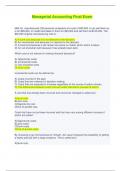
Managerial Accounting Final Exam
Managerial Accounting Final Exam Mell Co. manufactured 100 personal computers at a cost of $30,000. It can sell them as is for $65,000, or install hard disks in them for $25,000 and sell them for$105,000. The $30,000 original manufacturing cost is: A) A sunk cost because it is not relevant to the decision. B) An incremental cost because it is relevant to the decision. C) A fixed cost because it will remain the same no matter which action is taken. D) An out-of-pocket cost because it has already been paid. Which cost is not relevant in making financial decisions? A) Opportunity costs B) Incremental costs C) Out-of-pocket costs D) Sunk costs Incremental costs can be defined as: A) Costs incurred in the past. B) Costs that are irrelevant in decision making. C) Costs that are expected to increase regardless of the course of action chosen. D) The differences between costs incurred under alternative courses of action. A cost that has already been incurred and cannot be changed is called a(n): A)Sunk cost. B)Joint cost. C)Opportunity cost. D)Out-of-pocket cost. Costs that have not yet been incurred and that may vary among different courses of action are called: A)Opportunity costs. B)Joint costs. C)Sunk costs. D)Out-of-pocket costs. By choosing to go into business for himself, Jim Lazar foregoes the possibility of getting a highly paid job with a large company. This is called a(n): A)Sunk cost. B)Opportunity cost. C)Joint cost. D)Out-of-pocket cost. Which of the following would be an example of a sunk cost? A)The cost of a new oil burner that replaced a destroyed one B)Depreciation expense C)Lost revenue from a bad debt D)The cost of an old inefficient oil burner that will be replaced by a more modern and efficient one Sunk costs: A)Are benefits that could have been obtained by following another course of action. B)Result from unfavorable cost variances. C)Have already been incurred as a result of past actions. D)Vary among the alternative courses of action being considered. Accepting a special order is profitable whenever the revenue from the special order exceeds: A)The fixed manufacturing costs for the period. B)The incremental cost of producing the order. C)The average unit cost of production multiplied by the number of units in the order. D)The materials and direct labor costs of producing the order. In deciding whether or not to accept a special order, what is the opportunity cost of using machinery for which the firm has sufficient excess capacity to accept the order? A)Zero B)The same machinery cost allocated to regular production orders C)The historical cost of the machinery D)The undepreciated cost of the machinery Which of the following is not a relevant factor in Burns' decision concerning whether to accept the special order from Allen? A)Where and at what price Allen intends to sell the saws. B)The $65 average cost per unit to manufacture a power saw. C)The incremental cost of manufacturing an additional 5,000 saws per month. D)The opportunity cost involved in accepting Allen's order. On the basis of the above information only, which of the following is not true? A)It would not be profitable for JCN to consider the special order at a price less than $49 per unit. B)The fixed manufacturing costs of $146,000 are not relevant to this decision regarding the special order. C)At the 5,000-unit level of production, JCN's average cost per unit is $54.20. D)At the 6,000-unit level of production, JCN's average cost per unit is $49.33. Which is an example of joint products? A)Iron and plastic B)Pens and erasers C)Granulated charcoal and methyl alcohol D)Sugar and beef Products for which sales of one contribute to the sales of another are called: A)Competing products. B)Codependent products. C)Complementary products. D)Contributory products. The cost of draining sap out of a maple tree to manufacture maple syrup and maple sugar is an example of: A)Incremental costs. B)Sunk costs. C)Joint costs. D)After-split-off costs. Products that emerge from a shared manufacturing process are referred to as: A)Codependent products. B)Complementary products. C)Contributory products. D)Joint products. The Magic Microbrewery has a limited amount of vat capacity available in which it can ferment beer. In deciding which beers to brew, Magic management should consider: A)The contribution margins of the individual beers. B)The contribution margin ratios of the individual beers. C)The unit contribution margins of the individual beers. D)The contribution margin per unit of vat capacity of the individual beers. Which of the following would not be an important non financial factor for a farming company to consider in making a decision about the application of fertilizer?
Written for
- Institution
- Managerial Accounting
- Course
- Managerial Accounting
Document information
- Uploaded on
- August 20, 2023
- Number of pages
- 18
- Written in
- 2023/2024
- Type
- Exam (elaborations)
- Contains
- Questions & answers
Subjects
- managerial accounting
-
managerial accounting final exam
-
managerial accounting final

Also available in package deal