
Promoters
The expression of genes, such as those in the lac operon, is controlled by a promoter
– the region of DNA to which RNA polymerase binds as it starts transcription.
The promoter also ensures that it recognises which of the two DNA strands is the
template one. Within the sequence of nucleotides in the promoter region is the
transcription start point (the first nucleotide of the gene to be transcribed). The
promoter controls the expression of the gene and can ensure a high level of gene
expression. In eukaryotes, various proteins called transcription factors are also
required to bind to the promoter region or to RNA polymerase before transcription
can begin.
Gel electrophoresis
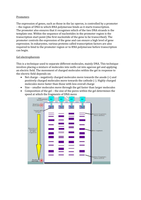
This is a technique used to separate different molecules, mainly DNA. This technique
involves placing a mixture of molecules into wells cut into agarose gel and applying
an electric field. The movement of charged molecules within the gel in response to
the electric field depends on:
Net charge – negatively charged molecules move towards the anode (+) and
positively charged molecules move towards the cathode (-). Highly charged
molecules move faster than those with less overall charge
Size – smaller molecules move through the gel faster than larger molecules
Composition of the gel – the size of the pores within the gel determines the
speed at which the fragments of DNA move
The expression of genes, such as those in the lac operon, is controlled by a promoter
– the region of DNA to which RNA polymerase binds as it starts transcription.
The promoter also ensures that it recognises which of the two DNA strands is the
template one. Within the sequence of nucleotides in the promoter region is the
transcription start point (the first nucleotide of the gene to be transcribed). The
promoter controls the expression of the gene and can ensure a high level of gene
expression. In eukaryotes, various proteins called transcription factors are also
required to bind to the promoter region or to RNA polymerase before transcription
can begin.
Gel electrophoresis
This is a technique used to separate different molecules, mainly DNA. This technique
involves placing a mixture of molecules into wells cut into agarose gel and applying
an electric field. The movement of charged molecules within the gel in response to
the electric field depends on:
Net charge – negatively charged molecules move towards the anode (+) and
positively charged molecules move towards the cathode (-). Highly charged
molecules move faster than those with less overall charge
Size – smaller molecules move through the gel faster than larger molecules
Composition of the gel – the size of the pores within the gel determines the
speed at which the fragments of DNA move


