THE SPECIAL SENSES
Five special senses
1. Gustation
2. Olfaction
3. Vision
4. Hearing
5. Equilibrium
GUSTATION AND OLFACTION
Olfaction and gustation are special senses that provide us with vital information about our
environment. Although the sensory information provided is diverse and complex, each special sense
originates at receptor cells that may be sensory neurons (olfaction) or specialized receptor cells that
communicate with sensory neurons (gustation).
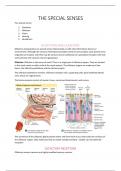
Olfaction: Olfaction is the sense of smell. There is a single pair of olfactory organs. They are located
in the nasal cavity on either side of the nasal septum. The olfactory organs are made up of two
layers: the olfactory epithelium and the lamina propria.
The olfactory epithelium contains: Olfactory receptor cells, supporting cells, basal epithelial (stem)
cells, which are regenerative.
The lamina propria consists of areolar tissue, numerous blood vessels, and nerves.
The secretions of the olfactory glands absorb water and form thick mucus that coats the surfaces of
the olfactory organs. Only molecules that are water-soluble and lipid - soluble can stimulate the
receptors
OLFACTORY RECEPTORS
Olfactory sensory neurons are highly modified sensory neurons.
, Exposed tips: prominent knob with up to 20 cilia-shaped dendrites extending into
surrounding mucus
The dendrites are parallel to epithelial surface, exposing their surface area to odorants.
Odorants are dissolved compounds
Between 10 and 20 million olfactory receptors fill an area of roughly 5 cm2. If we take into
account the exposed dendritic surfaces, the actual sensory area probably approaches that of
our entire body surface.
OLFACTORY RECEPTION
There are specialized olfactory neurons with dendrites. Reception occurs on the surface
membrane of the dendrites. Dissolved chemicals(odorants) stimulate olfactory receptors (=
odorant binding proteins on the membrane surface)
Odorant bind: activation of adenylate(adenylyl) cyclase (= enzyme). When active: converts
ATP to cyclic-AMP (cAMP). cAMP opens sodium channels in plasma membrane
Sodium ions enter
Depolarization
Receptor potential (graded potential)
If sufficient depolarization= threshold (generator potential) (= same cell)
Propagation of action potential in axons of sensory neuron
The olfactory pathways are very sensitive but does not guarantee an awareness of the stimulus in
the olfactory cortex: Influence of:
Convergence
Inhibition
Little peripheral adaptation
Mostly central adaptation
The olfactory pathway begins with axons of sensory neurons (olfactory nerve (N1) leaving olfactory
epithelium. The axons collect into 20 or more bundles. The bundles reach olfactory bulbs of
cerebrum where first synapse occurs. Efferent fibres from nuclei elsewhere also innervate neurons
in bulbs = central adaptation or facilitation
Five special senses
1. Gustation
2. Olfaction
3. Vision
4. Hearing
5. Equilibrium
GUSTATION AND OLFACTION
Olfaction and gustation are special senses that provide us with vital information about our
environment. Although the sensory information provided is diverse and complex, each special sense
originates at receptor cells that may be sensory neurons (olfaction) or specialized receptor cells that
communicate with sensory neurons (gustation).
Olfaction: Olfaction is the sense of smell. There is a single pair of olfactory organs. They are located
in the nasal cavity on either side of the nasal septum. The olfactory organs are made up of two
layers: the olfactory epithelium and the lamina propria.
The olfactory epithelium contains: Olfactory receptor cells, supporting cells, basal epithelial (stem)
cells, which are regenerative.
The lamina propria consists of areolar tissue, numerous blood vessels, and nerves.
The secretions of the olfactory glands absorb water and form thick mucus that coats the surfaces of
the olfactory organs. Only molecules that are water-soluble and lipid - soluble can stimulate the
receptors
OLFACTORY RECEPTORS
Olfactory sensory neurons are highly modified sensory neurons.
, Exposed tips: prominent knob with up to 20 cilia-shaped dendrites extending into
surrounding mucus
The dendrites are parallel to epithelial surface, exposing their surface area to odorants.
Odorants are dissolved compounds
Between 10 and 20 million olfactory receptors fill an area of roughly 5 cm2. If we take into
account the exposed dendritic surfaces, the actual sensory area probably approaches that of
our entire body surface.
OLFACTORY RECEPTION
There are specialized olfactory neurons with dendrites. Reception occurs on the surface
membrane of the dendrites. Dissolved chemicals(odorants) stimulate olfactory receptors (=
odorant binding proteins on the membrane surface)
Odorant bind: activation of adenylate(adenylyl) cyclase (= enzyme). When active: converts
ATP to cyclic-AMP (cAMP). cAMP opens sodium channels in plasma membrane
Sodium ions enter
Depolarization
Receptor potential (graded potential)
If sufficient depolarization= threshold (generator potential) (= same cell)
Propagation of action potential in axons of sensory neuron
The olfactory pathways are very sensitive but does not guarantee an awareness of the stimulus in
the olfactory cortex: Influence of:
Convergence
Inhibition
Little peripheral adaptation
Mostly central adaptation
The olfactory pathway begins with axons of sensory neurons (olfactory nerve (N1) leaving olfactory
epithelium. The axons collect into 20 or more bundles. The bundles reach olfactory bulbs of
cerebrum where first synapse occurs. Efferent fibres from nuclei elsewhere also innervate neurons
in bulbs = central adaptation or facilitation