

BIS 2C Pre-lab 3 (Graded A+)
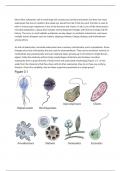
Most often, eukaryotes call to mind large and conspicuous animals and plants, but there are many eukaryotes that are not visible to the naked eye. Recall from lab 2 that the word ‘microbe’ is used to refer to microscopic organisms in any of the domains and viruses. In lab 3, you will be introduced to microbial eukaryotes, a group that includes several disparate lineages with diverse ecology and life history. The occur in most habitats worldwide, are key players in symbiotic interactions, and cause multiple human diseases such as malaria, sleeping sickness, Chagas disease, and leishmaniasis among others. As with all eukaryotes, microbial eukaryotes have a nucleus, mitochondria, and a cytoskeleton. Some lineages also have chloroplasts that are used for photosynthesis. They can be unicellular, colonial, or multicellular and, paradoxically, some are relatively large- growing up to 30 meters in length (brown algae). Unlike the relatively uniform body morphologies of Bacteria and Archaea, microbial eukaryotes show a great diversity of body forms and associated morphology (Figure 3.1). In fact, aside from the characters that they share with all other eukaryotes, they do not have any unifying features. Given this variability, why are these organisms presented as a single group? Figure 3.1 Historically, microbial eukaryotes were referred to as protists (first organisms) primarily because they were small and did not fit into other recognizable groups of eukaryotes such as plants, animals, and fungi. Many of their features were also thought to be ‘primitive’, but recent research has shown this assumption to be far from correct. Interestingly, despite the attention that eukaryotes in general have had from biologists, relationships among the main lineages remain unresolved (Figure 3.2). Microbial eukaryotes include the eukaryotic lineages outside of Plantae and Opisthokonts, namely the Amoebozoans, Excavates, and the monophyletic group called RAS (Rhizaria, Stramenopiles, and Alveolates). Question 1. Figure 3.2 is a phylogeny that shows relationships among major lineages of eukaryotes. The ‘microbial eukaryotes’ are outlined in gray. Based on what you learned in lab 1, and assuming the relationships are correct, do ‘microbial eukaryotes’ form a monophyletic group? Explain. Microbial eukaryotes are not a monophyletic group as that would require plantae to be apart of the group, otherwise it is only paraphyletic. Your answer Figure 3.2
Document information
- Uploaded on
- August 15, 2023
- Number of pages
- 13
- Written in
- 2023/2024
- Type
- Exam (elaborations)
- Contains
- Questions & answers


