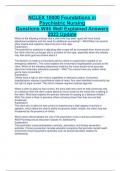
NCLEX 10000 Foundations in Psychiatric Nursing Questions With Well Explained Answers 2023 Update
NCLEX 10000 Foundations in Psychiatric Nursing Questions With Well Explained Answers 2023 Update Which of the following indicate that a client who has been raped will have future adjustment problems and the need for additional counseling? - ANS-When her parents show shame and suspicion about her part in the rape. Explanation: The potential for problems in adjusting after a rape will be increased when those around the victim treat her as though she is to blame for the rape, especially when she already may feel some guilt and shame about it The decision is made to involuntarily admit a client to a psychiatric hospital on an emergency detention. The nurse explains the involuntary hospitalization process to the client. Which of the following statements made by the nurse would not be accurate about the involuntary admission process? - ANS-"You cannot have any visitors while you're here involuntarily." Explanation: Clients have a right to see visitors regardless of admission status. Involuntary hospitalization requires a psychiatrist state-of-need. Any client admitted involuntarily has the right to legal counsel. The client's release requires medical approval. When a client is about to lose control, the extra staff who come to help commonly stay at a distance from the client unless asked to move closer by the nurse who is talking to the client. What best explains the primary rationale for staying at a distance initially? - ANS-The client is likely to perceive others as being closer than they are and feel threatened. Explanation: The client who is about to lose control is experiencing a high degree of anxiety or agitation, which alters the client's ability to perceive reality. Initially, the client may feel threatened by the presence of others. Which action demonstrates the role of the psychiatric nurse in primary prevention? - ANS-Providing sexual education classes for adolescents Explanation: The psychiatric nurse participates in primary, secondary, and tertiary prevention activities. Primary prevention includes education programs that promote mental health and prevent future psychiatric episodes such as sexual education classes for adolescents. One staff member in a psychiatric unit says to the nurse, "Why are we carrying out suicide precautions for someone who is dying? It's pointless and a waste of time." The nurse should: - ANS-Call for a multidisciplinary staff meeting. Explanation: The nurse should call for a multidisciplinary staff meeting because there is a need for staff members to share their feelings of anger, frustration, and grief. Because nurses focus on saving human lives, any feelings of hopelessness regarding a dying client can interfere with the client's care and management. A client with antisocial personality disorder smokes in prohibited areas and refuses to follow other unit and facility rules. The client persuades others to do his laundry and other personal chores, splits the staff, and will work only with certain nurses. The care plan for this client should focus primarily on: - ANS-consistently enforcing unit rules and facility policy. Explanation: Firmness and consistency regarding rules are the hallmarks of a care plan for a client with a personality disorder. A nurse assesses a client with psychotic symptoms and determines that the client likely poses a safety threat and needs vest restraints. The client is adamantly opposed to this. What would be the best nursing action? - ANS-Contact the physician and obtain necessary orders. Explanation: If a nurse feels that a client needs to be restrained, the nurse should inform the physician and obtain necessary orders. The nurse manager of a psychiatric unit notices that one of the nurses commonly avoids a 75-year-old client's company. Which factor should the nurse manager identify as being the most likely cause of this nurse's discomfort with older clients? - ANS-fears and conflicts about aging Explanation: The most common reason for the nurse's discomfort with elderly clients is that she has not examined her own fears and conflicts about aging A client is being discharged from the acute inpatient unit but needs further continuous supervision that is less intense than inpatient hospitalization. The nurse should refer the client to which of the following settings? - ANS-Subacute unit. Explanation: When inpatient hospitalization is no longer needed, subacute care is the next least restrictive setting when the client requires 24-hour supervision but less extensive and intensive services. Subacute units provide the client with a bed, meals, medication, groups, and activities. The client has autonomy and independence in choosing which groups to attend and can seek employment and housing and apply to school or training. A client who has experienced the loss of her husband through divorce, the loss of her job and apartment, and the development of drug dependency is suffering situational low self-esteem. Which outcome is most appropriate initially? Continues...
Written for
- Institution
- NCLEX 10000
- Course
- NCLEX 10000
Document information
- Uploaded on
- August 15, 2023
- Number of pages
- 13
- Written in
- 2023/2024
- Type
- Exam (elaborations)
- Contains
- Questions & answers
Subjects
- nclex 10000
- 2023 update
-
foundations in psychiatric nursing
-
questions with well explained answers

Also available in package deal