
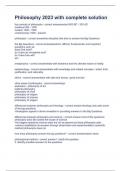
Philosophy 2023 with complete solution
four periods of philosophy - correct answerancient 600 BC - 300 AD medieval 300 - 1500 modern contemporary 1900 - present philosophy - correct answerthe discipline that tries to answer the Big Questions the Big Questions - correct answerabstract, difficult, fundamental, and important questions such as: does God exist? do I have an immaterial soul? do I have free will? etc.. metaphysics - correct answerdeals with existence and the ultimate nature of reality epistemology - correct answerdeals with knowledge and related concepts - belief, truth, justification, and rationality ethics - correct answerdeals with right and wrong - good and bad other areas of philosophy - correct answerlogic aesthetics - philosophy of art political philosophy philosophy of mind philosophy of religion philosophy of science philosophy of religion differences between philosophy and theology - correct answer-theology only asks some of the big questions -theologians appeal to divine revelation in providing answers to the Big Questions differences between philosophy and science - correct answer-most of the questions philosophy asks fall outside the scope of science -the biggest questions science asks are not as general as those philosophy asks -science establishes its answers through observation and experimentation (scientific method) philosophy does not how does philosophy answer the big questions? - correct answerreason alone philosophical method - correct answer1. clarify the question 2. identify possible answers to the questions 3. clarify these answers 4. think of arguments for and against these different answers 5. determine the relative strengths and weakness of these arguments 6. determine which answer (if any) is the most reasonable logic - correct answerthe part of philosophy that studies arguments argument - correct answerany set of two or more declarative sentences (propositions), one of which is the conclusion and the rest of which are premises which are supposed to support the conclusion arguments are made up of.. - correct answerdeclarative sentences (propositions) declarative sentences - correct answersentences that can be true or false two kinds of arguments - correct answerdeductive and inductive deductive - correct answerthe premises are supposed to guarantee the truth of its conclusion inductive - correct answerthe premises are supposed to make the truth of its conclusion probable deductive argument - correct answergood only if it is valid valid - correct answerif all of its premises are true, then its conclusion must be true impossible for all its premises to be true and its conclusion false can have false premises and false conclusion the conclusion follows from the premises and the premises entail the conclusion sound argument - correct answera valid argument with only true premises (and a true conclusion) invalid argument - correct answeran argument in which all of its premises are true and its conclusion is false valid arguments - correct answermodus ponens modus tollens disjunctive syllogism hypothetical syllogism invalid arguments - correct answeraffirming the consequent denying the antecedent modus ponens form - correct answer(1) If P, then Q (2) P (C) Therefore, Q modus ponens example - correct answer(1) If Bilbo is a hobbit, then Bilbo lives in the Shire (2) Bilbo is a hobbit (C) Therefore, Bilbo lives in the Shire modus tollens form - correct answer(1) If P, then Q (2) Not Q (c) Therefore, not P modus tollens example - correct answer(1) If Bilbo is a hobbit, then Bilbo lives in the shire (2) Bilbo does not live in the shire (C) Therefore, Bilbo is not a hobbit disjunctive syllogism form - correct answervalid (1) Either P or Q (2) Not P (C) Therefore, Q disjunctive syllogism example - correct answer(1) Either Bilbo is a hobbit or Bilbo is an elf. (2) Bilbo is not an elf (C) Therefore, Bilbo is a hobbit hypothetical syllogism form - correct answer(1) If P, then Q (2) If Q, then R (C) Therefore, if P, then R. hypothetical syllogism example - correct answer(1) If Bilbo is a hobbit, then Bilbo likes good tilled earth (2) If Bilbo likes good tilled earth, then Bilbo has a garden (C) Therefore, if Bilbo is a hobbit, then Bilbo has a garden Dilemma form - correct answer(1) Either P or Q (2) If P, then R (3) If Q, then R (C) Therefore, R Dilemma example - correct answer(1) Either Gollum is our friend or Gollum is our foe (2) If Gollum is our friend, then we should take him to Mordor (3) If Gollum is our foe, then we should take him to Mordor (C) Therefore, we should take Gollum to Mordor affirming the consequent form - correct answer(1) If P, then Q (2) Q (C) Therefore, P affirming the consequent example - correct answer(1) If Gimli is a dwarf, then Gimli likes precious stones (2) Gimli likes precious stones (C) Therefore, Gimli is a dwarf denying the antecedent form - correct answer(1) If P, then Q (2) Not P (C) Therefore, not Q denying the antecedent example - correct answer(1) If Gandalf is a wizard, then Gandalf can cast magical spells (2) Gandalf is not a wizard (C) Therefore, Gandalf cannot cast magical spells false dilemma - correct answerany sentence of the form "P or Q" which is false by superficially convincing "either Gollum is our friend or Gollum is our foe" "false dichotomy" begging the question - correct answeran argument that begs the question presupposes what it is trying to prove valid but not convincing (1) P (2) .... (C) Therefore, P inductive arguments - correct answerthe premises are supposed to make the truth of its conclusion probable strong - correct answerif all of its premises are true, then its conclusion is probably true similar to a valid deductive argument can come in degrees cogent - correct answera strong argument with only true premises the conclusion is probably true similar to a sound deductive argument abductive argument form - correct answera type of inductive arguments inferences to the best explanation (1) D (datum) (2) The best explanation of D is T (C) Therefore, T abductive argument example - correct answer(1) My car will not start (2) The best explanation of (1) is that my car battery is dead (C) Therefore, my car battery is dead best explanation - correct answerbetter than every alternative explanation taken together epistemology questions - correct answerBig questions about knowledge: what is belief? what is truth? what is evidence? what is rationality? believe - correct answerto accept it as true comes in degrees disbelief - correct answerto believe the negation nonbelief - correct answerto withhold judgment truth - correct answera belief is true just in case reality is the way that belief says it is -objective -does not legitimize any kind of dogmatism or intolerant attitude toward people who disagree with you evidence - correct answerperception memory testimony reason (argument) intuition notes about evidence - correct answer- having evidence for a belief does not guarantee that it is true - a person can have conflicting evidence - evidence, like belief but unlike truth, comes in degrees - the strengths of one's evidence for a belief is not always proportional to the strength of that belief - one's evidence for a belief is not always the same thing as the cause of that belief - evidence is relative to individual persons rationality - correct answertwo kinds epistemic and prudential epistemically rational - correct answerbelieves P only if S has stronger evidence for P than for not P prudentially rational - correct answer(morally) believes P only if believing P benefits S more than not believing P mind - correct answerthing with mental properties properties - correct answeraspects, attributes, characteristics, features, etc. the way things are mental properties - correct answerthinking, feeling, sensing, wanting, hoping, and believing a mind is - correct answera thing that thinks, feels, senses, wants, hopes, believes, etc. materialism - correct answerhuman minds are human bodies (or some part thereof) and human bodies (and all of their parts) are wholly material things we are minds... that are wholly material things wholly material things - correct answerthings with only material properties material properties - correct answerproperties natural science can study materialist view on you and your body - correct answeryou are your body or you are part of your body and you causally interact with the rest of your body (through your body's spinal cord) substance dualism - correct answerhuman minds are not human bodies (or any part thereof) human minds are wholly immaterial things agree bodies are wholly material things immaterial minds - correct answersouls famous substance dualists - correct answerSocrates Plato Descartes wholly immaterial things - correct answerthings with only immaterial properties immaterial properties - correct answerproperties natural science cannot study substance dualists view on you and your body - correct answeryou are not your body (or any part of it) you causally interact with your body (through your body's brain) life after death substance dualism - correct answer-when our bodies die we cease to exist -when our bodies die we continue to exist as disembodied -at some point after our bodies die we exist again as re-embodied (reincarnation or resurrection) arguments for substance dualism - correct answerthe argument from survival the argument from free will the argument from privacy the argument from indivisibility fips the argument from survival - correct answer(1) There is life after death only if substance dualism is true (2) there is life after death (C) therefore, substance dualism is true modus ponens - valid but not sound the argument from free will - correct answer(1) we have free will only if substance dualism is true (2) we have free will (C) therefore, substance dualism is true modus ponens - valid but not sound Leibniz's law - correct answerif x is the same thing as Y, then X and Y share all of the same properties (if X and Y do not share all of the same properties, then X is not the same thing as Y) private - correct answeronly one person can experience it (ourselves) minds public - correct answermore than one person can experience it bodies - scientists argument from privacy - correct answer(1) human minds are private (2) human bodies (and their parts) are public (3) if X and Y do not share all of the same properties, then X is not the same thing as Y (Leibniz's law) (C) Therefore, human minds are not human bodies (or any part thereof) valid argument from indivisibility - correct answer(1) human minds are indivisible (2) human bodies (and their parts) are divisible (3) if X and Y do not share all of the same properties, then X is not the same thing as Y (Leibniz's law) (C) Therefore, human minds are not human bodies (or any part thereof) arguments against substance dualism - correct answerthe argument from simplicity the argument from neural dependence the argument from evolution the argument from causal interaction snec argument from simplicity - correct answer(1) if theory A is simpler than theory B, and B offers no explanatory advantage over A, then A is more likely to be true than B (Ockham's razor) (2) materialism is simpler than substance dualism (3) substance dualism offers no explanatory advantage over materialism (C) therefore materialism is more likely to be true than substance dualism valid argument from neural dependence - correct answer(1) mental activity relies heavily on material brain activity (2) the best explanation of (1) is that mental activity is material brain activity (C) therefore, mental activity is material brain activity not valid - but strong SD claim brain is a tool of the mind argument from evolution - correct answer(1) human beings have evolved slowly over millions of years from wholly material things (2) if human beings have evolved slowly over millions of years from wholly material things, then human beings are wholly material things (C) therefore, human beings are wholly material things valid - modus ponens argument from causal interaction - correct answerprincess Elizabeth of bohemia (1) human minds and human bodies causally interact (2) if substance dualism is true, then human minds are immaterial things and human bodies are material things (3) material things and immaterial things cannot causally interact (C) therefore, substance dualism is false valid materialist philosophers - correct answerDemocritus Epicurus Thomas Hobbes Mind Brain Identity - correct answerversion of materialism J.J.C. Smart D.M. Armstrong mind brain identity theory - correct answermental properties of human minds are identical to material properties of human brains (material brain properties) argument from neural dependence cont. - correct answermost common argument for mind brain identity theory (1) mental activity relies heavily on material brain activity (2) the best explanation of (1) is that mental activity is material brain activity (C) Therefore, mental activity is material brain activity objections to mind brain identity theory - correct answerargument from introspection argument from scientific gaps argument from qualia qis argument from introspection - correct answer(1) introspected mental properties do not seem to be material brain properties (C) therefore, mental properties are not material brain properties invalid things are not always how they seem argument from scientific gaps - correct answer(1) science cannot currently explain how wholly material things (brains) can feel pain (2) therefore, wholly material things cannot feel pain (3) human minds can feel pain (4) if x and y do not share all of the same properties, then x is not the same thing as y (leibniz's law) (C) therefore, human minds are not wholly material things invalid argument from qualia - correct answerknowledge argument - Frank Jackson (1) before seeing the ripe tomato, Mary knows everything that science can in principle tell us about human minds (2) after seeing the ripe tomato Mary learns something new about human minds (3) therefore, there is something that science cannot in principle tell us about human minds (4) if there is something that science cannot in principle tell us about human minds, then human minds are not wholly material things (C) therefore, human minds are not wholly material things valid dualism - correct answermental properties of human minds are immaterial properties property dualist philosophers - correct answerThomas Nagel colin McGinn David Chalmers property dualism - correct answermental properties of human minds are immaterial properties of the human brains (immaterial brain properties) agree with materialists that human minds are nothing but human bodies but they believe mental properties of human minds are immaterial properties of human brains we are partly material and partly immaterial science and property dualism - correct answerscience can study the human mind (because science can study the human brain) but science cannot fully explain the human mind (because it has some immaterial properties) substance monism - correct answerhuman minds are just human bodies (or some part thereof) materialism and property dualism both versions of this versions of property dualism - correct answerepiphenomalism interactionist property dualism epiphenomenalism - correct answerproperty dualism is true but mental properties of human minds have no causal effect on material properties of human brains argument from mental efficacy - correct answeragainst epiphenomenalism (1) it seems that some mental events (being in pain) cause some body events (screaming) (2) therefore, some mental events do cause some body events (1) (3) if epiphenomalism is true, then mental events do not cause any body events (C) therefore, epiphenomalism is false invalid interactionist property dualism - correct answerproperty dualism is true and mental properties of human minds do have causal effects on material properties of human brains argument from no better alternatives - correct answer(1) one of the following three theories of mind is true: materialism, substance dualism, or property dualism (2) property dualism is more plausible than materialism (3) property dualism is more plausible than substance dualism (C) therefore, property dualism is the most plausible theory of mind valid property dualism vs materialism - correct answerfor property dualism: Argument from Qualia - PD can account for the fact that Mary learns something new after seeing the red tomato, for the property of experiencing redness is not a material property Argument from Introspection - introspected mental properties do not seem to be material brain properties because they aren't material brain properties; they're immaterial brain properties property dualism vs materialism continued - correct answerfor materialism: argument from simplicity argument from neural dependence argument from evolution argument from causal interaction property dualism vs substance dualism - correct answerfor PD: argument from simplicity - PD is simpler than SB argument from Neural dependence - mental activity relies heavily on material brain activity because mental activity is brain activity, albeit immaterial brain activity argument from evolution - the emergence of immaterial properties is less mysterious than the emergence of immaterial substances argument from causal interaction - causal interaction between material and immaterial properties of the same substance (a brain) is less mysterious than causal interaction between two radically different substances
Document information
- Uploaded on
- August 14, 2023
- Number of pages
- 11
- Written in
- 2023/2024
- Type
- Exam (elaborations)
- Contains
- Questions & answers


