BIOPSYCHOLOGY
The divisions of the nervous system: central and peripheral (somatic and
autonomic).
Nervous system: The nervous system is the main system that controls the mind
and body. It takes in information from the environment and elsewhere in the body
(transmitted across neurons) and co-ordinates a wide range of conscious functions
such as thinking and movement.
Central nervous system: The central nervous system is the main control system of
the body. It consists of two parts: the brain and spinal cord.
Peripheral nervous system: The peripheral nervous system goes beyond the
central nervous system to connect it with the rest of the body and the external world.
It consists of two parts: the somatic nervous system and the autonomic nervous
system.
Somatic nervous system: The somatic nervous system is responsible for voluntary
movement (e.g. walking)
Autonomic nervous system: The autonomic nervous system is responsible for
transmitting information between the central nervous system and the internal organs
(i.e. it connects the brain to the rest of the body).
The structure and function of sensory, relay and motor neurons. The process
of synaptic transmission, including reference to neurotransmitters, excitation
and inhibition.
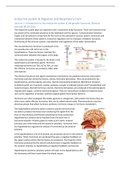
Neurons: Neurons are the main components of the nervous system. They are how
information is transmitted from one part of the nervous system to another.
The dendrite (receptor) receives a signal
The signal is carried towards a cell body (which contains the nucleus)
The signal travels along an axon (which is protected by myelin sheaths) towards the
axon terminal
Terminal boutons at the end of the axon pass the electrical signal to the next neuron
in the chain
Synaptic transmission: Neurons are separated by small gaps called synapses, and
synaptic transmission is the process of sending information from one neuron to
another.
Excitatory: Increase the likelihood of the neuron firing
Inhibitory: Decrease the likelihood of the neuron firing
Sensory neurons: Transmit information from the senses (e.g. the eyes or fingertips)
to the central nervous system
,Motor neurons: Transmit information between the central nervous system and the
organs and muscles (e.g. an instruction to the adrenals to produce adrenaline)
Relay neurons: Connect neurons to other neurons (e.g. motor neurons to sensory
neurons) and transmit information within the central nervous system (also called
interneurons)
The function of the endocrine system: glands and hormones.
Endocrine system: The endocrine system is a system of glands that are
responsible for the release of hormones.
Hormones: Hormones are chemicals that communicate information throughout the
body
The fight or flight response including the role of adrenaline.
Fight or flight: An activation of the sympathetic side of the autonomic nervous
system to prepare the body for action.
Localisation of function in the brain and hemispheric lateralisation: motor,
somatosensory, visual, auditory and language centres; Broca’s and
Wernicke’s areas, split brain research.
Localisation of function: Localisation of function in the brain examines the idea
that different parts of the brain serve specific functions such as language, memory or
even hearing.
Broca's area: Broca’s area is located in the frontal lobe of the dominant hemisphere
(which is usually the left) and is believed to be primarily responsible for speech and
language production.
Wernicke's area: Wernicke’s area was discovered by Carl Wernicke and is believed
to be involved in understanding language.
Hemispheric lateralisation: Hemispheric lateralisation refers to the fact that the two
halves (hemispheres) of the brain are not identical with each having specialised
components limited to them.
Plasticity and functional recovery of the brain after trauma.
Neuroplasticity: Neuroplasticity, also known as brain plasticity, refers to the brains
ability to adapt and change through the creation of new neural pathways and the
alteration of existing ones to adapt to new experiences due to learning.
Neuronal unmasking: Neuronal unmasking was first identified by Wall (1977)
through what he identified as “dormant synapses” within the brain. Synaptic
connections exist within the brain but their functions are blocked and ineffective as
the rate of neural input is too low for them to be activated.
Ways of studying the brain: scanning techniques, including functional
magnetic resonance imaging (fMRI); electroencephalogram (EEGs) and event-
related potentials (ERPs); post-mortem examinations.
,FMRI: FMRI measures changes to particular areas of the brain while individuals
engage in various tasks.
EEGs: The electroencephalogram (EEG) was developed by Hans Berger (1929) and
measures the general state of the brain. It does this by measuring electrical activity
in the brain through electrodes placed on the head which detect electrical activity of
brain cells and the millions of neurons.
ERP: Event-related potentials use electrodes to measure very small voltage changes
within the brain when patients are presented with a stimulus such as a picture or
sound which requires cognitive processing.
Post-mortem: Post-mortem examinations help establish the underlying
neurobiology for people that display particular sets of behaviour.
Biological rhythms: circadian, infradian and ultradian and the difference
between these rhythms. The effect of endogenous pacemakers and exogenous
zeitgebers on the sleep/wake cycle.
Circadian rhythms: Circadian rhythms are biological cycles lasting 24hours like the
sleep/wake cycle, which is facilitated by time-checks and regular events such as
meal times (external cues).
Infradian rhythms: Infradian Rhythms are biological cycles lasting more than 24
hours and are greater than circadian rhythms
Ultradian rhythms: Ultradian rhythms are biological cycles lasting less than 24
hours and one example is the cycle of brain activity during sleep (sleep stages).
Endogenous pacemakers: Endogenous pacemakers are biological “clocks” that
are generated from within organisms.
Exogenous zeitgebers: Exogenous zeitgebers are external cues that play an
important role in regulating biological rhythms helping to synchronise and reset them.
, BIOPSYCHOLOGY
The fight or flight response including the role of adrenaline.
FIGHT OR FLIGHT EVALUATION AO3
Taylor et al (2000) found that females dealt with stress using the “tend and befriend
response” rather than fight or flight. This saw them engage in nurturing behaviour
and forming protective alliances with other women to protect themselves and their
children.
Lee and Harley (2012) found evidence to suggest there was a genetic basis for the
fight or flight stress response being found mostly in males. For example the SRY
gene which has been found only in the male Y chromosome is believed to be
responsible for promoting aggression. This has been linked to the fight or flight
stress response and one explanation is it primes male to respond to stress through
releasing adrenaline and increasing blood flow. The lack of a Y chromosome and
thus SRY gene in females coupled with oestrogen and oxytocin may stop this
response from occurring.
Gray (1988) suggested that prior to the fight or flight response people engaged in
actively avoiding confrontations or a “freeze response”. This freeze response played
the role of helping people stop, look and listen so the person can become hyper
vigilant to signs of danger and more aware of their surroundings to try find a suitable
solutions to threats before them
Localisation of function in the brain and hemispheric lateralisation: motor,
somatosensory, visual, auditory and language centres; Broca’s and
Wernicke’s areas, split brain research.
LOCALISATION OF FUNCTION EVALUATION: AO3
Lashley (1950) conducted an animal study involving rats and found that there was
not specific areas involved in memory but instead memory was stored all over the
brain
A famous case involving an Italian boy referred to as EB had most of his left
hemisphere removed when just younger than 3 years old. He lost his language
ability initially but through rehabilitation he showed dramatic improvements to the
point of there being no discernable difference to a normal individual. His right
hemisphere appeared to compensate for the loss of his lefts functioning although
there were some deficits suggesting other parts of the brain can compensate for one
another and function does not necessarily have to be localised to fixed parts of the
brain.
Dejerine (1982) reported one case who had damaged the connection between the
visual cortex and Wernicke’s area resulting in him losing the ability to read. This
suggests that behaviours such as reading, movement and language can be
damaged not only through specific parts of the brain becoming damaged but through
damage to the connections between any two points which play a part in joining
different structures together.
The divisions of the nervous system: central and peripheral (somatic and
autonomic).
Nervous system: The nervous system is the main system that controls the mind
and body. It takes in information from the environment and elsewhere in the body
(transmitted across neurons) and co-ordinates a wide range of conscious functions
such as thinking and movement.
Central nervous system: The central nervous system is the main control system of
the body. It consists of two parts: the brain and spinal cord.
Peripheral nervous system: The peripheral nervous system goes beyond the
central nervous system to connect it with the rest of the body and the external world.
It consists of two parts: the somatic nervous system and the autonomic nervous
system.
Somatic nervous system: The somatic nervous system is responsible for voluntary
movement (e.g. walking)
Autonomic nervous system: The autonomic nervous system is responsible for
transmitting information between the central nervous system and the internal organs
(i.e. it connects the brain to the rest of the body).
The structure and function of sensory, relay and motor neurons. The process
of synaptic transmission, including reference to neurotransmitters, excitation
and inhibition.
Neurons: Neurons are the main components of the nervous system. They are how
information is transmitted from one part of the nervous system to another.
The dendrite (receptor) receives a signal
The signal is carried towards a cell body (which contains the nucleus)
The signal travels along an axon (which is protected by myelin sheaths) towards the
axon terminal
Terminal boutons at the end of the axon pass the electrical signal to the next neuron
in the chain
Synaptic transmission: Neurons are separated by small gaps called synapses, and
synaptic transmission is the process of sending information from one neuron to
another.
Excitatory: Increase the likelihood of the neuron firing
Inhibitory: Decrease the likelihood of the neuron firing
Sensory neurons: Transmit information from the senses (e.g. the eyes or fingertips)
to the central nervous system
,Motor neurons: Transmit information between the central nervous system and the
organs and muscles (e.g. an instruction to the adrenals to produce adrenaline)
Relay neurons: Connect neurons to other neurons (e.g. motor neurons to sensory
neurons) and transmit information within the central nervous system (also called
interneurons)
The function of the endocrine system: glands and hormones.
Endocrine system: The endocrine system is a system of glands that are
responsible for the release of hormones.
Hormones: Hormones are chemicals that communicate information throughout the
body
The fight or flight response including the role of adrenaline.
Fight or flight: An activation of the sympathetic side of the autonomic nervous
system to prepare the body for action.
Localisation of function in the brain and hemispheric lateralisation: motor,
somatosensory, visual, auditory and language centres; Broca’s and
Wernicke’s areas, split brain research.
Localisation of function: Localisation of function in the brain examines the idea
that different parts of the brain serve specific functions such as language, memory or
even hearing.
Broca's area: Broca’s area is located in the frontal lobe of the dominant hemisphere
(which is usually the left) and is believed to be primarily responsible for speech and
language production.
Wernicke's area: Wernicke’s area was discovered by Carl Wernicke and is believed
to be involved in understanding language.
Hemispheric lateralisation: Hemispheric lateralisation refers to the fact that the two
halves (hemispheres) of the brain are not identical with each having specialised
components limited to them.
Plasticity and functional recovery of the brain after trauma.
Neuroplasticity: Neuroplasticity, also known as brain plasticity, refers to the brains
ability to adapt and change through the creation of new neural pathways and the
alteration of existing ones to adapt to new experiences due to learning.
Neuronal unmasking: Neuronal unmasking was first identified by Wall (1977)
through what he identified as “dormant synapses” within the brain. Synaptic
connections exist within the brain but their functions are blocked and ineffective as
the rate of neural input is too low for them to be activated.
Ways of studying the brain: scanning techniques, including functional
magnetic resonance imaging (fMRI); electroencephalogram (EEGs) and event-
related potentials (ERPs); post-mortem examinations.
,FMRI: FMRI measures changes to particular areas of the brain while individuals
engage in various tasks.
EEGs: The electroencephalogram (EEG) was developed by Hans Berger (1929) and
measures the general state of the brain. It does this by measuring electrical activity
in the brain through electrodes placed on the head which detect electrical activity of
brain cells and the millions of neurons.
ERP: Event-related potentials use electrodes to measure very small voltage changes
within the brain when patients are presented with a stimulus such as a picture or
sound which requires cognitive processing.
Post-mortem: Post-mortem examinations help establish the underlying
neurobiology for people that display particular sets of behaviour.
Biological rhythms: circadian, infradian and ultradian and the difference
between these rhythms. The effect of endogenous pacemakers and exogenous
zeitgebers on the sleep/wake cycle.
Circadian rhythms: Circadian rhythms are biological cycles lasting 24hours like the
sleep/wake cycle, which is facilitated by time-checks and regular events such as
meal times (external cues).
Infradian rhythms: Infradian Rhythms are biological cycles lasting more than 24
hours and are greater than circadian rhythms
Ultradian rhythms: Ultradian rhythms are biological cycles lasting less than 24
hours and one example is the cycle of brain activity during sleep (sleep stages).
Endogenous pacemakers: Endogenous pacemakers are biological “clocks” that
are generated from within organisms.
Exogenous zeitgebers: Exogenous zeitgebers are external cues that play an
important role in regulating biological rhythms helping to synchronise and reset them.
, BIOPSYCHOLOGY
The fight or flight response including the role of adrenaline.
FIGHT OR FLIGHT EVALUATION AO3
Taylor et al (2000) found that females dealt with stress using the “tend and befriend
response” rather than fight or flight. This saw them engage in nurturing behaviour
and forming protective alliances with other women to protect themselves and their
children.
Lee and Harley (2012) found evidence to suggest there was a genetic basis for the
fight or flight stress response being found mostly in males. For example the SRY
gene which has been found only in the male Y chromosome is believed to be
responsible for promoting aggression. This has been linked to the fight or flight
stress response and one explanation is it primes male to respond to stress through
releasing adrenaline and increasing blood flow. The lack of a Y chromosome and
thus SRY gene in females coupled with oestrogen and oxytocin may stop this
response from occurring.
Gray (1988) suggested that prior to the fight or flight response people engaged in
actively avoiding confrontations or a “freeze response”. This freeze response played
the role of helping people stop, look and listen so the person can become hyper
vigilant to signs of danger and more aware of their surroundings to try find a suitable
solutions to threats before them
Localisation of function in the brain and hemispheric lateralisation: motor,
somatosensory, visual, auditory and language centres; Broca’s and
Wernicke’s areas, split brain research.
LOCALISATION OF FUNCTION EVALUATION: AO3
Lashley (1950) conducted an animal study involving rats and found that there was
not specific areas involved in memory but instead memory was stored all over the
brain
A famous case involving an Italian boy referred to as EB had most of his left
hemisphere removed when just younger than 3 years old. He lost his language
ability initially but through rehabilitation he showed dramatic improvements to the
point of there being no discernable difference to a normal individual. His right
hemisphere appeared to compensate for the loss of his lefts functioning although
there were some deficits suggesting other parts of the brain can compensate for one
another and function does not necessarily have to be localised to fixed parts of the
brain.
Dejerine (1982) reported one case who had damaged the connection between the
visual cortex and Wernicke’s area resulting in him losing the ability to read. This
suggests that behaviours such as reading, movement and language can be
damaged not only through specific parts of the brain becoming damaged but through
damage to the connections between any two points which play a part in joining
different structures together.