Patho D236 WGU Exam With Complete Solutions.
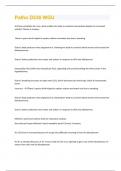
s Diane completes her race, what enables her body to maintain homeostasis despite her increased activity? Choose 3 answers. Diane's sports drink helped to replace sodium and water lost due to sweating. Diane's body produces more angiotensin II, allowing her body to constrict blood vessels and increase her blood pressure. Diane's kidney reabsorbs more water and sodium in response to ADH and aldosterone. Extracellular fluid shifts into intracellular fluid, expanding cells and stimulating the thirst center in the hypothalamus. Diane's breathing increases to expel more CO2, which decreases pH and brings it back to homeostatic levels. incorrect - Diane's sports drink helped to replace sodium and water lost due to sweating. Diane's body produces more angiotensin II, allowing her body to constrict blood vessels and increase her blood pressure. Diane's kidney reabsorbs more water and sodium in response to ADH and aldosterone. Michael's pulmonary edema leads to respiratory acidosis. How does pH impact Michael's basal metabolic panel? Choose 3 answers. His CO2 level is increased because his lungs have difficulty removing it from the bloodstream. His K+ is elevated because, as H+ moves inside of cells in an attempt to get it out of the bloodstream, K+ moves from cells into the bloodstream.His sodium level is decreased due to hypervolemia. His calcium level is reduced because the elevated concentration of H+ makes it easier for Ca+ to bind to albumin. His CO2 level is decreased because his lungs have difficulty adding it into the bloodstream. - His CO2 level is increased because his lungs have difficulty removing it from the bloodstream. His K+ is elevated because, as H+ moves inside of cells in an attempt to get it out of the bloodstream, K+ moves from cells into the bloodstream. His sodium level is decreased due to hypervolemia. What differentiates type I from type II diabetes? The insulin producing cells of type I diabetics are destroyed, and they do not produce insulin. In type II diabetics, their cells are less responsive to insulin. Type I diabetes can be treated, while type II diabetics do not benefit from supplemental insulin. The insulin producing cells of type II diabetics are destroyed, and they do not produce insulin. In type I diabetics, their cells are less responsive to insulin. Type I diabetes is characterized by high blood glucose levels, while type II diabetics have normal blood glucose levels. - The insulin producing cells of type I diabetics are destroyed, and they do not produce insulin. In type II diabetics, their cells are less responsive to insulin. A patient with a viral illness and severe vomiting has an elevated CO2 level and a blood pH of 7.53. She is breathing slowly.What condition does the patient have? Metabolic acidosis Respiratory alkalosis. Respiratory acidosis Metabolic alkalosis - Metabolic alkalosis
Written for
- Institution
- Patho D236 WGU
- Course
- Patho D236 WGU
Document information
- Uploaded on
- August 12, 2023
- Number of pages
- 34
- Written in
- 2023/2024
- Type
- Exam (elaborations)
- Contains
- Questions & answers
Subjects

Also available in package deal