PHYS 261 FINAL EXAM
Study online at https://quizlet.com/_a1p084
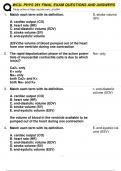
1.Match each term with its definition.
A. cardiac output (CO)
B. heart rate (HR)
C. end-diastolic volume (EDV)
D. stroke volume (SV)
E. end-systolic volume (ESV)the volume of blood pumped out of the heart from one ventricle during one contractionD. stroke volume (SV)
2.The rapid depolarization phase of the action poten-
tials of myocardial contractile cells is due to which ion(s)?
Ca2+ only
K+ only
Na+ only
both Ca2+ and K+
both Na+ and K+Na+ only
3.Match each term with its definition.
A. cardiac output (CO)
B. heart rate (HR)
C. end-diastolic volume (EDV)
D. stroke volume (SV)
E. end-systolic volume (ESV)
the volume of blood in the ventricle available to be pumped out of the heart during one contractionc. end-diastolic volume (EDV)
4.Match each term with its definition.
A. cardiac output (CO)
B. heart rate (HR)
C. end-diastolic volume (EDV)
D. stroke volume (SV)
E. end-systolic volume (ESV)E. end-systolic vol-
ume (ESV) WCU- PHYS 261 FINAL EXAM QUESTIONS AND ANSWERS PHYS 261 FINAL EXAM
Study online at https://quizlet.com/_a1p084
the volume of blood left in the ventricle after it con-
tracts
5.The volume of blood ejected from each ventricle dur-
ing a contraction is called the
end-diastolic volume.
stroke volume.
cardiac reserve.
cardiac output.
end-systolic volume.stroke volume.
6.What happens when calcium binds troponin?
Troponin binds to actin and causes sarcomere short-
ening.
Troponin changes shape and covers the SR calcium channel, which is a form of negative feedback.
Tropomyosin is pulled away from the myosin-binding site on actin.
Troponin releases myosin and activates actin.Tropomyosin is pulled away from the myosin-bind-
ing site on actin.
7.The driving force for blood flow is a(n) ________ gra-
dient.
gravity
pressure
osmotic
volumepressure
8.Which would NOT cause an increase in blood pres-
sure?
an increase in arterial resistance
a decrease in cardiac output
a decrease in arterial diameter
an increase in sympathetic activitya decrease in car-
diac output
9. B. QRS complex PHYS 261 FINAL EXAM
Study online at https://quizlet.com/_a1p084
Match the name of the wave with the correlated event.
A. P wave
B. QRS complex
C. T wave
D. PR segment
E. ST segment
ventricular depolarization
10.The function of transverse tubules is to
a. conduct ATP molecules out of the mitochondria throughout the sarcoplasm.
b. ensure a supply of glycogen throughout the muscle sarcoplasm.
c. store Ca2+ ions inside the muscle fiber.
d. rapidly move action potentials to the interior of the muscle fiber.d. rapidly move ac-
tion potentials to the interior of the muscle fiber.
11.Which is greater?
a. blood pressure when the peripheral vessels con-
strict
b. blood pressure when the peripheral vessels dilatea. blood pressure when the periph-
eral vessels con-
strict
12.The P wave of an ECG corresponds to
a. the progressive wave of ventricular
b. depolarization.
c. depolarization of the atria.
d. repolarization of the atria.
e. repolarization of the ventricles.
f. None of the answers are correct.c. depolarization of the atria.
13.The reflex that complements a withdrawal reflex by making compensatory adjustments on the opposite side of the body receiving the stimulus is the
a. stretch reflex.c. crossed exten-
sor reflex.
Study online at https://quizlet.com/_a1p084
1.Match each term with its definition.
A. cardiac output (CO)
B. heart rate (HR)
C. end-diastolic volume (EDV)
D. stroke volume (SV)
E. end-systolic volume (ESV)the volume of blood pumped out of the heart from one ventricle during one contractionD. stroke volume (SV)
2.The rapid depolarization phase of the action poten-
tials of myocardial contractile cells is due to which ion(s)?
Ca2+ only
K+ only
Na+ only
both Ca2+ and K+
both Na+ and K+Na+ only
3.Match each term with its definition.
A. cardiac output (CO)
B. heart rate (HR)
C. end-diastolic volume (EDV)
D. stroke volume (SV)
E. end-systolic volume (ESV)
the volume of blood in the ventricle available to be pumped out of the heart during one contractionc. end-diastolic volume (EDV)
4.Match each term with its definition.
A. cardiac output (CO)
B. heart rate (HR)
C. end-diastolic volume (EDV)
D. stroke volume (SV)
E. end-systolic volume (ESV)E. end-systolic vol-
ume (ESV) WCU- PHYS 261 FINAL EXAM QUESTIONS AND ANSWERS PHYS 261 FINAL EXAM
Study online at https://quizlet.com/_a1p084
the volume of blood left in the ventricle after it con-
tracts
5.The volume of blood ejected from each ventricle dur-
ing a contraction is called the
end-diastolic volume.
stroke volume.
cardiac reserve.
cardiac output.
end-systolic volume.stroke volume.
6.What happens when calcium binds troponin?
Troponin binds to actin and causes sarcomere short-
ening.
Troponin changes shape and covers the SR calcium channel, which is a form of negative feedback.
Tropomyosin is pulled away from the myosin-binding site on actin.
Troponin releases myosin and activates actin.Tropomyosin is pulled away from the myosin-bind-
ing site on actin.
7.The driving force for blood flow is a(n) ________ gra-
dient.
gravity
pressure
osmotic
volumepressure
8.Which would NOT cause an increase in blood pres-
sure?
an increase in arterial resistance
a decrease in cardiac output
a decrease in arterial diameter
an increase in sympathetic activitya decrease in car-
diac output
9. B. QRS complex PHYS 261 FINAL EXAM
Study online at https://quizlet.com/_a1p084
Match the name of the wave with the correlated event.
A. P wave
B. QRS complex
C. T wave
D. PR segment
E. ST segment
ventricular depolarization
10.The function of transverse tubules is to
a. conduct ATP molecules out of the mitochondria throughout the sarcoplasm.
b. ensure a supply of glycogen throughout the muscle sarcoplasm.
c. store Ca2+ ions inside the muscle fiber.
d. rapidly move action potentials to the interior of the muscle fiber.d. rapidly move ac-
tion potentials to the interior of the muscle fiber.
11.Which is greater?
a. blood pressure when the peripheral vessels con-
strict
b. blood pressure when the peripheral vessels dilatea. blood pressure when the periph-
eral vessels con-
strict
12.The P wave of an ECG corresponds to
a. the progressive wave of ventricular
b. depolarization.
c. depolarization of the atria.
d. repolarization of the atria.
e. repolarization of the ventricles.
f. None of the answers are correct.c. depolarization of the atria.
13.The reflex that complements a withdrawal reflex by making compensatory adjustments on the opposite side of the body receiving the stimulus is the
a. stretch reflex.c. crossed exten-
sor reflex.