TCC Biology Exam 1 Top Exam Questions and answers, 100% Accurate.
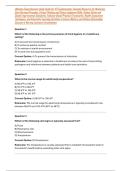
TCC Biology Exam 1 Top Exam Questions and answers, 100% Accurate. A scientific theory is: - -a concept that is supported by experimental evidence that explains the facts in an area of study. energy utilization - -shares which fundamental property of life with actual living organisms inductive reasoning - -A yellow jacket, an insect in the order hymenoptera, stung you. Then a wasp, an insect in hymenoptera, stung you as well. A hornet, an insect in hymenoptera, stung you last. It is an observable pattern that all insects in this order must have stingers. Bicarbonate ions in the blood can absorb hydrogen ions, keeping the pH balanced. Therefore bicarbonate is acting as a ______ in the blood. - -buffer When two atoms share a pair of electrons, the bonding is referred to as - -covalent Water molecules are polar with ends that exhibit partial positive and negative charges. These opposite charges allow water molecules to attract each other through - -hydrogen bonds All atoms tend to fill their outer energy levels with the maximum number of electrons, usually eight. Depending on whether atoms satisfy the octet rule will predict - -chemical behavior of the atoms The amino acid glycine (C3NO2H6) is a(an): - -organic (biological) molecule The pH of water is: - -7 10. Your dog becomes ill and you rush him to the veterinarian's office. A technician draws blood from your dog's leg for a vet-ordered lab test. After a few minutes the lab results are given to the vet, who immediately grabs a bottle from a shelf and begins to fill a syringe with an unknown fluid. You inquire about the fluid, and the vet informs you that the fluid is necessary to manage your dog's metabolic acidosis. Based on the information provided, what is acidosis, and what is the likely effect of the veterinarian's injection? - -a. Acidosis means that your dog's blood pH has decreased from its normal level, and an injection of buffering solution is required to reverse the condition. 11. Water is most dense and thus heaviest at 4°C. At 0°C, ice forms and can float on liquid water. Suppose ice were most dense at 0°C. What would happen in a lake at this temperature? - -b. The ice would cover the bottom of the aquatic system and would build up in layers over time. The reaction (H2 + F2 → 2HF) is an example of a redox reaction. In reality, two half reactions are occurring. The half reaction (H2 → 2H+ + 2e-) is a(n) - -d. oxidation reaction The water strider will walk around on the surface of water without sinking into it. What properties of water allow this insect to walk on water? - -The surface tension created by hydrogen bonds is greater than the weight of the insect. chitin - -A modified form of cellulose (a polysaccharide) found in the exoskeletons of insects and crustaceans is known as lipids - -These biological compounds are nonpolar and insoluble in water dehydration reaction - -The covalent bonds connecting monomer units in sugars can be formed by the removal of a water molecule. This reaction is referred to as DNA molecules - -Macromolecules that are used by most organisms to store hereditary information are called Monosaccharide - -Starch is a type of polysaccharide formed of structural units called Amino Acids - -Proteins are polymers formed of structural units (monomers) called A double-stranded DNA strand contains 26 pyramidines. How many purines will the copied strand contain? - -26 Biological membranes contain bilayers containing mostly... - -phospholipids Uracil - -The nitrogneous base that is only found in RNA and not in DNA is: The asthma medications
Written for
Document information
- Uploaded on
- August 10, 2023
- Number of pages
- 6
- Written in
- 2023/2024
- Type
- Exam (elaborations)
- Contains
- Questions & answers
Subjects
-
tcc biology exam 1 top exam questions and answers