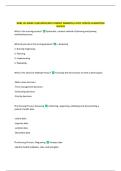
QUIZ 9 (FRACTURE AND AMPUTATION) STUDY GUIDE Fractures Fracture is a break or disruption in the continuity of a bone Complete fracture: break extends across the entire bone, dividing into two separate pieces Incomplete fracture : bone only breaks partway across Greenstick fracture: common in children. Bone is splintered on one side, but only bent on the other side Classification of Fractures: Closed or simple fracture: The bone does not break through the skin Open or compound fracture: Fragments of the broken bone break through skin, Open fractures have three grades of severity Grade I: least severe injury, with minimal skin damage Grade II : moderately severe injury, with skin and muscle contusions (bruises) Grade III: most severe injury (wound larger than 6 to 8 cm), with skin, muscle, blood vessel, and nerve damage. Stress fracture: Caused by either repeated or prolonged stress Pathologic fracture: Occurs because of a pathologic condition in the bone, such as a tumor or disease process, that causes a spontaneous break. Cause and Risk Factors: Commonly caused by trauma to the bone, especially as a result of automobile accident s and falls, Bone disease; e.g., bone cancer, can lead to a fracture, Hip fractures in older adults usually from falls, Risk factors for hip fractures: osteoporosis, advanced age, white race, use of psychotropic drugs, and female, In adults, ribs most comm only fractured, Fractures of the femur most common in young and middle -aged adults, Hip and wrist fractures are most common in older adults. Stage 4: ossification: Within 3 weeks to 6 months after the break, a permanent bone callus, known as woven bo ne, forms. During this stage, the ends of the broken bone begin to knit. Complication - Fat Embolism: Fat globules released from marrow of broken bone into bloodstream, then migrate to the lungs. They lodge in capillaries and obstruct blood flow. The fat particles break down into fatty acids, which inflame the pulmonary blood vessels, leading to pulmonary edema. Common with fractures of the long bones, multiple fractures, and severe trauma. Complication – Shock: After fracture, there is a risk of ex cessive blood loss. Trauma may rupture local blood vessels; internal organs may be punctured; results in internal bleeding. Loss of blood leads to shock, evidenced by tachycardia; anxiety; pallor; and cool, clammy skin. Immobilizing fractures reduces the r isk of hemorrhage. If severe external bleeding, external pressure should be applied, and medical assistance summoned immediately. Complication - Avascular Necrosis: A variety of factors can interfere with blood supply after a bone injury. Once bone c ells are deprived of oxygen and nutrients, they die and their cell walls collapse . Signs and symptoms: Pain, instability, and decreased function in the affected area. Precipitated by a fracture or other trauma. Severe pain at the injury site despite no detectable nerve damage, edema, muscle spasm, stiffness, vasospasms, increased sweating, atrophy, contractions, and loss of bone mass, Symptoms persist longer than expected with the type of injury suffered. Reduc tion: The process of bringing the ends of the broken bone into proper alignment. Closed Reduction or Manipulation: Nonsurgical realignment that returns bones to their previous anatomic position. No surgical incision is made; however, general or local anesthesia is given. By using traction, manual pressure, or a combination. After reduction of a fracture, x -ray taken, and a cast usually applied. Variety of materials used for splints/immobilizers. Four main groups of casts: (1) upper extremity, (2) lo wer extremity, (3) cast brace, and (4) body or spica cast. Traction: Skin traction: Buck’s traction for hip and knee contractures, muscle spasms, and alignment of hip fractures. Weight used during skin traction should not be more than 5 to 10 pounds to prevent injury to the skin Skeletal traction: Provides a strong, steady, continuous pull and can be used for prolonged periods . Examples of skeletal traction are Gardner -Wells, Crutchfield, and Vinke tongs and a halo vest, in which pins are inserted into the skull on either side.
Summary
Summary VN 201 quiz 11 chapter 29,30
Rating
Sold
-
Pages
8
Uploaded on
10-08-2023
Written in
2023/2024
summary and key pointer of quiz 11
Whoops! We can’t load your doc right now. Try again or contact support.
Written for
Document information
- Uploaded on
- August 10, 2023
- Number of pages
- 8
- Written in
- 2023/2024
- Type
- Summary
Subjects
Content preview
$7.99
Get access to the full document:
100% satisfaction guarantee
Immediately available after payment
Both online and in PDF
No strings attached

Also available in package deal
Package deal
vn200 quizes, focus review with answers and notes with summaries
1
9
2023
$ 61.51
More info