

LNAT/Law Interview Preparation Notes
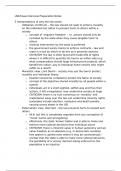
3 interpretations of why the law exists:
- Utilitarian, JS Mill etc – the law should not seek to enforce morality
on the individual but rather to prevent harm to others within a
society
o concept of ‘negative freedom’ – i.e. actions should only be
curtailed by the state when they cause tangible harm to
others
o minimal intervention by the state is preferred
o the government exists mainly to enforce contracts – law and
order is a tool by which to do this as it prevents anarchy
o CRITICISM: the law is often faced with trade-offs of rights
where it is difficult to quantify the harms on either side (e.g.
what compensation should large infrastructure projects, which
benefit the nation, pay to individual home owners who might
suffer as a result)
- Moralistic view, Lord Devlin – society may use the law to protect
morality and individual liberty
o freedom should be curtailed to protect the fabric of society
o concept of the objective shared morality by all people within a
system
o individuals act in a short-sighted, selfish way and thus their
actions, if left unregulated, may undermine society at large
o CRITICISM: there is no true consensus on ‘morality’ and
majoritarian sway over the law can undermine minority rights
(examples include abortion, marijuana and death penalty
varying across states in the US)
- Paternalistic view, HLA Hart – the law prevents harm to oneself and
others
o (N.B. but this is completely separate from any conception of
‘moral’ harms and wrongdoing)
o effectively, the state ‘knows’ better and is able to make and
enforce more rational decisions than individual actors
o CRITICISM: there is inherent value in human autonomy and we
value freedom as an absolute (e.g. in democratic societies
free speech is upheld even where it may be controversial) –
unclear that the state is able to make more rational decisions,
the possibility of a ‘wrong’ decision being enforced on the
population is an injustice
3 interpretations of why the law exists:
- Utilitarian, JS Mill etc – the law should not seek to enforce morality
on the individual but rather to prevent harm to others within a
society
o concept of ‘negative freedom’ – i.e. actions should only be
curtailed by the state when they cause tangible harm to
others
o minimal intervention by the state is preferred
o the government exists mainly to enforce contracts – law and
order is a tool by which to do this as it prevents anarchy
o CRITICISM: the law is often faced with trade-offs of rights
where it is difficult to quantify the harms on either side (e.g.
what compensation should large infrastructure projects, which
benefit the nation, pay to individual home owners who might
suffer as a result)
- Moralistic view, Lord Devlin – society may use the law to protect
morality and individual liberty
o freedom should be curtailed to protect the fabric of society
o concept of the objective shared morality by all people within a
system
o individuals act in a short-sighted, selfish way and thus their
actions, if left unregulated, may undermine society at large
o CRITICISM: there is no true consensus on ‘morality’ and
majoritarian sway over the law can undermine minority rights
(examples include abortion, marijuana and death penalty
varying across states in the US)
- Paternalistic view, HLA Hart – the law prevents harm to oneself and
others
o (N.B. but this is completely separate from any conception of
‘moral’ harms and wrongdoing)
o effectively, the state ‘knows’ better and is able to make and
enforce more rational decisions than individual actors
o CRITICISM: there is inherent value in human autonomy and we
value freedom as an absolute (e.g. in democratic societies
free speech is upheld even where it may be controversial) –
unclear that the state is able to make more rational decisions,
the possibility of a ‘wrong’ decision being enforced on the
population is an injustice


