Direct and indirect speech
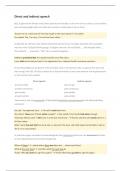
[B1] Je gebruikt de directe rede (direct speech) om letterlijk, in de vorm van een citaat, na te vertellen
wat iemand gezegd heeft. Het citaat kan vooraan of achteraan in de zin staan.
‘Excuse me sir, could you tell me how to get to the train station?’, she asked.
He replied: ‘No, I’m sorry, I’m not from here either.’
Je gebruikt de indirecte rede (indirect/reported speech) als je in je eigen woorden wilt navertellen
wat een ander (of jijzelf) heeft gezegd. Je begint vaak met: He said (that) ... , She thought (that) ... ,
They asked if ... , enzovoort. ‘That’ kun je meestal weglaten.
Kathleen promised that she would read the court files soon.
Lucas told me he had just sent in his application for a reduced health insurance premium.
De werkwoordtijd van de directe rede verandert vaak in de indirecte rede. Je gaat als het ware één
stap ‘terug in de tijd’. Dit doe je alleen als er tijd verstreken is tussen het moment van de gebeurtenis
en het moment van spreken.
Direct speech Indirect speech
present simple past simple
present continuous past continuous
past simple past perfect
present perfect past perfect
Vaak moet je ook het persoonlijk of (bijvoeglijk) bezittelijk voornaamwoord en de tijdsaanduiding
aanpassen.
He said: ‘You can wait here.’ → He said I could wait here.
She asked: ‘Have your friends eaten enough?’ → She asked if my friends had eaten enough.
Yesterday Sheena said: ‘I will come in a bit later tomorrow’. → Sheena said that she would come in a
bit later today.
Maar: Sarah has just told me she is sick, so she won’t be here. (Ze heeft zojuist verteld dat ze ziek is;
dat is ze nu nog steeds.)
In indirecte vragen verandert de woordvolgorde: het onderwerp komt voor het werkwoord te staan
en het hulpwerkwoord do wordt niet gebruikt.
Where is Dave? → I asked where Dave was (dus niet: … where was Dave).
What is the next step? → I wonder what the next step is.
Thalia: ‘Why do I have to sign this paper?’ → Thalia asked why she had to sign the paper.
[B1] Je gebruikt de directe rede (direct speech) om letterlijk, in de vorm van een citaat, na te vertellen
wat iemand gezegd heeft. Het citaat kan vooraan of achteraan in de zin staan.
‘Excuse me sir, could you tell me how to get to the train station?’, she asked.
He replied: ‘No, I’m sorry, I’m not from here either.’
Je gebruikt de indirecte rede (indirect/reported speech) als je in je eigen woorden wilt navertellen
wat een ander (of jijzelf) heeft gezegd. Je begint vaak met: He said (that) ... , She thought (that) ... ,
They asked if ... , enzovoort. ‘That’ kun je meestal weglaten.
Kathleen promised that she would read the court files soon.
Lucas told me he had just sent in his application for a reduced health insurance premium.
De werkwoordtijd van de directe rede verandert vaak in de indirecte rede. Je gaat als het ware één
stap ‘terug in de tijd’. Dit doe je alleen als er tijd verstreken is tussen het moment van de gebeurtenis
en het moment van spreken.
Direct speech Indirect speech
present simple past simple
present continuous past continuous
past simple past perfect
present perfect past perfect
Vaak moet je ook het persoonlijk of (bijvoeglijk) bezittelijk voornaamwoord en de tijdsaanduiding
aanpassen.
He said: ‘You can wait here.’ → He said I could wait here.
She asked: ‘Have your friends eaten enough?’ → She asked if my friends had eaten enough.
Yesterday Sheena said: ‘I will come in a bit later tomorrow’. → Sheena said that she would come in a
bit later today.
Maar: Sarah has just told me she is sick, so she won’t be here. (Ze heeft zojuist verteld dat ze ziek is;
dat is ze nu nog steeds.)
In indirecte vragen verandert de woordvolgorde: het onderwerp komt voor het werkwoord te staan
en het hulpwerkwoord do wordt niet gebruikt.
Where is Dave? → I asked where Dave was (dus niet: … where was Dave).
What is the next step? → I wonder what the next step is.
Thalia: ‘Why do I have to sign this paper?’ → Thalia asked why she had to sign the paper.