Real Estate Express Exam Prep General Exams Questions & Answers Solved 100%
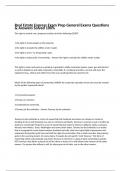
The right to control one's property includes all of the following EXCEPT 1 the right to invite people on the property. 2 the right to exclude the utilities meter reader. 3 the right to erect "no trespassing" signs. 4 the right to enjoy pride of ownership. - Answer the right to exclude the utilities meter reader. This right to enter and work on a property is granted to utility companies (water, sewer, gas and electric) as well as telephone and cable companies. Essentially, if a company provides a service and owns the equipment (e.g., phone and cable lines), they are usually granted an Which of the following types of ownership CANNOT be created by operation of law, but must be created by the parties' expressed intent? 1 Community property 2 Tenancy in common 3 Condominium ownership 4 Tenancy by the entireties - Answer Tenancy by the entireties Tenancy by the entireties is a form of ownership that husbands and wives can choose or create by deciding to do so and declaring it as such in contracts and deeds. Tenancy in common is put in motion by state law. Community Property is a law of ownership that exists in Arizona, California, Idaho, Louisiana, Nevada, New Mexico, Texas, Washington and some other states. Tenancy by the Entireties is an estate that is recognized in some states between husband and wife, who have equal right of possession and enjoyment during their joint lives and with the right of survivorship--that is when one dies, the property goes to the surviving tenant. (In many states, if couples do not specify "Joint Tenancy," this form of ownership will be automatically assumed.) Tenancy in Common is a type of joint ownership by parties NOT married, that allows a person to sell his share or leave it in a will without the consent of the other owners. If a person dies without a will, his share goes to his heirs, not to the other owners. Which of the following is/are considered to be personal property? 1 Wood-burning fireplace 2 Furnace 3 Bathtubs 4 Lamps - Answer Lamps The concept of personal property typically comes into play at the time of sale. Things that are part of the house--bathroom fixtures, fireplaces, carpeting and such--go with the sale. (Unless specifically excluded, as can happen in the case of a dining room chandelier or one or two other objects with which the owners have an emotional attachment.) Furniture, rugs, lamps and other portable items that are not "nailed down" constitute personal property and are not included in the sale. The word "improvement" would refer to all of the following EXCEPT 1 streets. 2 a sanitary sewer system. 3 trade fixtures. 4 the foundation. - Answer trade fixtures. The term "trade fixture" refers to an item installed by a tenant in a rented commercial property that he or she removes at the end of the occupancy. All of the following are physical characteristics of land EXCEPT 1 indestructibility. 2 uniqueness. 3 immobility. 4 scarcity. - Answer scarcity. Scarcity is a fundamental economic concept that holds that the rarer and more desirable something is, the more valuable it will be. For example, professional athletes are highly paid because only the smallest percentage of people have the ability to perform at that level. Land is "scarce" because there is a finite amount available and, as Will Rogers once said, "They ain't making any more of it." Jack owns a leasehold interest in a property whose owners or tenants agree to use the property on a periodic, non-overlapping basis. With what type of property does Jack have this leasehold interest? 1 A cooperative 2 A time-share 3 A condominium 4 A planned-urban development - Answer A time-share Time-shares are most common with vacation and resort properties. Time-share arrangements provide for equal sharing of the property's expenses among the owners. Personal property includes all of the following EXCEPT 1 chattels. 2 fructus industriales. 3 emblements. 4 fixtures. - Answer fixtures. "Chattel" is a legal term that means personal property. Emblements and fructus industriales refer to profit from crops that are grown as a result of a person's labor, such as corn, as opposed to those that occur naturally, such as grass or minerals. By the custom of English common law, they are considered personal property. By contrast, a fixture is considered attached to a property and thus part of the structure. A person who has complete control over a parcel of real estate is said to own a 1 leasehold estate. 2 fee simple estate. 3 life estate. 4 defeasible fee estate. - Answer fee simple estate. All the other options have conditions attached. A leasehold estate is, as the name implies, leased property. Similarly, a life estate gives a person ownership or control of a property only for the duration of his or her natural life. "Defeasible estates" give a person or entity control over a property only so long as certain conditions are met or avoided. For example, a community might be deeded a property on the condition that it be used only for building a school, or land willed to a child on the condition it never be used for commercial development. If the community tries to use the property for a recreation complex or the heir tries to sell to a retail developer, control would automatically revert to another party and the deed would become void. A portion of Wendell's building was inadvertently built on Ginny's land. This is called an 1 accretion. 2 avulsion. 3 encroachment. 4 easement. - Answer encroachment. The principal attributes of an encroachment are: 1) It is accidental and 2) it involves only part of a structure. Typically, the issue would be resolved by selling Wendell an easement or a lease or, if practical, actually moving the structure. The purchase of a ticket for a professional sporting event gives the bearer what? 1 An easement right to park his car 2 A license to enter and claim a seat for the duration of the game 3 Partial ownership in the professional sporting team 4 A license to sell food and beverages at the sporting event - Answer A license to enter and claim a seat for the duration of the game Easements grant access, not use. Commercial licenses, such as those required to sell beverages, souvenirs or services, cover extended periods. Although tickets to sporting events, concerts, shows and the like are technically licenses, they differ from most in their degree of restriction. For example, a concert ticket does not give the bearer the right to sit anywhere he or she chooses or wander backstage to meet the performers. If the owner of the dominant tenement becomes the owner of the servient tenement and merges the two properties, what happens? 1 The easement becomes dormant. 2 The easement is unaffected. 3 The easement is terminated. 4 The properties retain their former status. - Answer The easement is terminated. "Dominant" and "servient" tenements involve two adjacent properties in which an easement is involved. For example, let's say Bridle Creek Farms and Barnstable Farms are separate parcels divided by a country lane that provides access to the county road system. The lane is owned by Bridle Creek, but the deeds of both properties stipulate that Barnstable Farms shall have unrestricted access for the purpose of accessing county roads. That access is an easement. Thus, if the owner of Barnstable Farms buys Bridle Creek Farms, the need for the easement disappears. Homeowner Tanya acquired the ownership of land that was deposited by a river running through her property by 1 reliction. 2 succession. 3 avulsion. 4 accretion. - Answer accretion. Accretion means the addition to a parcel of land by sand or soil deposits due to the action of a river or other body of water over time. Avulsion refers to the loss of land as a result of its being washed away by sudden or unexpected action of nature, such as a flash flood that re-routes a river. The rights of the owner of property located along the banks of a river are called 1 littoral rights. 2 prior appropriation rights. 3 riparian rights. 4 hereditament rights. - Answer riparian rights. "Littoral" and "prior appropriation" are different kinds of water rights: in the first case, navigation rights to an ocean or other large body of water; in the second, the right to use a water source for irrigation. A hereditament is any inheritable property. The local utility company dug up Charlotte's garden to install a natural gas line. The company claimed it had a valid easement and proved it through the county records. Charlotte claimed the easement was not valid because she did not know about it. The easement 1 was valid even though the owner did not know about it. 2 was an appurtenant easement owned by the utility company. 3 was not valid because it had not been used during the entire time that Charlotte owned the property. 4 was not valid because Charlotte was not informed of its existence when she purchased the property. - Answer was valid even though the owner did not know about it. Easements grant only access, not ownership, use or occupancy rights. Further, that access is generally for the benefit of the property owner, such as maintaining utilities or sidewalks. As such, they "attach" to a deed or lease and remain in effect, until specifically lifted. Jim and Sandy are next-door neighbors. Sandy tells Jim that he can store his camper in her yard for a few weeks until she needs the space. Sandy did not charge Jim rent for the use of her yard. Sandy has given Jim a(n) what? 1 Easement appurtenant 2 Easement by necessity 3 Estate in land 4 License - Answer License Granting the use of property for a defined period for a specific purpose is almost always a form of licensing. Easements grant only access, not ownership, use or occupancy rights. Further, that access is generally for the benefit of the property owner, such as maintaining utilities or sidewalks. Owner Stan has been defaulting on mortgage payments and owes more than his property is worth. Stan's lender is allowing him to sell the property for less money than necessary to satisfy the loan. The bank has permitted Stan to do what? 1 Commit tax fraud 2 Short sale the property 3 Deed the property to HUD 4 "Flip" the property - Answer Short sale the property Short sales avoid the delay and expense of a foreclosure sale. The lender usually forgives the mortgage balance owed after the sale. A defaulting borrower who faces foreclosure may avoid court actions and costs by voluntarily deeding the property to the mortgagee. This is accomplished with a __________, which transfers legal title to the lienholder. 1 short sale 2 deficiency judgment 3 deed in lieu of foreclosure 4 caveat emptor - Answer deed in lieu of foreclosure With the deed in lieu option, a borrower voluntarily deeds collateral property in exchange for a release from all obligations under the mortgage. The transfer, however, does not terminate any existing liens on the property. Anna owns 50 acres of land with 500 feet of frontage on a desirable recreational lake. She wishes to subdivide the parcel into salable lots, but she wants to retain control over the lake frontage while allowing lot owners to have access to the lake. Which of the following types of access rights would provide the greatest protection for a prospective purchaser? 1 An easement in gross 2 An appurtenant easement 3 An easement by necessity 4 A license - Answer An appurtenant easement Appurtenant easements afford the most protection since they are generally a permanent feature of the property. Thus, in the case of sale, the lake access passes to any new owners. By contrast, an "easement in gross" is between two individuals, which would severely limit the attractiveness and value of the property if the original owner wished to sell. Sam and Nancy bought a store building and took title as joint tenants. Nancy died testate. Sam now owns the store 1 as a joint tenant with rights of survivorship. 2 in severalty. 3 as a tenant in common with Nancy's heirs. 4 in trust. - Answer in severalty. Joint tenancy means that two parties have an undivided interest in a particular property and, upon the death of one party, full ownership automatically goes to the survivor. Despite the way it sounds, "in severalty" means as sole owner. When real estate under an estate for years is sold, what happens to the lease? 1 It expires with the conveyance. 2 It binds the new owner. 3 It is subject to termination with proper notice. 4 It is valid but unenforceable. - Answer It binds the new owner. Tenancy for years is the common form of rental agreements and binds all future owners for the term of the lease. Evan lives in an apartment building. The land and structures are owned by a corporation, with one mortgage loan covering the entire property. Like the other residents, Evan owns stock in the corporation and has a lease on his apartment. This type of ownership is called a(n) 1 condominium. 2 planned unit development. 3 time-share. 4 cooperative. - Answer cooperative. This is the distinguishing characteristic that differentiates cooperative from condominium ownership. Although often confused, a condominium owner holds title to his individual unit. A co-op owner, on the other hand, is technically a renter. It's his stock in the corporation holding title to the property that gives him the right to lease the unit as well as sell that right to another. Tom leases store space to Kim for a restaurant, and Kim installs her ovens, booths, counters, and other equipment. When do these items become real property? 1 When they are installed 2 When Kim defaults on her rental payments 3 When the lease takes effect 4 When the lease expires, if the items are not taken by the tenant - Answer When the lease expires, if the items are not taken by the tenant Kim is free to move these fixtures at the end of her lease. However, if she chooses to leave them behind, they are considered a permanent part of the structure (just like a dining room chandelier in a home) and revert to Tom. Jim, Manny, and Harry are joint tenants owning a parcel of land. Harry conveys his interest to his long-time friend Wendell. After the conveyance, Jim and Manny 1 become tenants in common. 2 continue to be joint tenants with Harry. 3 become joint tenants with Wendell. 4 remain joint tenants owning a two-thirds interest. - Answer remain joint tenants owning a two-thirds interest. Because joint tenancy must be declared, Jim and Manny remain joint tenants with a two-thirds interest while Wendell, because of his passive acquisition of his share of the property, becomes a tenant in common with Jim and Manny. The difference between the two forms is that Jim and Manny's share retains the right of survivorship provisions but Wendell's does not. In a gift of a parcel of real estate, one of the two owners was given an undivided 60 percent interest and the other received an undivided 40 percent interest. The two owners hold their interests as what? 1 Cooperative owners 2 Joint tenants 3 Community property owners 4 Tenants in common - Answer Tenants in common In order to create joint tenancy, some form of relationship must exist between the parties involved, whether business, spousal or other. Because their interests were acquired as a gift, the parties in this instance become tenants in common, with all the ownership benefits of joint tenancy, but not the survivorship rights. To create a joint tenancy relationship in the ownership of real estate, there must be unities of 1 desires, ownership, claim of right, and possession. 2 title, interest, liens, and survivorship. 3 possession, time, interest, and title. 4 ownership, possession, heirs, and title. - Answer possession, time, interest, and title. This essentially means that all parties to the agreement share equally in all aspects of the property, including the length of time it's been held. That means if one party sells or transfers interest in a joint tenancy relationship, his or her place is taken by another in the same capacity. What is a Schedule of Exceptions on a title policy? 1 Encumbrances 2 Tax liens 3 List of things not insured in the policy 4 Defects - Answer List of things not insured in the policy Almost no title insurance policy protects against all conceivable events. As the name suggests, the Schedule of Exceptions is a specific list of items not covered and can include things such as unrecorded mechanic's liens, assessments, water rights and mining Owner Grace's property has been foreclosed. After the property was sold for $340,000, she still owed $60,000 to the lender. The lender may be able to get a personal judgment against Grace for the $60,000. This is called a 1 leverage lien. 2 partition lawsuit. 3 reverse foreclosure judgment. 4 deficiency judgment. - Answer deficiency judgment. A deficiency judgment enables the lender to attach and foreclose a judgment lien on other real or personal property the borrower owns.The lender's ability to pursue such a judgment may be limited, however. Which of the following liens does not need to be recorded to be valid? 1 Materialman's lien 2 Real estate tax lien 3 Judgment lien 4 Mechanic's lien - Answer Real estate tax lien The requirement for individuals to record liens is due in part to the necessity of correctly identifying the complainant. For example, not just "Jones Contracting," but the specific Jones Contracting that performed the work and is owed the money. Because they bear the authority of government and are easily identified, liens by taxing authorities do not need to be recorded. The system of ownership of real property in the United States is what? 1 Incorporeal 2 Allodial 3 Command 4 Feudal - Answer Allodial "Allodial" is the modern form of ownership and is often contrasted with "feudal" in which land is held on the condition of rent or service due the government. For example, a medieval knight held property subject to coming to his baron's service when called. Similarly, the baron's land holdings were conditional on his raising an army and fighting for the king in times of conflict. Failure of any party to "perform as promised" was cause for holdings to be confiscated, often as a preliminary step to more extreme actions. A mechanic's lien would be properly classified as a(n) 1 equitable lien. 2 voluntary lien. 3 general lien. 4 statutory lien. - Answer statutory lien. A "statutory lien" is one that arises out of specific law (otherwise known as statutes). By contrast, an "equitable lien" has its roots in common law or custom. A "voluntary lien" is one entered with the property owner's knowledge and consent, such as a mortgage. A "general lien" grants a creditor the right to file a claim against all of a debtor's assets, not just a particular property. Under which of the following types of liens can both the real property and the personal property of the debtor be sold to pay the debt? 1 Real estate tax lien 2 Mechanic's lien 3 Judgment lien 4 Assessment lien - Answer Judgment lien Most liens are against a specific property, such as a primary residence. Thus, a contractor seeking payment for a new deck cannot have a homeowner's car attached in settlement. A judgment lien, however, is a decision directed by the courts and can apply to whatever assets it deems appropriate. A homeowner owned a house on a lot. The front ten feet of the lot were taken by eminent domain for a sidewalk. Would the homeowner be entitled to compensation? 1 Yes. The land was taken for public use by eminent domain. 2 Yes. He must be paid for the use of the sidewalk. 3 No. He still had use of the house and lot. 4 No. Compensation is not given on land taken for public use. - Answer Yes. The land was taken for public use by eminent domain. Governments and municipalities can only seize property (other than in criminal cases) for the public good and through eminent domain, which is a process, not an arbitrary action. Part of that process involves determining fair compensation to the owner. The covenant in a deed which states that the grantor is the owner and has the right to convey the title is called 1 covenant of power. 2 covenant of warranty forever. 3 covenant of seisin. 4 covenant against encumbrances. - Answer covenant of seisin. Another outgrowth of the feudal system, "seisen" derives from the French meaning to "sit upon or own" and gives owners the right to sell or transfer property at will. The recording of a deed 1 is all that is required to transfer the title to real estate. 2 gives constructive notice of the ownership of real property. 3 insures the interest in a parcel of real estate. 4 warrants the title to real property. - Answer gives constructive notice of the ownership of real property. Recording a deed does not convey, insure or warrant ownership. However, it does protect the owner's interest in a property by serving notice that the recorded owner is the only recognized holder of title. This places a larger burden of proof and process on someone trying to assert a prior ownership interest and/or claiming a deedholder's title is clouded. Which of the following provides a buyer with the best assurance of clear, marketable title? 1 Certificate of title 2 Title insurance 3 Abstract of title 4 General warranty deed - Answer Title insurance Title insurance provides the best assurance of marketable title. What do liens and easements have in common? 1 Both are encumbrances. 2 Both must be on the public record to be valid. 3 Neither can be done without the consent of the owner. 4 Both are money claims against the property. - Answer Both are encumbrances. Liens are, of course, serious in that they indicate the owner has failed to pay a debt secured directly or indirectly by the property. Easements, on the other hand, are generally a practical necessity for most residential properties. The title to real estate passes when a valid deed is 1 signed and recorded. 2 delivered and accepted. 3 filed and uploaded to the cloud. 4 executed and mailed. - Answer delivered and accepted. Fundamentally, real estate transactions only involve two parties--the buyer and the seller. All that's necessary to create a legal sale is for one party to make an offer the other accepts. Recording, escrow, real estate licensees, mortgage companies and the like facilitate and support the transaction process but are not requirements of a legal sale. The primary purpose of a deed is to 1 prove ownership. 2 transfer title rights. 3 give constructive notice. 4 prevent adverse possession. - Answer transfer title rights. A deed is the instrument by which ownership of a property is transferred from one person to another, while a title is evidence of that ownership. A special warranty deed differs from a general warranty deed in that the grantor's covenant in the special warranty deed 1 applies only to a definite limited time. 2 covers the time back to the original title. 3 is implied and is not written in full. 4 protects all subsequent owners of the property. - Answer applies only to a definite limited time. The more common deed in most states is the general warranty, because it establishes the ownership trail and validity of title going back to the original recorded ownership (for example, the purchase of Manhattan Island and all subsequent divisions, subdivisions and resales). Under a special warranty deed, an owner transfers property guaranteeing the quality of title only during the period of his or her ownership, leaving subsequent buyers vulnerable to prior claims. How many days do landlords have under current California law to return the unused portion of a security deposit? 1 It must be returned immediately 2 It must be returned within ten days 3 They have twenty-one days 4 They have thirty days - Answer They have twenty-one days Deductions may be taken only be for actual damages, not normal wear and tear such as carpet stains. Further, all deductions must be include "line item" details. In California, there are 4 levels of licensing for real estate appraisers. Which of the following is not one of them? 1 Trainee licensed appraisers 2 Licensed managing appraiser 3 Certified general appraisers 4 Residential licensed appraisers - Answer Licensed managing appraiser There is no such thing as a licensed managing appraiser. Certified residential appraisers are the 4th level of appraiser. California Real Estate Law requires that every applicant for a real estate broker license must have successfully completed 1 eight courses before taking the licensing exam. 2 two postlicense courses. 3 thirty hours of continuing education in the last six months. 4 fifty real estate transactions. - Answer eight courses before taking the licensing exam. California Real Estate Law requires that every applicant for a real estate broker license must have successfully completed eight courses before taking the licensing exam. The courses are broken into two groups - the "mandatory courses" and the "elective courses." Who would not be eligible to become a broker? 1 A 40 year old high school graduate with 3 years of real estate experience in the last 5 years 2 A 25 year old with 1 year of real estate experience 3 A naturalized citizen who has been a salesperson for the past 10 years 4 A 33 year old with a Ph.D and 2 years of real estate experience over the past 3 years - Answer A 25 year old with 1 year of real estate experience
Written for
- Institution
-
Real Estate Express
- Course
-
Real Estate Express
Document information
- Uploaded on
- August 6, 2023
- Number of pages
- 65
- Written in
- 2023/2024
- Type
- Exam (elaborations)
- Contains
- Questions & answers
Subjects
- real estate express
-
real estate express exam prep general exams
-
the right to exclude the utilities meter reader

Also available in package deal