SANS GFACT SQL Exam- Questions & Answers (100% Verified)
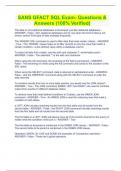
SANS GFACT SQL Exam- Questions & Answers (100% Verified) SANS GFACT SQL Exam- Questions & Answers (100% Verified) The data in non-relational databases is structured, just like relational databases. - ANSWER - False - Non-relational databases are for use when the kind of data is not known, and/or if the type of data changes frequently. The 'WHERE' SQL command is used to filter data that meet certain criteria. - ANSWER - True - The `WHERE` clause helps us to filter records to only the ones that match a certain condition, defined value within a database column To select all data from a table, use the wild card character '!', exclamation point - ANSWER - False - The asterisks '*' is the wild card character When using the AS command, the renaming of the field is permanent - ANSWER - False - The renaming of a field using the AS command only exists fo the duration of the SQL query. When using the SELECT command, data is returned in alphabetical order - ANSWER - False - Use the ORDER BY command along with the SELECT command to order the data returned To combine results from two or more table queries, you would use the JOIN clause? - ANSWER - True - The JOIN command, INNER, LEFT and RIGHT, are used to combine output from queries to different database tables To retrieve rows that meet defined conditions in 2 tables, use the INNER JOIN command - ANSWER - True - An INNER JOIN is used for retrieving rows that meet a condition in both tables a LEFT JOIN includes matching results from the first table and all results from the second table - ANSWER - False - the RIGHT JOIN command includes matching results from the first table and all results from the second table The first table in a LEFT JOIN will always have all of its records returned in the query no matter what the condition of the join is - ANSWER - True The first table to be joined is mentioned in the INNER JOIN clause. - ANSWER - False - The second table to be joined is mentioned in the INNER JOIN clause. Operators UNION, IN, LIKE and SOME are examples of Comparison operators - ANSWER - False - These are Logical operators
Written for
- Institution
- GFACT GIAC
- Course
- GFACT GIAC
Document information
- Uploaded on
- August 6, 2023
- Number of pages
- 2
- Written in
- 2023/2024
- Type
- Exam (elaborations)
- Contains
- Questions & answers
Subjects
- sans gfact sql exam
-
sans gfact sql exam questions amp answers
-
sans gfact sql exam questions
-
sans gfact sql exam answers

Also available in package deal