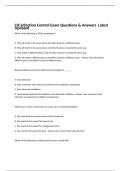
CIC-Infection Control Exam Questions & Answers Latest Updated
Which of the following is TRUE of pathogens? A. They all reside in the same places but infect humans in different ways. B. They all reside in the same places and infect humans in exactly the same way. C. They reside in different places, but all infect humans in exactly the same way. D. They all reside in different places and affect humans in different ways. - Answer They all reside in different places and affect humans in different ways. Beauty professionals are permitted and encouraged to ______. A. treat infections B. refer customers with infections and abnormal conditions to physicians C. treat abnormal conditions D. recommend treatments for infections and abnormal conditions - Answer refer customers with infections and abnormal conditions to physicians When does a client's impression of a salon, spa, or barbershop begin? A. the moment they see the results of their treatment B. the moment they meet their beauty pro C. the moment they meet the management team D. the moment they open the door - Answer the moment they open the door Which of the following is mainly used to remove visible dirt? cleaning sanitization disinfection sterilization - Answer cleaning Which of the following refers to the methods used to eliminate or reduce the transmission of infectious organisms from one individual to another? Standard Precautions infection control sterilization sanitization - Answer infection control Which of the following would OSHA most likely be involved in regulating? A. the disposal of chemical products in the workplace B. the manufacture of chemical products used in the workplace C. the sale of chemical products used in the workplace D. the registration of chemical products used in the workplace - Answer the disposal of chemical products in the workplace Which of the following would the EPA most likely be involved in regulating? A. the safe manufacture of chemical products used in the workplace B. the safe use of chemical products used in the workplace C. the safe mixing of chemical products used in the workplace D. the safe storing of chemical products used in the workplace - Answer the safe manufacture of chemical products used in the workplace Preventing the spread of infections is ______. A. impossible because the sources of infections are all unknown B. very unlikely because there are no set safety procedures to take C. difficult but possible if you run your shop like a hospital D. easy when you know the proper procedures to follow - Answer easy when you know the proper procedures to follow Which of the following is more likely to be governed by federal regulatory agencies rather than state regulatory agencies? A. sale of chemicals used on the job and enforcement of job safety b. licensing for working on the job and termination of employment c. protecting the customers health and safety during services d. conduct on the job and hiring practices - Answer sale of chemicals used on the job and enforcement of job safety Which of the following destroys all microbial life? sterilization disinfection sanitization cleaning - Answer sterilization Which of the following is NOT required of disinfectants used in salons, spas, and barbershops? They must be bactericidal. They must be fungicidal. They must be virucidal. They must be hypoallergenic. - Answer They must be hypoallergenic. Which of the following BEST defines transmission? a. the process by which the spread of infections is controlled or suppressed b. the process by which individuals are cured of sickness c. the process by which pathogens move between individuals d. the process by which diseases become infectious - Answer the process by which pathogens move between individuals There are ______ of different kinds of bacteria, which fall into ______ primary type(s). dozens; four hundreds; three millions; one thousands; two - Answer thousands; two When an individual's immune system prevents transmission, it ______. prevents the spread of disease spreads disease prevents illness causes illness - Answer prevents illness Which of the following is TRUE of nonpathogenic and pathogenic bacteria? a. Nonpathogenic bacteria are harmful to humans, whereas pathogenic bacteria are not. b. Pathogenic bacteria are harmful to humans, whereas nonpathogenic bacteria are not. c. Both pathogenic and nonpathogenic bacteria are harmful to humans. d. Neither pathogenic nor nonpathogenic bacteria are harmful to humans. - Answer Pathogenic bacteria are harmful to humans, whereas nonpathogenic bacteria are not. Which of the following is TRUE of direct and indirect transmission of disease? a. Direct transmission requires contact with another person, whereas indirect transmission does not. b. Direct transmission does not require contact with another person, whereas indirect transmission does. c. Both direct and indirect transmission require contact with another person. d. Neither direct nor indirect transmission require contact with another person. - Answer Direct transmission requires contact with another person, whereas indirect transmission does not. What is a microorganism? any plant-based organism any infectious organism any living organism any organism of microscopic size - Answer any organism of microscopic size Which of the following is TRUE of diseases spread by direct transmission and indirect transmission? a. Neither diseases spread by direct nor indirect transmission can live for long periods of time away from a host. b. Diseases spread by direct transmission can live for long periods of time away from a host, whereas those spread by indirect transmission cannot. c. Diseases spread by indirect transmission can live for long periods of time away from a host, whereas those spread by direct transmission cannot. d. Both diseases spread by direct and indirect transmission can live for long periods of time away from a host. - Answer Diseases spread by indirect transmission can live for long periods of time away from a host, whereas those spread by direct transmission cannot. Most bacteria are ______. contagious deadly nonpathogenic pathogenic - Answer nonpathogenic Indirect transmission of a disease ______. a. occurs by kissing another person b. occurs by shaking hands with another person c. happens through contact with an intermediate object d. cannot make an individual sick - Answer happens through contact with an intermediate object Which of the following is NOT caused by a virus? rabies HIV influenza strep throat - Answer strep throat The presence of pus is a sign of ______. nonpathogenic organisms contagious disease bacterial infection inflammation - Answer bacterial infection Which of the following is NOT true of staphylococci? a. Most strains make us very ill. b. They are among the most common forms of bacteria. c. They can be picked up on doorknobs or through skin-to-skin contact. d. They are routinely found in our environment. - Answer Most strains make us very ill. Which of the following is a type of fungi? pus mildew mycobacterium staphylococci - Answer Mildew HIV is spread through which of the following means? a. from person to person through the blood b. HIV is not contagious c. from person to person through the air d. indirectly through the touching of objects - Answer from person to person through the blood What are disease-causing microorganisms that are carried in the body by blood or body fluids, such as hepatitis and HIV, called? Parasites mycobacteria bloodborne pathogens systemic infections - Answer bloodborne pathogens Which of the following is TRUE of a disease that spreads from one person to another? It is nonpathogenic. It is systemic. It is communicable. It is deadly. - Answer It is communicable.
Written for
- Institution
- CIC - Certified Professional in Infection Control
- Course
- CIC - Certified Professional in Infection Control
Document information
- Uploaded on
- August 5, 2023
- Number of pages
- 23
- Written in
- 2023/2024
- Type
- Exam (elaborations)
- Contains
- Questions & answers
Subjects
- cic
-
cic infection control exam
-
cic infection control exam questions amp answers la
-
which of the following is true of pathogens

Also available in package deal