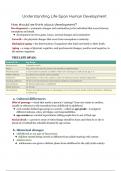
Understanding Life-Span Human Development
How should we think about development?
Development = systematic changes and continuities in the individual that occur between
conception and death.
➔ development involves gains, losses, neutral changes and continuities
Growth = the physical changes that occur from conception to maturity.
Biological aging = the deterioration of organisms that leads inevitably to their death.
Aging = a range of physical, cognitive, and psychosocial changes, positive and negative, in
the mature organism.
THE LIFE SPAN:
a. Cultural differences
Rite of passage = ritual that marks a person’s “passage” from one status to another,
usually in reference to the transition from childhood to adulthood.
➔ each socially defined age group in a society - called an age grade - is assigned
different statuses, roles, privileges, and responsibilities
➔ age norms are societal expectations telling people how to act at their age
Social clock = a person’s sense of when things should be done and when he or she is
ahead of or behind the schedule dictated by age norms.
b. Historical changes
● childhood as an age of innocence
➔ children started being viewed as different from adults starting 17th century
● adolescence
➔ adolescence was given a distinct phase from adulthood in the 19th/20th century
,● emerging adulthood
➔ this phase has been defined in the late 20th and early 21st centuries
● middle age as an emptying of the nest
➔ this phase emerged in the 20th century as parents began to bear fewer children and
live long enough to see their children grow up and leave home
● old age as retirement
➔ old age was defined as a period of retirement in the 20th century
➔ before then, adults who survived old age would work until they dropped
FRAMING THE NATURE-NURTURE ISSUE
Nature-nurture issue = the question of how biological forces and environmental forces
act and interact to make us what we are.
➔ development is the product of a complex interplay between nature and nurture
Nature
➔ some aspects of development are inborn/innate, while others are the product of
maturation (the biological unfolding of the individual as sketched out in the genes)
➔ maturational changes in the brain contribute to cognitive changes
Nurture
➔ those on the nurture side of the debate emphasize learning
➔ they emphasize change in response to the environment
What is the science of life-span development?
➔ the goals driving the study of development are describing, predicting, explaining, and
optimizing development
➔ professionals are being asked to engage in evidence-based practice
EARLY BEGINNINGS
➔ scholars observed their own children and published findings as baby biographies
➔ the most influential baby biography was by Charles Darwin (daily records of his son)
➔ Darwin’s evolutionary perspective strongly influenced early theories of development
➔ Darwin influenced G. Stanley Hall
G. Stanley Hall, regarded as
the founder of developmental
psychology
and first president
of the American Psychological
Association, did pioneering
research on childhood,
adolescence,
and old age. He is
perhaps best known for characterizing
adolescence
as a period.
,➔ Hall developed the questionnaire to explore the “contents of children’s minds” at
different ages (Hall, 1891)
➔ Hall characterized storm and stress (the time of emotional ups and downs and
rapid changes of adolescence)
THE MODERN LIFE-SPAN PERSPECTIVE
Assumptions of the life-span perspective:
➔ development is a lifelong process
➔ development is multidirectional (capacities show different patterns of change in time)
➔ development involves both gain and loss
➔ development is characterized by lifelong plasticity
● plasticity refers to the capacity to change in response to experience, whether
positive or negative
● neuroplasticity is the brain’s remarkable ability to change in response to
experience throughout the life-span
➔ development is shaped by its historical-cultural context
➔ development is multiply influenced (nature/nurture)
➔ development must be studied by multiple disciplines
Gerontology = the study of aging and old age.
Video deficit is the difficulty learning as much from video presentations as they do from
face-to-face presentations (seen in infants).
c. Developmental research designs
● cross-sectional designs
➔ comparison of the performance of people of different age groups or cohorts
➔ age effects = relationships between age and an aspect of development
➔ cohort effects = the effects of being born as a member of a particular cohort
● longitudinal designs
➔ involves the assessment of one cohort of individuals repeatedly over time
● sequential designs
➔ combines the cross-sectional approach and the longitudinal approach in a single
study
What special challenges do developmental scientists face?
➔ psychology has been characterized as the study of WEIRD people (western,
educated, industrialized, rich, democratic)
➔ two-thirds of research is done on Americans
➔ ethnocentrism is the belief that one’s own group and culture are superior
, Theories of Human Development
Developmental theories and the issue they raise
NATURE-NURTURE
➔ believers in nature: importance of genetic makeup and biological predispositions
➔ believers in nurture: influences of the physical/social environment
ACTIVITY-PASSIVITY
➔ the extent to which humans are active in influencing their own environments
➔ they either produce their own development or are passively shaped by environment
CONTINUITY-DISCONTINUITY
➔ focuses on whether the changes people undergo are gradual or abrupt
➔ continuity theorists believe that development occurs in small steps. while
discontinuity theorists picture it through developmental stages
UNIVERSALITY-CONTEXT SPECIFICITY
➔ extent to which changes are common to all humans or differ across contexts
Psychoanalytic theory
Psychoanalytic theory = focused on the development and dynamics of the personality,
revolutionized thinking about human nature and human development.
➔ Freud viewed newborns as creatures driven by instincts
➔ strongly believed in unconscious motivation
a. Id, ego, superego
➔ id = the impulsive, irrational part of the personality (aims to satisfy the instincts)
➔ ego = the rational side (tries to find realistic ways of gratifying the instincts)
➔ superego = the individual’s moral standards
b. Psychosexual stages
➔ Freud thought that the libido shifts from
one part of the body to another, seeking to satisfy
different biological needs
➔ through fixation, a person can be “stuck” on
one of the stages
➔ Oedipus Complex: through identification a
child takes his parent’s attitudes and behaviors to
impress opposite-sex parent
➔ to protect itself from against anxiety, the ego
adopts defense mechanisms:
Repression = removing traumatic memories or thoughts from consciousness.
Regression = retreating to an earlier, less traumatic stage of development.
How should we think about development?
Development = systematic changes and continuities in the individual that occur between
conception and death.
➔ development involves gains, losses, neutral changes and continuities
Growth = the physical changes that occur from conception to maturity.
Biological aging = the deterioration of organisms that leads inevitably to their death.
Aging = a range of physical, cognitive, and psychosocial changes, positive and negative, in
the mature organism.
THE LIFE SPAN:
a. Cultural differences
Rite of passage = ritual that marks a person’s “passage” from one status to another,
usually in reference to the transition from childhood to adulthood.
➔ each socially defined age group in a society - called an age grade - is assigned
different statuses, roles, privileges, and responsibilities
➔ age norms are societal expectations telling people how to act at their age
Social clock = a person’s sense of when things should be done and when he or she is
ahead of or behind the schedule dictated by age norms.
b. Historical changes
● childhood as an age of innocence
➔ children started being viewed as different from adults starting 17th century
● adolescence
➔ adolescence was given a distinct phase from adulthood in the 19th/20th century
,● emerging adulthood
➔ this phase has been defined in the late 20th and early 21st centuries
● middle age as an emptying of the nest
➔ this phase emerged in the 20th century as parents began to bear fewer children and
live long enough to see their children grow up and leave home
● old age as retirement
➔ old age was defined as a period of retirement in the 20th century
➔ before then, adults who survived old age would work until they dropped
FRAMING THE NATURE-NURTURE ISSUE
Nature-nurture issue = the question of how biological forces and environmental forces
act and interact to make us what we are.
➔ development is the product of a complex interplay between nature and nurture
Nature
➔ some aspects of development are inborn/innate, while others are the product of
maturation (the biological unfolding of the individual as sketched out in the genes)
➔ maturational changes in the brain contribute to cognitive changes
Nurture
➔ those on the nurture side of the debate emphasize learning
➔ they emphasize change in response to the environment
What is the science of life-span development?
➔ the goals driving the study of development are describing, predicting, explaining, and
optimizing development
➔ professionals are being asked to engage in evidence-based practice
EARLY BEGINNINGS
➔ scholars observed their own children and published findings as baby biographies
➔ the most influential baby biography was by Charles Darwin (daily records of his son)
➔ Darwin’s evolutionary perspective strongly influenced early theories of development
➔ Darwin influenced G. Stanley Hall
G. Stanley Hall, regarded as
the founder of developmental
psychology
and first president
of the American Psychological
Association, did pioneering
research on childhood,
adolescence,
and old age. He is
perhaps best known for characterizing
adolescence
as a period.
,➔ Hall developed the questionnaire to explore the “contents of children’s minds” at
different ages (Hall, 1891)
➔ Hall characterized storm and stress (the time of emotional ups and downs and
rapid changes of adolescence)
THE MODERN LIFE-SPAN PERSPECTIVE
Assumptions of the life-span perspective:
➔ development is a lifelong process
➔ development is multidirectional (capacities show different patterns of change in time)
➔ development involves both gain and loss
➔ development is characterized by lifelong plasticity
● plasticity refers to the capacity to change in response to experience, whether
positive or negative
● neuroplasticity is the brain’s remarkable ability to change in response to
experience throughout the life-span
➔ development is shaped by its historical-cultural context
➔ development is multiply influenced (nature/nurture)
➔ development must be studied by multiple disciplines
Gerontology = the study of aging and old age.
Video deficit is the difficulty learning as much from video presentations as they do from
face-to-face presentations (seen in infants).
c. Developmental research designs
● cross-sectional designs
➔ comparison of the performance of people of different age groups or cohorts
➔ age effects = relationships between age and an aspect of development
➔ cohort effects = the effects of being born as a member of a particular cohort
● longitudinal designs
➔ involves the assessment of one cohort of individuals repeatedly over time
● sequential designs
➔ combines the cross-sectional approach and the longitudinal approach in a single
study
What special challenges do developmental scientists face?
➔ psychology has been characterized as the study of WEIRD people (western,
educated, industrialized, rich, democratic)
➔ two-thirds of research is done on Americans
➔ ethnocentrism is the belief that one’s own group and culture are superior
, Theories of Human Development
Developmental theories and the issue they raise
NATURE-NURTURE
➔ believers in nature: importance of genetic makeup and biological predispositions
➔ believers in nurture: influences of the physical/social environment
ACTIVITY-PASSIVITY
➔ the extent to which humans are active in influencing their own environments
➔ they either produce their own development or are passively shaped by environment
CONTINUITY-DISCONTINUITY
➔ focuses on whether the changes people undergo are gradual or abrupt
➔ continuity theorists believe that development occurs in small steps. while
discontinuity theorists picture it through developmental stages
UNIVERSALITY-CONTEXT SPECIFICITY
➔ extent to which changes are common to all humans or differ across contexts
Psychoanalytic theory
Psychoanalytic theory = focused on the development and dynamics of the personality,
revolutionized thinking about human nature and human development.
➔ Freud viewed newborns as creatures driven by instincts
➔ strongly believed in unconscious motivation
a. Id, ego, superego
➔ id = the impulsive, irrational part of the personality (aims to satisfy the instincts)
➔ ego = the rational side (tries to find realistic ways of gratifying the instincts)
➔ superego = the individual’s moral standards
b. Psychosexual stages
➔ Freud thought that the libido shifts from
one part of the body to another, seeking to satisfy
different biological needs
➔ through fixation, a person can be “stuck” on
one of the stages
➔ Oedipus Complex: through identification a
child takes his parent’s attitudes and behaviors to
impress opposite-sex parent
➔ to protect itself from against anxiety, the ego
adopts defense mechanisms:
Repression = removing traumatic memories or thoughts from consciousness.
Regression = retreating to an earlier, less traumatic stage of development.