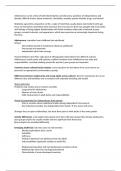
566 Midterm Study Guide (PHARMACOLOGY)
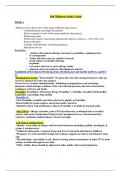
-Things to know about each of the major antibiotic drug classes • Contraindications and high-risk patients • Know examples of each of the major antibiotic drug classes • Monitoring needs • Which ones require renal dosing adjustments and how much (i.e., 25%, 50%, etc.) • Patient education • Lifespan considerations including pregnancy • Indications for use Penicillins • caution with patients allergic reactions to penicillins, cephalosporins, or carbapenems • Treats infection cause by sensitive bacteria check culture to identify infecting organism • Can order skin test to assess allergy status • adjusted doses for patients with impaired renal fnx NARROW SPECTRUM PENICILLINS: PENICILLIN SENSITIVE(PEN G &PEN V) -Mechanism of Action: “Bactericidal”- Weakens the cell wall, causing bacteria to take up excessive amounts of water and rupture. Occurs by two actions simultaneously: inhibiting transpeptidases and activating autolysins which disrupts synthesis of the cell wall and promotes the active destruction resulting in cell lysis and death. -Examples: Penicillin G (Prototype Drug), Penicillin V, Nafcillin, Oxacillin, Dicloxacillin, Ampicillin, Amoxicillin, Piperacillin Penicillin G- -First Penicillin Available and often referred to plainly as Penicillin -Bactericidal for gram negative and gram positive bacteria -Should be taken with medications whereas Penicillin V is stable in stomach acids. -Side Effects: Allergic reactions, pain at IM injection sites, prolonged (but reversible) sensory and motor dysfunction if injected into peripheral nerves, and neurotoxicity (seizures, confusion, hallucinations- if levels too high) . -Life Span Considerations: *Infants- Used safely in infants with bacterial infections including syphilis, meningitis, & group A streptococcus *Children/Adolescents- Common drug used to treat bacterial infections in children. *Pregnant- No well controlled studies but evidence suggests no 2nd or 3rd trimester fetal risk. *Breastfeeding- Amoxicillin is safe. Data is lacking about transmission of other PCNs from mother to infant through breast milk. *Older Adults- Doses should be adjusted in older adults with renal dysfunction. Penicillin Allergy: -Most common drug allergy to date with severity ranging from minor rash to anaphylaxis -Can possibly display cross sensitivity to cephalosporins and should not be used if possible -observed 30 minutes minimum post drug injection for adverse reactions -For history of PCN allergy, a skin allergy test can be done to assess current risk by injecting a tiny amount of allergen ID (only to be done where epinephrine and respiratory support is available if needed) Penicillin V- • Stable in stomach acid (Pen G is not) • Used for oral therapy, can be taken with meals NARROW SPECTRUM PENICILLIN: PENICILLIN RESISTANT: (Nafcillin, Oxacillin, Dicloxacillin) -Treats S. aureus and S. epidermidis Broad-Spectrum Penicillins (Ampicillin & Amoxicillin): -Most common side effects are rash and diarrhea (rash usually 3-10 days post TX start). -Therapy can be PO or IV and requires dosage adjustment for renal impairment -Treats Haemophilus influenzae, E. Coli, proteus mirabilis, enterococci, and Neisseria gonorrhoeae EXTENDED SPECTRUM PENICILLIN: (Piperacillin) -Treats same diseases as broad spectrum PLUS: *pseudomonas aeruginosa*, enterobacter spp, proteus, bacteroides fragilis, klebsiella spp -Can cause bleeding secondary to disrupting platelet function -Usually administered IV -Reduce dose in renal pt’s Cephalosporins (Cephalexin) -Bactericidal drug (similar to PCNs) -Increases activity against gram-negative agents -Increases ability to reach cerebral spinal fluid (CSF)-3rd,4th,5th generations -no routine lab monitoring -Administered IM or IV -Take cultures to determine sensitivity and infecting organism -Contraindicated in pt’s with severe allergic reaction to cephalosporins or penicillins - CAN CAUSE C. DIFF INFECTION (tell pt. To monitor for frequent stools) -Used to treat infants & neonates. Especially in otitis media and gonococcal and pneumococcal infections -Adverse Effects: Maculopapular rash, bronchospasm, anaphylaxis -Education: Patients should not consume alcohol First generation: tx’s staphylococci or streptococci Cefadroxil, Cefazolin, Cephalexin Second generation: TX’s H. Influenza, Klebsiella, pneumococci, staphylococci Cefaclor, Cefotetan, Cefoxitin, Cefurozime Third generation: tx’s pseudomonas aeruginosa, Neisseria gonorrhoeae, Klebsiella, Serratia Cefdinir, Cefotaxime, Cefpodoxime, Ceftazidime, Ceftriaxone Fourth generation: Pseudomonas aeruginosa Cefepine, Ceftolozane/tazobactam Fifth generation: Methicillin resistant Staphylococcus aureus Ceftaroline Carbapenems (Imipenem) -Patients on valproate for seizures not to give -Avoid in renal impairment pts -Adverse effects: N/V/D, seizures (rare), rashes, pruritus Vancomycin -Used for C. Diff infection -Treats S. Aureus and S. epidermidis, and MRSA -Monitor Vanco drug levels -Use caution in pt’s with renal impairment Telavancin -Black Box Warning: when used to tx hospital acquire or ventilator-associated bacterial pneumonia with creatinine clearance of less thn 50 ml/min, increased chance of mortality. Not safe in pregnancy Aztreonam -Adverse effects: pain & thrombophlebitis at injection site USES: -treats gram negative bacteria: E. Coli, salmonella, Shigella, Serratia, Klebsiellam Proteus, H. influenza, P. aeruginosa Fosfomycin -Single dose therapy in women with uncomplicated UTI -Adverse effects: diarrhea, headache, vaginitis, nausea, abdominal pain, rhinitis, drowsiness, dizziness, rash Tetracyclines (Tetracycline) -Broad spectrum bacteriostatic -Contraindication/Precautions: - After the 4th month of pregnancy can stain deciduous teeth and stain permanent teeth of children ages of 4 month and 8 years - If given to treat an STD, abstain from intercourse until med is finished. o Food decreases absorption • Complications o GI discomfort (cramping, nausea, diarrhea, and esophageal ulceration) § Taking Doxycycline and Minocycline with meals will with GI discomfort BUT food will reduce absorption. § Avoid taking at bedtime to reduce the risk of esophageal ulceration. o Yellow/Brown tooth discoloration, Hypoplasia of tooth enamel, Effects on bones § Avoid in children younger than 8 and women who are pregnant. § Can suppress the growth of long bones in premature infants. o Hepatoxicity (lethargy, jaundice) § Avoid high daily doses IV. § Fatty infiltration of the liver o Photosensitivity (exaggerated sunburn) § Use sunscreen with an SPF 30 or higher. o Superinfection of the Bowel § C-diff associated diarrhea AKA antibiotic-associated pseudomembranous colitis. D/C med immediately § Yeast infections of the mouth, pharynx, vagina o Dizziness. Lightheadedness (Minocycline) o Renal Toxicity ..................................................................................................CONTINUE.
Written for
- Institution
-
Chamberlain College Of Nursing
- Course
-
NR 566 / NR566
Document information
- Uploaded on
- August 4, 2023
- Number of pages
- 34
- Written in
- 2023/2024
- Type
- Exam (elaborations)
- Contains
- Questions & answers
Subjects
- anaphylaxis
- thrombophlebitis
-
broad spectrum bacteriostatic

Also available in package deal