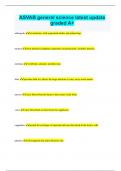
ASVAB general science latest update graded A+
ASVAB general science latest update graded A+ arthropods invertebrates with segmented bodies and jointed legs monera most primitive kingdom; organisms are prokaryotic; includes bacteria chordata vertebrates animals; includes man fiber provides bulk w/c allows the large intestine to carry away waste matter arteries carry blood from the heart to the tissues of the body veins carry blood back to heart from the cappilaries cappilaries permit the exchange of materials between the blood & the body's cells platelets cell fragment that allow blood to clot lipase changes fats to glycerol and fatty acids pancreatic amylase breaks down complex carbohydrates into simple sugar; helps digest starchy foods trypsin converts polypeptides into amino acid bile produced by the liver aids in the physical digestion of emulsifying fat cerebellum concerned with the mascular coordination of the brain medulla connection between the brain and the spinal cord; controls involuntary actions spinal cord carry impulses; control center for many simple reflexes somatic nervous system part of the peripheral nervous system; sending sensory information; controls voluntary actions autonomic nervous system part of the peripheral nervous system; regulates involuntary activities meiosis process by which gametes are created protista simplest eukaryotes (cells have nuclei) ex: slime, water slime molds fungi decomposers (saprothrops) ; includes mushrooms ecology study of interrelationships between organisms & their physical surroundings biosphere zone of planet earth where life naturally occurs, including land, water & air biome species bound together by similar climate, vegetation & animal life ecosystem system made up of a community of animals, plants as well as the non-living geology deals with the history and composition of the earth and its life outer core 2,300 km thick liquid inner core 1,200 km radius solid richter scale use to measure the intensity of the earthquake igneous rock formed from hardening of molten rock or magma, w/c is called lava when reaches the surface of the earth ex: granite, pumice, basalt, obsidian sedimentary rock formed by sedimentation or gradual depositing of small bits of rock, clay & other materials ex: shale, sandstone, gypsum, dolomite, coal metamorphic rock formed when existing rock material is altered through temperature, pressure, or chemical processes ex: marble, slate, gneiss, quartzite precambrian eon period before the fossil record began meteorology study of weather, atmosphere, & atmospheric phenomena troposphere lowest level of the atmosphere where all weather takes place. here found the 79% nitrogen & 21% oxygen stratosphere above troposphere and jet stream where airflow is mostly horizontal; here found the ozone layer; 60 degrees celcius ozone layer absorbs ultraviolet radiation from the sun mesosphere above the stratosphere where we see "falling stars", meteors that fall to the earth & burn up in the atmosphere; 90 degrees celcius thermosphere outermost layer of the earth; above mesosphere; 2000 degrees celcius at its upper limit sun classified as a "G2V star" or "yellow dwarf" asteroids a.k.a. "meteoroids", when they fall into the earth's gravitational field, they are seen as falling stars called "meteors" comets sometimes called dirty snowballs or icy mudballs volume measurement of three-dimensional space physics deals with the properties, changes & interactions of matter & energy work force exerted on an object times the distance moved in the direction of the force newton unit of force joule unit of work power rate at which work is performed watt unit of power newton's first law of motion an object at rest tends to stay at rest, an object in motion tends to stay in motion unless acted upon by an unbalanced force friction force that resists relative motion between two bodies in contact newton's second law of motion "law of inertia" the greater the mass, the greater the force needed to overcome its inertia newtons' third law of motion for every action, there is an equal and opposite reaction newton's law of gravitation all objects in the universe attract each other w/an equal force that varies directly as a product of their masses. this force is known as "gravity" sound waves produced when an object vibrates, disturbing the medium around it doppler effect occurs when either the source of the sound waves, the listener, or both are moving gamma rays most active radiant energy refractive index ratio by which light is slowed down law of reflection angle of incidence is equal to the angle of reflection concave mirror converging mirror convex mirror diverging mirror concave lens one that is thicker on the edges than it is in the middle; also called "diverging lens" convex lens one that is thicker in the middle than on the edges; also called "converging lens" conduction simplest method of heat transfer; it is accomplished by direct contact such as placing your finger on a hot iron convection transfer of heat unevenly in a liquid or gas, lowering the density of the heated liquid or gas, w/c causes it to rise & the cooler liquid or gas to fall radiation occurs when electromagnetic waves transmit heat, the heat we get from the sun is called like this element a substance that cannot be separated into different substances by ordinary chemical methods atom smallest component of an element that still retains the properties of the element molecule smallest particle of an element or compound that can exist in the free state & still retains the characteristic of an element or compound acid substance that gives up positively charged hydrogen ions(H+) when dissolved in water ex: vinegar, lemon juice base substance that gives up negative charged hydroxyl ions(OH-) when dissolved in water. tastes bitter ex: soap, baking soda pH number from 0 to 14. less than 7 are "acidic" greater then 7 are "basic" sublimation the process by which a solid converts directly into a gas; example of endothermic change heat can be described as a from of energy silver best conductor of heat group in the periodic elements, it defines the number of outer electrons found in the atoms of its element cold front when a cold air mass meets and replaces the warm air mass alveoli this is where the blood receives oxygen during the process of respiration cellulose main difference between plant and animal cell, component of the cell wall of plants lithosphere where you can find 30 plates of continental landmasses, a rigid layer made up of the uppermost part of the mantle and the crust ionosphere The lower part of the thermosphere, where electrically charged particles called ions are found. thin layer of ozone that reflects 27 1/2 days moon completes an entire revolution around the earth point of absolute zero coldest point at w/c all matter stop moving decomposition occurs when hydrogen peroxide is broken down into separate elements halley's comet composed mostly of ice & rocks biofact object found at an archaeological site signifying that it was once a living organism tundra coldest; has treeless plains as the ground is frozen taiga below the tundra; it has short & moist summer but long & dry winter; mostly evergreen trees can survive in this climate deciduous forests have a moderate climate where tress shed their leaves every year grasslands more grass than tress beacuse rainfall is not enough tropical rainforests located near the equator when the sun strikes directly; it has a lots of rainfall; trees have thick leaves marine aquatic environment is the largest biome; covers 3/4 of the entire earth phylum porifera (sponges) porous marine animals that lack a bony structure phylum coelanterata more complex than sponges; ex: jellyfish, coral phylum platyhelminthes (flatworms) have organs:; ex: tapeworm phylum nematoda (roundworms) parasites that contain digestive tracts with two openings ex: hookworm phylum annelida long, round & segmented; ex: earthworm phylum mollusca (mollusks) soft-bodied animals protected by a hard covering phylum echinodermata spiny marine animals that have five or more legs branching out into radial symmetry; ex: starfish systolic contraction stage diastolic rest stage pulmonary artery the only artery that doesnt carry oxygenated blood diffusion happens when oxygen and nutrients are transferred from the blood tothe cells estrogen produced by the ovaries light year used to measure distance magnifying lens you can use this to start a fire with the aid of the sun alcohol substance that is readily absorbed through the walls of the stomach methane what will be loss if the aeration of water will produced CO2 correct formula for dry ice renal system urine system; responsible for filtering out impurities from the blood & excreting them refraction the bending of a wave caused by a change in its speed as it moves from one medium to another nucleotides smaller parts of nucleic acid commensalism the relation between two different kinds of organisms when one receives benefits from the other without damaging it angiosperm produces flowers catalysts substance that hasten chemical reaction time without themselves undergoing change anemometer measures the wind speed endocrine system responsible for releasing hormones into the blood stream
Written for
- Institution
- ASVAB general science
- Course
- ASVAB general science
Document information
- Uploaded on
- August 4, 2023
- Number of pages
- 16
- Written in
- 2023/2024
- Type
- Exam (elaborations)
- Contains
- Questions & answers
Subjects
-
asvab general science latest update graded a

Also available in package deal