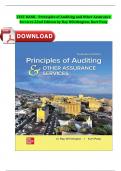
TEST BANK For Principles of Auditing and Other Assurance Services 22nd Edition By Ray Whittington & Kurt Pany
Your client left the cash receipts journal open after year-end for an extra day and included January 1 cash receipts in the 12/31/XX totals. All of those cash receipts were due to cash sales. Assuming the client uses a periodic inventory system with a 12/31/XX count of the physical inventory, which of the following is most likely to be true relating to the year XX financial statements? A) Sales are understated. B) Accounts receivable are understated. C) Inventory is overstated. D) Net income is overstated. 8) An internal control questionnaire indicates that an approved receiving report is required to accompany every check request for payment of merchandise. Which of the following procedures provides the best evidence on operating effectiveness? A) Select and examine receiving reports and test whether the related canceled checks are dated no earlier than the receiving reports. B) Select and examine receiving reports and test whether the related canceled checks are dated no later than the receiving reports. C) Select and examine canceled checks and test whether the related receiving reports are dated no earlier than the checks. D) Select and examine canceled checks and test whether the related receiving reports are dated no later than the checks. Version 1 249 9) By preparing a four-column bank reconciliation ("proof of cash") at year-end, an auditor will generally not be able to detect: A) An unrecorded deposit made at the bank at the end of the month. B) A second payment of an account payable which had already been paid in full two months earlier. C) An unrecorded check cashed during that month. D) A bank charge during the month not recorded on the books. 10) Which procedure is an auditor most likely to use to detect a check outstanding at yearend that was not recorded as outstanding on the year-end bank reconciliation? A) Prepare a bank transfer schedule using the client's cash receipts and cash disbursements journal. B) Receive a cutoff bank statement directly from the client's bank. C) Prepare a four column bank reconciliation using the year-end bank statement. D) Confirm the year-end balance using the standard form to confirm account balance information with financial institutions. 11) An auditor may obtain information on the December 31 month-end balance per bank in which of the following? Standard Confirmation Form January 1 to 10 Cutoff Statement A. Yes Yes B. Yes No C. No Yes D. No No Version 1 250 A) Option A B) Option B C) Option C D) Option D 12) An auditor may obtain information on the December 31 month-end balance per bank in which of the following? December 31 Bank Statement Schedule of Bank (Cash) Transfers A. Yes Yes B. Yes No C. No Yes D. No No A) Option A B) Option B C) Option C D) Option D 13) Which of the following is correct concerning "window dressing" for cash? A) A segregation of duties within the cash function effectively eliminates its occurrence. B) It generally involves manipulation of inventory. C) It is illegal, and an audit is designed to provide reasonable assurance of its detection. D) It may increase but not falsify cash position. 14) Which of the following statements is not correct? Version 1 251 A) Cash is important to the audit process because of its vulnerability to misappropriation, despite the fact that the balance at the balance sheet date may be immaterial. B) Payroll cash account balances kept on an imprest basis are more easily controlled than others not so kept. C) Confirmation of cash should only be performed as of the balance sheet date because the auditor expresses an opinion as of that date. D) Reviewing interbank transfers is important to the auditor because of the possibility that the client may be engaged in kiting. 15) The auditors use a bank cutoff statement to compare: A) Deposits in transit on the year-end cash general ledger account to deposits in the cash receipts journal. B) Checks dated prior to year-end to the outstanding checks listed on the year-end bank reconciliation. C) Deposits listed on the cutoff statement to disbursements in the cash disbursements journal. D) Checks dated subsequent to year-end to the outstanding checks listed on the year-end bank statement. 16) A practical and effective audit procedure for the detection of lapping is: A) Preparing an interbank transfer schedule. B) Comparing recorded cash receipts in detail against items making up the bank deposit as shown on duplicate deposit slips validated by the bank. C) Tracing recorded cash receipts to postings in customers' ledger cards. D) Preparing a proof of cash. 17) Which of the following is not a control that generally is established over cash transactions? Version 1 252 A) Separating cash handling from recordkeeping. B) Centralizing the receipt of cash. C) Depositing each day's receipts intact. D) Obtaining a receipt for every disbursement. 18) Which of the following controls would be most likely to reduce the risk of diversion of customer receipts by a company's employees? A) A bank lockbox system. B) Approval of all disbursements by an individual independent of cash receipts. C) Monthly bank cutoff statements. D) Prenumbered remittance advices. 19) Which of the following is not a control that generally is established over cash receipts? A) To prevent abstraction of cash, a control listing of cash receipts should be prepared by mailroom personnel. B) To ensure accurate posting, the accounts receivable clerk should post the customers' receipts from customers' checks. C) To ensure accuracy of the accounts receivable records, the records should be reconciled monthly to the accounts receivable controlling account. D) To prevent theft of cash, receipts should be deposited daily. 20) By preparing a four-column bank reconciliation ("proof of cash") for the last month of the year, an auditor will generally be able to detect: Version 1 253 A) An unrecorded check written at the beginning of the month which was cashed during the period covered by the reconciliation. B) A cash sale whichwas not recorded on the books and wasstolen by a bookkeeper. C) An embezzlement of unrecorded cash receipts on receivables before they had been deposited into the bank. D) A credit sale which has been recorded twice in the sales journal. 21) In November, two months before year-end, the bookkeeper erroneously recorded the receipt of a one year bank loan with a debit to cash and a credit to interest revenue. The most effective method for detecting this type of error is: A) Foot the cash receipts journal for November. B) Send a bank confirmation as of year-end. C) Prepare a bank reconciliation as of year-end. D) Prepare a bank transfer schedule as of year-end. 22) Anderson embezzled $20,000 from her company's account in Bank X. At year-end, she hid the shortage by making a deposit on December 31 in Bank X, drawn on Bank Y. She has not recorded the transaction on the books. This is an example of: A) Lapping. B) Kiting. C) Effective cash management. D) Related party transactions. 23) Anderson embezzled $20,000 from her company's account in Bank X. At year-end, she hid the shortage by making a deposit on December 31 in Bank X, drawn on Bank Y. She has not recorded the transaction on the books. Which of the following is most likely to be effective in detecting this fraud? Version 1 254 A) Bank confirmation. B) Bank transfer schedule prepared using only the cash receipts and cash disbursements journals. C) Comparison of bank cutoff statement to the cash receipts and disbursements records. D) Receivable confirmation. 24) Which of the following is not a universal rule for achieving internal control over cash? A) Separate recordkeeping from accounting for cash to the extent possible. B) Deposit each day's cash receipts intact. C) Separate cash handling from recordkeeping. D) Have monthly bank reconciliations prepared by employees not responsible for the issuance of checks. 25) Which of the following is not a control over cash disbursements? A) Disbursements should be made by check. B) A check protecting machine should be used. C) Documents supporting the payment of a disbursement should be canceled by the person preparing the check to prevent reuse. D) Voided checks should be defaced and filed with paid checks. 26) Which of the following is the best audit procedure for the detection of lapping? A) Comparison of postings of cash receipts to accounts with the details of cash deposits. B) Confirmation of the cash balance. C) Reconciliation of the cash account balances. D) Preparing a proof of cash. Version 1 255 27) Which of the following manipulations of cash transactions would overstate the cash balance on the financial statements? A) Understatement of outstanding checks. B) Overstatement of outstanding checks. C) Understatement of deposits in transit. D) Overstatement of bank services charges. 28) Which of the following is not confirmed on the standard confirmation form used for cash balances at financial institutions? A) Cash checking account balances. B) Cash savings account balances. C) Loans payable. D) Securities held for the client by the financial institution. 29) Internal control over marketable securities is enhanced when: A) Securities are held by the cashier. B) Securities are registered in the name of the custodian. C) Detailed records of securities are maintained by the custodian of the securities. D) Custody of securities is maintained by a stockbroker or bank. 30) Which one of the following audit procedures would give the least assurance of the existence of investment in stocks and bonds account at the audit date? Version 1 256 A) Confirmation from the broker. B) Inspection of year-end brokers' statements. C) Vouching all changes during the year to brokers' advises and statements. D) Examination of paid checks issued in payment of securities purchased. 31) The Standard Form to Confirm Account Balances with Financial Institutions includes information on all of the following except: A) Date due of a direct liability. B) The principal amount paid on a direct liability. C) Description of collateral for a direct liability. D) The interest rate of a direct liability. 32) The auditors should insist that a representative of the client be present during the physical examination of securities in order to: A) Lend authority of the auditor's directives. B) Detect forged securities. C) Coordinate the return of all securities to proper locations. D) Acknowledge the receipt of securities returned. 33) The auditors' count of the client's cash should be coordinated to coincide with the: A) Consideration of the internal controls with respect to cash. B) Close of business on the balance sheet date. C) Count of investment securities. D) Count of inventories. Version 1 257 34) The auditors compare information on canceled checks with information contained in the cash disbursement journal. The objective of this test is to determine that: A) Recorded cash disbursement transactions are properly authorized. B) Proper cash purchase discounts have been recorded. C) Cash disbursements are for goods and services actually received. D) No discrepancies exist between the data on the checks and the data in the journal. 35) Garcia was engaged to audit the financial statements of Delta Corporation for the year ended September 30, 20X0. Having completed an examination of the investment securities, which of the following is the best method of verifying the accuracy of recorded dividend income? A) Tracing recorded dividend income to cash receipts records and validated deposit slips. B) Utilizing analytical techniques and statistical sampling. C) Comparing recorded dividends with amounts appearing on federal information form 1099s. D) Comparing recorded dividends with a standard financial reporting service's record of dividends. 36) Which of the following is one of the better auditing techniques that might be used by an auditor to detect kiting? A) Review composition of authenticated deposit slips. B) Review subsequent bank statements and canceled checks received directly from the banks. C) Prepare a schedule of bank transfers. D) Prepare year-end bank reconciliations. Version 1 258 37) Which one of the following would the auditor consider to be an incompatible operation if the cashier receives remittances from the mailroom? A) The cashier prepares the daily deposit. B) The cashier makes the daily deposit at a local bank. C) The cashier posts the receipts to the accounts receivable subsidiary ledger. D) The cashier endorses the checks. 38) As one of the year-end audit procedures, the auditor instructed the client's personnel to prepare a confirmation request for a bank account that had been closed during the year. After the client's treasurer has signed the request, it was mailed by the assistant treasurer. What is the major flaw in this audit procedure? A) The confirmation request was signed by the treasurer. B) Sending the request was meaningless because the account was closed before the year-end. C) The request was mailed by the assistant treasurer. D) The Certified Public Accountant (CPA) did not sign the confirmation request before it was mailed. 39) On receiving the bank cutoff statement, the auditor should trace: A) Deposits in transit on the year-end bank reconciliation to deposits in the cash receipts journal. B) Checks dated prior to year-end to the outstanding checks listed on the year-end bank reconciliation. C) Deposits listed on the cutoff statement to deposits in the cash receipts journal. D) Checks dated subsequent to year-end to the outstanding checks listed on the year-end bank reconciliation. Version 1 259 40) To gather evidence regarding the balance per bank in a bank reconciliation, an auditor could examine all of the following except: A) Cutoff bank statement. B) Year-end bank statement. C) Bank confirmation. D) General ledger.
Connected book
Written for
- Institution
- Principles of Auditing and Other Assurance Service
- Course
- Principles of Auditing and Other Assurance Service
Document information
- Uploaded on
- August 4, 2023
- Number of pages
- 513
- Written in
- 2023/2024
- Type
- Exam (elaborations)
- Contains
- Questions & answers
Subjects
- principles of auditing
- ray whittington
- kurt pany
-
principles of auditing and other assurance service
-
complete 20232024
-
test bank for principles of auditing
-
test bank for principles of auditing and ot