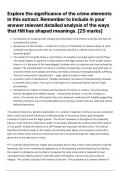
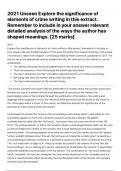
Explore the significance of the crime elements
in this extract. Remember to include in your
answer relevant detailed analysis of the ways
that Hill has shaped meanings. [25 marks]
Construction of suspense and missing out information (what Keyes looks like and how he
committed the crime).
Appearance of the criminal – Lombrosoʼs Theory of Criminality. Introduces ideas of what
criminals look like and who they are. Does Keyes look like a criminal is that why he is
assumed guilty?
The verdict of not guilty being a commentary of societies own legal system and its flaws.
The reader begins to question to what extent is the legal system fair. Is the verdict really a
shock or is it because of the homodiegetic focaliser who is a reporter who has mislead the
reader? The sensationalism of crime is a further commentary on society and what type of
a society breeds such people and enjoy and make a living out of people peoples suffering.
They are compared to “greyhounds” – dogs ready to jump on fresh meat.
A primary crime is introduced of ‘Hindley and Bradyʼ and idea of criminals being released
to commit more crimes. The type of crime genre of ‘courtroom dramaʼ and the ‘legal
proceedingsʼ.
Introduction of victims of crimes and the impact of crimes on victims. The crime being
that he strangled three elderly women – we question whether or not this is better or
worse. The women are old however they also represent weakness and fragility suggesting
that this criminal is even more despicable as he chooses victims who are weak and cannot
defend themselves.
The extract presents a dynamic exploration of a variety of aspects of crime as we are presented
with a court case which introduces conflicting ideas of innocence versus guilt alongside
concepts of justice and the legal system. The extract misleads us throughout into expecting
Keyes a “man innocent until proven guilty” to be guilty, although the verdict determines that he
is “not guilty” ending the extract on a cliff-hanger and surprised narrative twist. This extract
therefore introduces ideas to the reader surrounding what allows us to assume a characters
guilt, the effect of the crime on victims and the role of society through the ‘legal-proceedingʼ
genre and crime reporters in crime.
H P Lovecraft stated that the “oldest and strongest kind of fear is fear of the unknown” and Hill
harnesses this in not revealing the appearance of the assumed criminal Keyes but by leaving
the reader in anticipation and a state of suspense for what a man who is believed to have
“strangled three elderly women” looks like which the reporter cannot even look at due to
disgust: “He couldnʼt actually look at Keyes at all now”. This suspense is a common theme of
in this extract. Remember to include in your
answer relevant detailed analysis of the ways
that Hill has shaped meanings. [25 marks]
Construction of suspense and missing out information (what Keyes looks like and how he
committed the crime).
Appearance of the criminal – Lombrosoʼs Theory of Criminality. Introduces ideas of what
criminals look like and who they are. Does Keyes look like a criminal is that why he is
assumed guilty?
The verdict of not guilty being a commentary of societies own legal system and its flaws.
The reader begins to question to what extent is the legal system fair. Is the verdict really a
shock or is it because of the homodiegetic focaliser who is a reporter who has mislead the
reader? The sensationalism of crime is a further commentary on society and what type of
a society breeds such people and enjoy and make a living out of people peoples suffering.
They are compared to “greyhounds” – dogs ready to jump on fresh meat.
A primary crime is introduced of ‘Hindley and Bradyʼ and idea of criminals being released
to commit more crimes. The type of crime genre of ‘courtroom dramaʼ and the ‘legal
proceedingsʼ.
Introduction of victims of crimes and the impact of crimes on victims. The crime being
that he strangled three elderly women – we question whether or not this is better or
worse. The women are old however they also represent weakness and fragility suggesting
that this criminal is even more despicable as he chooses victims who are weak and cannot
defend themselves.
The extract presents a dynamic exploration of a variety of aspects of crime as we are presented
with a court case which introduces conflicting ideas of innocence versus guilt alongside
concepts of justice and the legal system. The extract misleads us throughout into expecting
Keyes a “man innocent until proven guilty” to be guilty, although the verdict determines that he
is “not guilty” ending the extract on a cliff-hanger and surprised narrative twist. This extract
therefore introduces ideas to the reader surrounding what allows us to assume a characters
guilt, the effect of the crime on victims and the role of society through the ‘legal-proceedingʼ
genre and crime reporters in crime.
H P Lovecraft stated that the “oldest and strongest kind of fear is fear of the unknown” and Hill
harnesses this in not revealing the appearance of the assumed criminal Keyes but by leaving
the reader in anticipation and a state of suspense for what a man who is believed to have
“strangled three elderly women” looks like which the reporter cannot even look at due to
disgust: “He couldnʼt actually look at Keyes at all now”. This suspense is a common theme of