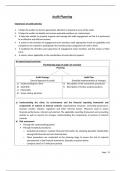
Audit Planning
Importance of audit planning
1. It helps the auditor to devote appropriate attention to important areas of the audit.
2. It helps the auditor to identify and resolve potential problems on a timely basis.
3. It helps the auditor to properly organise and manage the audit engagement so that it is performed
in an effective and efficient manner.
4. It assists in the selection of engagement team members with appropriate levels of capabilities and
competence to respond to anticipated risks and the proper assignment of work to them.
5. It facilitates the direction and supervision of engagement team members and the review of their
work.
6. It assists, where applicable, in the coordination of work done by experts
An exam focused overview
The Planning stage of audit- An overview
Planning
Audit Strategy Audit Plan
(Overall approach to audit) (Detailed implementation of strategy)
a) Understanding the client e) Description of risk assessment procedures
b) Audit Risk f) Description of further audit procedures
c) Materiality
d) Scope, timing, direction
a) Understanding the client, its environment and the financial reporting framework and
components of systems of internal controls: organizational structure, ownership governance,
business models, industry, regulatory and other external factors. Measures used to assess
financial performance, internal and external. The applicable reporting framework and accounting
policies as well as reasons for changes. Understanding the components of systems of internal
controls.
b) Risk assessment
Through the understanding gained
Through Analytical procedures.
o Analytical procedures: evaluate financial information by analysing plausible relationships
among both financial and non-financial data.
o These procedures are conducted at the planning stage to assess the risk of material
misstatement in the financial statements. Examples are given below.
- Compare client’s F/S with prior periods
Page | 39
, - Compare client’s F/S with budgets/forecasts
- Compare client’s F/S with similar industry information ( sales to accounts receivable ratio)
- Compare client’s F/S with auditor’s own expectations ( proof in total)
- Evaluate relationships among elements of F/S that are expected to have a predictable
pattern based on client’s previous experience
- Evaluate relationship between financial and non-financial data ( payroll cost to number of
employees, revenue to sales volume)
Explanation of the term Audit Risk
Audit Risk: Is the risk that the auditor might give an incorrect opinion when the F/S are materially
misstated. Audit Risk has two components ( Risk of material misstatement in F/S and Detection Risk)
Audit Risk
Risk of material misstatement in the F/S Detection Risk
(Risk that the F/S might be materially misstated before ( risk that the auditor’s procedures will
the audit) not detect misstatements in the F/S)
Inherent Risk Control Risk Possible reasons for high detection risk
include:
( Risk that a class of ( risk that a material
transaction/account misstatement in a class of - inadequate planning
balance/disclosure is transaction/account - audit team related issues
misstated before balance/disclosure will not be - lack of professional scepticism
considering any prevented/detected/corrected - inadequate supervision and review
controls) by the client’s internal control of work
because controls are not - incorrect audit procedures
designed or implemented - improper sample selection
properly)
Important: If risk of material misstatements in financial statement is high, the auditor will need to
reduce detection risk in order to decrease audit risk.
c) Materiality: Misstatements, including omissions, are considered material if they are expected to
influence the economic decisions of users taken on the basis of the financial statements.
Auditor’s determination of materiality is a matter of professional judgment.
Material by amount for F/S as a whole: The exam: 5% of PBT, 1% of Total Assets, 0.5% of
Revenue
Page | 40
, Material by nature: related party transactions, Bank, items which affect debt covenants.
Items which affect statutory items ect.)
Materiality may be revised at a later stage in audit ( for example if auditor gets new
information, or if there is a change in auditor’s understanding of the client)
Performance materiality ( should be lower than the overall materiality level) The amount of
performance materiality is considered necessary to reduce to an appropriately low level the
probability that the aggregate of uncorrected and undetected misstatements is greater than
materiality.
Important: Risk and materiality are inversely proportional!
d) Scope:
locations/branches
financial reporting framework
any industry specific regulation that apply
need of experts
reliance on internal auditor’s work
use of service org by client (outsourced functions)
use of computer aided audit techniques (CAATs) by the auditor
Timing:
reporting deadlines
meetings with the management/TCWG
expected communication with the management
team meetings
review of audit work by audit partner.
Direction:
Controls plus substantive or mainly substantive (to be explained later)
Page | 41
Importance of audit planning
1. It helps the auditor to devote appropriate attention to important areas of the audit.
2. It helps the auditor to identify and resolve potential problems on a timely basis.
3. It helps the auditor to properly organise and manage the audit engagement so that it is performed
in an effective and efficient manner.
4. It assists in the selection of engagement team members with appropriate levels of capabilities and
competence to respond to anticipated risks and the proper assignment of work to them.
5. It facilitates the direction and supervision of engagement team members and the review of their
work.
6. It assists, where applicable, in the coordination of work done by experts
An exam focused overview
The Planning stage of audit- An overview
Planning
Audit Strategy Audit Plan
(Overall approach to audit) (Detailed implementation of strategy)
a) Understanding the client e) Description of risk assessment procedures
b) Audit Risk f) Description of further audit procedures
c) Materiality
d) Scope, timing, direction
a) Understanding the client, its environment and the financial reporting framework and
components of systems of internal controls: organizational structure, ownership governance,
business models, industry, regulatory and other external factors. Measures used to assess
financial performance, internal and external. The applicable reporting framework and accounting
policies as well as reasons for changes. Understanding the components of systems of internal
controls.
b) Risk assessment
Through the understanding gained
Through Analytical procedures.
o Analytical procedures: evaluate financial information by analysing plausible relationships
among both financial and non-financial data.
o These procedures are conducted at the planning stage to assess the risk of material
misstatement in the financial statements. Examples are given below.
- Compare client’s F/S with prior periods
Page | 39
, - Compare client’s F/S with budgets/forecasts
- Compare client’s F/S with similar industry information ( sales to accounts receivable ratio)
- Compare client’s F/S with auditor’s own expectations ( proof in total)
- Evaluate relationships among elements of F/S that are expected to have a predictable
pattern based on client’s previous experience
- Evaluate relationship between financial and non-financial data ( payroll cost to number of
employees, revenue to sales volume)
Explanation of the term Audit Risk
Audit Risk: Is the risk that the auditor might give an incorrect opinion when the F/S are materially
misstated. Audit Risk has two components ( Risk of material misstatement in F/S and Detection Risk)
Audit Risk
Risk of material misstatement in the F/S Detection Risk
(Risk that the F/S might be materially misstated before ( risk that the auditor’s procedures will
the audit) not detect misstatements in the F/S)
Inherent Risk Control Risk Possible reasons for high detection risk
include:
( Risk that a class of ( risk that a material
transaction/account misstatement in a class of - inadequate planning
balance/disclosure is transaction/account - audit team related issues
misstated before balance/disclosure will not be - lack of professional scepticism
considering any prevented/detected/corrected - inadequate supervision and review
controls) by the client’s internal control of work
because controls are not - incorrect audit procedures
designed or implemented - improper sample selection
properly)
Important: If risk of material misstatements in financial statement is high, the auditor will need to
reduce detection risk in order to decrease audit risk.
c) Materiality: Misstatements, including omissions, are considered material if they are expected to
influence the economic decisions of users taken on the basis of the financial statements.
Auditor’s determination of materiality is a matter of professional judgment.
Material by amount for F/S as a whole: The exam: 5% of PBT, 1% of Total Assets, 0.5% of
Revenue
Page | 40
, Material by nature: related party transactions, Bank, items which affect debt covenants.
Items which affect statutory items ect.)
Materiality may be revised at a later stage in audit ( for example if auditor gets new
information, or if there is a change in auditor’s understanding of the client)
Performance materiality ( should be lower than the overall materiality level) The amount of
performance materiality is considered necessary to reduce to an appropriately low level the
probability that the aggregate of uncorrected and undetected misstatements is greater than
materiality.
Important: Risk and materiality are inversely proportional!
d) Scope:
locations/branches
financial reporting framework
any industry specific regulation that apply
need of experts
reliance on internal auditor’s work
use of service org by client (outsourced functions)
use of computer aided audit techniques (CAATs) by the auditor
Timing:
reporting deadlines
meetings with the management/TCWG
expected communication with the management
team meetings
review of audit work by audit partner.
Direction:
Controls plus substantive or mainly substantive (to be explained later)
Page | 41