Audit Sampling
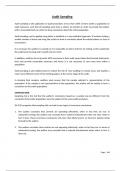
Audit sampling is the application of audit procedures to less than 100% of items within a population of
audit relevance, such that all sampling units have a chance of selection in order to provide the auditor
with a reasonable basis on which to draw conclusions about the entire population.
Audit sampling can be applied using either a statistical or a non-statistical approach. It involves testing a
smaller number of items and using the results to draw a conclusion about the whole balance or class of
transactions.
It is necessary for auditors to sample as it is impossible to select all items for testing as this would take
the audit team too long and it would cost too much.
In addition, auditors do not provide 100% assurance in their audit report about the financial statements,
they only provide reasonable assurance and hence it is not necessary to test every item within a
population.
Audit sampling is also widely known to reduce the risk of ‘over-auditing’ in certain areas, and enables a
much more efficient review of the working papers at the review stage of the audit.
In devising their samples, auditors must ensure that the sample selected is representative of the
population. If the sample is not representative of the population, the auditor will be unable to form a
conclusion on the entire population.
SAMPLING RISK
Sampling risk is the risk that the auditor’s conclusions based on a sample may be different from the
conclusion if the entire population were the subject of the same audit procedure.
ISA 530 recognises that sampling risk can lead to two types of erroneous conclusions:
1. The auditor concludes that controls are operating effectively, when in fact they are not. In
substantive testing, the auditor may conclude that a material misstatement does not exist, when in
fact it does. These erroneous conclusions will more than likely lead to an incorrect opinion being
formed by the auditor.
2. The auditor concludes that controls are not operating effectively, when in fact they are. In terms of
substantive testing, the auditor may conclude that a material misstatement exists when, in fact, it
does not.
Page | 164
Audit sampling is the application of audit procedures to less than 100% of items within a population of
audit relevance, such that all sampling units have a chance of selection in order to provide the auditor
with a reasonable basis on which to draw conclusions about the entire population.
Audit sampling can be applied using either a statistical or a non-statistical approach. It involves testing a
smaller number of items and using the results to draw a conclusion about the whole balance or class of
transactions.
It is necessary for auditors to sample as it is impossible to select all items for testing as this would take
the audit team too long and it would cost too much.
In addition, auditors do not provide 100% assurance in their audit report about the financial statements,
they only provide reasonable assurance and hence it is not necessary to test every item within a
population.
Audit sampling is also widely known to reduce the risk of ‘over-auditing’ in certain areas, and enables a
much more efficient review of the working papers at the review stage of the audit.
In devising their samples, auditors must ensure that the sample selected is representative of the
population. If the sample is not representative of the population, the auditor will be unable to form a
conclusion on the entire population.
SAMPLING RISK
Sampling risk is the risk that the auditor’s conclusions based on a sample may be different from the
conclusion if the entire population were the subject of the same audit procedure.
ISA 530 recognises that sampling risk can lead to two types of erroneous conclusions:
1. The auditor concludes that controls are operating effectively, when in fact they are not. In
substantive testing, the auditor may conclude that a material misstatement does not exist, when in
fact it does. These erroneous conclusions will more than likely lead to an incorrect opinion being
formed by the auditor.
2. The auditor concludes that controls are not operating effectively, when in fact they are. In terms of
substantive testing, the auditor may conclude that a material misstatement exists when, in fact, it
does not.
Page | 164