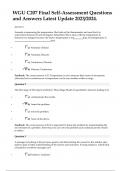
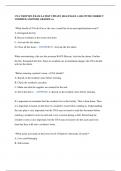
WGU C207 Final Self-Assessment Questions and Answers Latest Update 2023/2024.
WGU C207 Final Self-Assessment Questions and Answers Latest Update 2023/2024. Question 1 Amanda is measuring the temperature. She looks at the thermometer and sees that it is somewhere between 65 and 66 degrees Fahrenheit. She is okay with the temperature in between two integers because she knows temperature is not data, but temperature is data. • a) Nominal, Ordinal • b) Nominal, Discrete • c) Continuous, Discrete • d) Discrete, Continuous Feedback: The correct answer is D. Temperature is not a measure that comes in increments (discrete) but is continuous as a temperature can be any number within a range. Question 2 The first stage of Davenport and Kim's Three-Stage Model of quantitative decision making is to • a) communicate the results. • b) frame the problem. • c) solve the problem. • d) None of the above. Feedback: The correct answer is B. It is important to frame the problem by understanding the environment of a problem. After that, one can solve the problem and communicate the results to others. Question 3 A manager is looking at his previous quarter and determining the causes for the sudden sales spike to gain a better understanding of the actions and outcomes. If using analytics, which kind of analytics would the manager use? • a) Predictive Analytics • b) Prescriptive Analytics • c) Descriptive Analytics • d) Proactive Analytics Feedback: The correct answer is C. The manager should use descriptive analytics because it is used to describe the characteristics of what is being studied. In this situation, the previous quarter sales would be studied. Question 4 In a study of cancer treatments, the subjects and the treatment allocator (who is also the data gatherer) are unaware of which treatment is being given to which subject. This is a study. • a) Double-Blind • b) Triple-Blind • c) Information-biased • d) Response-biased Feedback: The correct answer is A. There are two layers being blinded in this study. If the treatment allocator and the data gatherer were different people, then this would be a tripleblind study. There is no stated bias. Question 5 Adam is measuring the temperature as the lake outside his office is freezing over. He measures the temperatures in Fahrenheit ten times with the same thermometer and gets the following results: 20, 21, 21, 20, 20, 19, 19, 21, 20, 19. Is his thermometer reliable? Is it valid? • a) Reliable and Valid • b) Reliable but not Valid • c) Not Reliable but Valid • d) Not Reliable or Valid Feedback: The correct answer is B. The thermometer consistently gives about the same number for the freezing point and therefore is reliable. It is not valid because it does not accurately measure what it is trying to measure. We know this because we know water freezes at 32 degrees Fahrenheit. Question 6 Toby is trying to determine the number of people at today's parade in order to determine the impact of advertising at parades. He asks a number of different people leaving the parade their projected number of attendants. He gets the following responses: 70,000; 450,000; 2,000; 130,000; 3,000,000; 75,000; 200,000; 800,000; 150,000; and 210,000. Is this survey reliable? Is it valid? • a) Reliable and Valid • b) Reliable but not Valid • c) Not Reliable but Valid • d) Not Reliable or Valid Feedback: The correct answer is D. The answers are not consistent and do not accurately measure the number of people. Therefore it is not reliable or valid. Question 7 Harry is doing a survey of the city of Los Angeles' population. He is wondering everyone's favorite food. He sends out a survey to all of the renters in the city and receives basically all of the surveys back in the mail. What is the flaw in this experiment? • a) Small Sample Size • b) Blinding • c) Truly Representative Sample • d) Association vs. Causation Feedback: The correct answer is C. This does not represent the entire population that Harry is concluding about as he did not get responses from the other samples such as homeowners in Los Angeles. Question 8 Tom Brady is on the street in Chicago. He is asking anyone he meets if they prefer Tom Brady or Peyton Manning. The survey results show that people greatly prefer Tom Brady. What is the flaw in this experiment? • a) Small Sample Size • b) Truly Representative Sample • c) Response Bias • d) Conscious Bias Feedback: The correct answer is C. It is response bias, as the respondents might be responding believing that Tom Brady wants to hear that they prefer him over Peyton Manning. This is not Conscious bias as conscious bias would be in the way Tom Brady is asking a question and this scenario does not indicate any bias in that way. Question 9 There is a 50 percent chance that the president will slip on a banana peel. Also, there is a 25 percent chance that the president will be hit in the face with an apple. There is a 10 percent chance that the president will slip on a banana peel and get hit in the face with an apple. What is the likelihood that the president has a run-in with at least one of these fruits? • a) 65% • b) 85% • c) 35% • d) 22.50% Feedback: The correct answer is A. This is a union between P(banana) and P(apple). Therefore, P(banana ∪ apple) =P(banana)+P(apple)−P(banana∩apple) =0.50+0.25−0.10=0.65=65% . The president will probably not have a great week. Question 10 There is a 20 percent chance that Charlie's company will merge with another company. If there is a merger, there is an 80 percent chance Charlie will have to fire three people from his team. There is a 15 percent chance Charlie will have to fire three people from his team no matter what. What is the likelihood there will be a merger, and Charlie will have to fire three people from his team? • a) 16% • b) 18% • c) 28% • d) 35% Feedback: The correct answer is A. The probability of a merger is 20 percent (P(merger)=0.20 ), and the probability of Charlie having to fire three people if there is a merger is 80 percent (P(fire∣∣merger)=0.80). Therefore to determine the likelihood of a merger and Charlie firing three people, these probabilities are multiplied together. Therefore P(merger∪fire)=P(merger)×P(fire∣∣merger)=0.20×0.80 =0.16=16% Question 11 The probability that Junkins Food launches a new product in November is 55%. The probability that the director of new products plans a vacation in November is 8.3%. If these events are independent, what is the probability that the director of new products is on vacation when a new product launches in November? • a) 4.6% • b) 14.6% • c) 46.7% • d) 63.3% Feedback: The correct answer is A. The two events are independent; therefore, the probability both happen is the product of the probability of each. 0.55×0.083=0.043 Question 12 Determine the Mean, Median, and Mode (in that order) from the following test results. 23, 54, 67, 71, 72, 74, 74, 75, 77, 77, 77, 78, 80, 81, 81, 83, 84, 86, 89, 89, 89, 89, 95, 99, 100 • a) 80, 78.56, 89 • b) 78.56, 80, 89 • c) 77, 78.56, 89 • d) 80, 81.12, 77 Feedback: The correct answer is B. The mean is 78.56 as it is the result of the sum of the numbers, 1964, divided by 25, the count of numbers. The median is 80 as it is the 13th number out of 25 ordered numbers. The mode is 89 as it shows up 4 times and no other data point shows up as many times.
Written for
- Institution
- C207
- Course
- C207
Document information
- Uploaded on
- July 31, 2023
- Number of pages
- 62
- Written in
- 2022/2023
- Type
- Exam (elaborations)
- Contains
- Questions & answers
Subjects
-
wgu c207 final self assessment
-
wgu c207 final questions and answers
-
wgu c207 final questions and answerslatest update
-
wgu c207 final questions ampanswers update 20232024
-
wgu c207 questions ampans

Also available in package deal