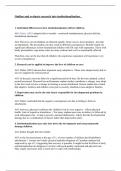
Outline and evaluate research into institutionalisation.
1. Individual differences in how institutionalisation affects children.
A01: Rutter (2010) adopted after 6 months - emotional maladjustment, physical deficits,
disinhibited attachment.
A03: However, not all children are affected equally. Some receive more attention - develop
an attachment. The personality can also result in different consequences. Bowlby found out
significant differences in how hospitalised children with TB cope with separation. Those with
hardy personalities cope better since are more resilient and won't as emotionally affected
Therefore, may not be true that all children who experience separation will experience very
severe consequences.
2. Research can be applied to improve the lives of children on care.
A01: Rutter (2010) showed how important early adoption is. Those who adopted early able to
recover supports the critical period.
A03: In the past, nurse the baby for a significant period of time. By the time adopted, critical
period has passed. Research has an Romanian orphan studies contributes a change, now adopt
in the first week to have a change in forming a secure attachment. Recent studies have found
that adoptive mothers and children were just as securely attached as non-adoptive families
3. Deprivation may not be the only factor responsible for developmental problems in
children.
A01: Rutter concluded that the negative consequences are due to failing to form an
attachments
A03: however, physical conditions the children lived in were negative - effects physical
health. Lack of cognitive stimulation. + For many orphans poor care in infancy is followed by
such subsequent care - living in poverty, parental disharmony. Likely that the developmental
damage due to a combination of factors rather than deprivation alone.
4. Institutionalisation may only slow down the development and not permanently
damage children.
A01; Rutter thought that irreversible.
A03; at the last assessment at the age of 11, a lower number of children had disinhibited
attachments + Lemare and Audet: physical underdevelopment of Canadian orphans had
improved by age of 11 suggesting that recovery is possible. It might be that th effects of early
institutionalisation do disappear over time with good-quality emotional and physical care.
May simply need more time to learn how to cope with relationships.
1. Individual differences in how institutionalisation affects children.
A01: Rutter (2010) adopted after 6 months - emotional maladjustment, physical deficits,
disinhibited attachment.
A03: However, not all children are affected equally. Some receive more attention - develop
an attachment. The personality can also result in different consequences. Bowlby found out
significant differences in how hospitalised children with TB cope with separation. Those with
hardy personalities cope better since are more resilient and won't as emotionally affected
Therefore, may not be true that all children who experience separation will experience very
severe consequences.
2. Research can be applied to improve the lives of children on care.
A01: Rutter (2010) showed how important early adoption is. Those who adopted early able to
recover supports the critical period.
A03: In the past, nurse the baby for a significant period of time. By the time adopted, critical
period has passed. Research has an Romanian orphan studies contributes a change, now adopt
in the first week to have a change in forming a secure attachment. Recent studies have found
that adoptive mothers and children were just as securely attached as non-adoptive families
3. Deprivation may not be the only factor responsible for developmental problems in
children.
A01: Rutter concluded that the negative consequences are due to failing to form an
attachments
A03: however, physical conditions the children lived in were negative - effects physical
health. Lack of cognitive stimulation. + For many orphans poor care in infancy is followed by
such subsequent care - living in poverty, parental disharmony. Likely that the developmental
damage due to a combination of factors rather than deprivation alone.
4. Institutionalisation may only slow down the development and not permanently
damage children.
A01; Rutter thought that irreversible.
A03; at the last assessment at the age of 11, a lower number of children had disinhibited
attachments + Lemare and Audet: physical underdevelopment of Canadian orphans had
improved by age of 11 suggesting that recovery is possible. It might be that th effects of early
institutionalisation do disappear over time with good-quality emotional and physical care.
May simply need more time to learn how to cope with relationships.