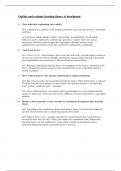
Outline and evaluate learning theory of attachment
1. Clear believable explanation, face validity
A01: Cupboard love, attaches to the feeding mechanism, seek mom because she is associated
with food
A03: However, largely based in studies with animals - oversimplified. Not all human
behaviour can be explained by conditioning especially a complex behaviour such as
attachment. Non-behaviourists argue that attachment in humans involves innate
predispositions and mental activity that could not be explained by conditioning.
2. Food is not the key
A01: Harlow (1959), infant monkeys spent more time with cloth -covered monkey turning to
the wire-covered only for food. Schaffer and Emerson, human infants attached to the person
who responded the most sensitively to their needs and not who fed them.
A03: Research contradicting learning theory. Overemphasis on the food is a limitation as the
theory subsequently ignores contact comfort and sensitivity as more important aspects in
human attachment.
3. Drive reduction theory uses operant conditioning to explain attachment
A01: has a drive to reduce the discomfort provided by hunger. When fed the drive is reduced.
The behaviour that led to being fed is more likely to be repeated because it was rewarded.
Food - primary reinforcer, mom – secondary
A03: Drive reduction theory is no longer used by psychologists as it can explain a limited
number of behaviours. Some activities involve deliberate increase of discomfort - e.g bungee-
jumping.
4. Bowlby’s theory provides a better account for attachment development than learning
theory.
A01: According to the evolutionary theory attachment is innate. It increases the chances of
survival. Social releases elicit a caregiving response from adults.
A03: Support from Lorenz – goslings imprinted on Lorenz because they would not have
survived on their own. Bowlby’s theory can explain why attachments form, whereas the
Learning theory can only explain how. It also offers strengths of attachment such as
protection from harm and thus increased chance of survival
1. Clear believable explanation, face validity
A01: Cupboard love, attaches to the feeding mechanism, seek mom because she is associated
with food
A03: However, largely based in studies with animals - oversimplified. Not all human
behaviour can be explained by conditioning especially a complex behaviour such as
attachment. Non-behaviourists argue that attachment in humans involves innate
predispositions and mental activity that could not be explained by conditioning.
2. Food is not the key
A01: Harlow (1959), infant monkeys spent more time with cloth -covered monkey turning to
the wire-covered only for food. Schaffer and Emerson, human infants attached to the person
who responded the most sensitively to their needs and not who fed them.
A03: Research contradicting learning theory. Overemphasis on the food is a limitation as the
theory subsequently ignores contact comfort and sensitivity as more important aspects in
human attachment.
3. Drive reduction theory uses operant conditioning to explain attachment
A01: has a drive to reduce the discomfort provided by hunger. When fed the drive is reduced.
The behaviour that led to being fed is more likely to be repeated because it was rewarded.
Food - primary reinforcer, mom – secondary
A03: Drive reduction theory is no longer used by psychologists as it can explain a limited
number of behaviours. Some activities involve deliberate increase of discomfort - e.g bungee-
jumping.
4. Bowlby’s theory provides a better account for attachment development than learning
theory.
A01: According to the evolutionary theory attachment is innate. It increases the chances of
survival. Social releases elicit a caregiving response from adults.
A03: Support from Lorenz – goslings imprinted on Lorenz because they would not have
survived on their own. Bowlby’s theory can explain why attachments form, whereas the
Learning theory can only explain how. It also offers strengths of attachment such as
protection from harm and thus increased chance of survival