Lattice Enthalpy
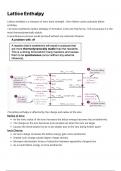
Lattice enthalpy is a measure of ionic bond strength . Born Haber cycles calculate lattice
enthalpy.
The most exothermic lattice enthalpy of formation is the one that forms. This is because it is the
most thermodynamically stable.
A spontaneous process would proceed without any external influence.
The lattice enthalpy is affected by the charge and radius of the ions.
Radius of Ions:
As the ionic radius of the ions increases the lattice energy becomes less endothermic
The charge on the ions becomes more spread out when the ions are larger
Causes the electrostatic forces to be weaker due to the ions being further apart
Ionic Charge:
As ionic charge increases the lattice energy gets more exothermic
Greater ionic charge equals higher charge density
Stronger electrostatic forces of attraction between oppositely charged ions
As a result lattice energy is more exothermic
Lattice enthalpy is a measure of ionic bond strength . Born Haber cycles calculate lattice
enthalpy.
The most exothermic lattice enthalpy of formation is the one that forms. This is because it is the
most thermodynamically stable.
A spontaneous process would proceed without any external influence.
The lattice enthalpy is affected by the charge and radius of the ions.
Radius of Ions:
As the ionic radius of the ions increases the lattice energy becomes less endothermic
The charge on the ions becomes more spread out when the ions are larger
Causes the electrostatic forces to be weaker due to the ions being further apart
Ionic Charge:
As ionic charge increases the lattice energy gets more exothermic
Greater ionic charge equals higher charge density
Stronger electrostatic forces of attraction between oppositely charged ions
As a result lattice energy is more exothermic