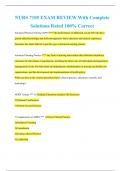
NURS 7105 EXAM REVIEW With Complete Solutions Rated 100% Correct
NURS 7105 EXAM REVIEW With Complete Solutions Rated 100% Correct Advanced Practice Nursing (APN) *** The performance of additional acts by RN who have gained added knowledge and skills through post- basic education and clinical experience. Describes the whole field of a specific type of advanced nursing practice Advanced Nursing Practice *** Any form of nursing intervention that influences healthcare outcomes for individuals or populations, including the direct care of individuals and population, management of care for individuals and populations, administration of nursing and health care organizations, and the development and implementation of health policy. What one does in the various specialized roles (clinical practice, education, research, and leadership) APRN Criteria *** 1) Graduate Education (masters OR doctorate) 2) National Certification 3) Patient Focused Practice 7 Competencies of APRN *** 1) Direct Clinical Practice 2)Guidance/Coaching 3)Consultation 4)Evidence-Based Practice 5) Leadership 6) Collaboration 7) Ethical Decision Making Direct Clinical Practice *** Central competency of APRN distinguished by use of a holistic perspective, therapeutic relationship with patient, expert clinical performance, reflective practice, evidence based practice, and use of diverse approaches to health and illness management Scope of Practice *** The legal authority granted to the APRN which varies amongst roles and from state to state DNP *** Highest level of nursing education (i.e. terminal degree). AACN defines as a practice focused doctorate degree. Focus is on expertise in clinical practice. AACN *** Organization responsible for publishing the 8 essentials of DNP curriculum (Essentials of Doctoral Education of Advanced Nursing Practice) APRN Consensus Model *** Proposed regulatory model for advanced practice nursing that defines APRN licensure, accreditation, certification, and education (LACE) Provides guidance for states to adopt uniformity in the regulation of APRN roles NCSBN *** Independent, not-for-profit organization through which boards of nursing act and counsel together on matters of common interest and concern affecting public health, safety, and welfare Has 59 member boards Prescriptive Authority *** Legal authority granted to advanced practice nurses to prescribe medication Collaborative Practice Agreement (CPA) *** Formal agreement addressing the parameters between an APRN and a collaborating physician; approved by LSBN Controlled Substances *** Additional privilege of an APRN not included with prescriptive authority; requires LCDS number + DEA Number Restrictions on Controlled Substances *** APRNs may not prescribe controlled substances in connection with/treatment of: a) chronic pain b) obesity c) oneself, a spouse, child or any other family member 1970s *** Doctorate degrees in nursing emerged AACN Essentials of Doctorate Education for ANP *** I: Scientific Underpinning for Practice II: Organizational and systems leadership for quality improvement and systems thinking III: Clinical scholarship and analytical methods for EBP IV: Information- Systems- Technology and Patient care technology for the improvement of health care V: Healthcare policy for advocacy in health care VI: Interprofessional collaboration for improving patient and population health outcomes. VII: Clinical prevention and population health for improving the nation's health VIII: Advanced Nursing Practice. Focus of the DNP *** Clinical Practice Leadership Health Policy and Advocacy Information Technology 1. Collaboration 2. Credibility 3. Compassion 4. Coordination *** Four C's of Professional Nurse Communications in Health Care Teams Nursing Theory *** Concepts connected by relational statements that describe, predict, or explain phenomena consistent with nursing's perspective. Conceptual Models *** Nursing theory model that communicates knowledge useful to the whole discipline of nursing Grand Theories *** Nursing theory model that is more delimited in scope than conceptual models and tends to focus on developing one aspect of a conceptual model Middle- Range Theories *** Nursing theory model that describes, explains, or predicts concrete and specific phenomena. It is narrower in scope and more amenable to validation through empirical testing, and more immediately applicable to clinical practice. Evidence Based Nursing Practice *** Conscientious integration of best research evidence with clinical expertise and patient values and needs in the delivery of quality, cost- effective health care. Quantitative Research *** Objectivity and use of numerical data to obtain information about the world Qualitative Research *** Use of subjective, interactive approaches to describe life experiences and give meaning to them Scholarship in Nursing *** Those activities that systematically advance the teaching, research, and practice of nursing through rigorous inquiry that: is significant to the profession is creative can be documented can be replicated or elaborated can be peer reviewed through various methods Networking *** Proactive involvement in activities to develop and maintain personal and professional relationships with others for the purpose of mutual benefit in work or career. Six Characteristics of Advanced Direct Care Practice *** 1. Use of holistic perspective 2. Formation of therapeutic partnerships with patients 3. Expert clinical performance 4. Use of reflective practice 5. Use of evidence as a guide to practice 6. Use of diverse approaches to health and illness management CNS *** APRN role that has three spheres: patient/ client, nurses and nursing practice, organization/ system Clinical expert who provides direct care to patients with complex health problems Formal consultants to nursing staff and other care providers within the organization NP *** APRN role that possesses advanced health assessment, diagnostic, and clinical management skills, including pharmacology management Expert direct care to patients and their families Provide primary health care focused on wellness and prevention CNM *** APRN role that focuses on advanced health assessment and intervention skills focused on women's health and childbearing Independent management of women's health, including pregnancy, childbirth, postpartum and neonatal care; family planning, gynecologic care, and women's health through menopause CRNA *** APRN role that focuses on advanced procedural and pharmacological management of patients undergoing anesthesia Practice independently, in collaboration with physicians, or as employees of health care institutes Acquisition of new practice knowledge and skills, partially theoretical and EBP which may overlap with medicine practice Role autonomy Responsibility for health promotion, diagnosis/ management Greater complexity for decision making Specialization at the level of the particular APRN role *** APRN includes specialization but also involves expansion and educational advancement, further characterized by: LA County Medical Association vs. Dagmar Nelson Case (1930s) *** Case that established that the practice of nurse anesthesia was legal and within the scope of nursing practice, as long as it was done under the guidance and supervision of a physician. Granny Midwives *** Untrained African- American women who provided most of obstetric care in the US south Outcomes were the same as physicians. Frontier Nursing Service (FNS) *** Provided midwifery and most of primary health care needs of people in rural Appalachia through nurse- led clinics Nurses had considerable autonomy with permission of medical advisory committee Role acquisition *** Changes occurring during role transitions experienced during the educational component of an APN role. Role Implementation *** Changes occurring during the actual performance of the role following program completion. Novice to Expert Skill Acquisition Model *** Acquisition of knowledge and skills occurs in a progressive movement through stages of novice to expert Expertise doesn't develop simply as a matter of time The progression from novice to advanced beginner and them to competent is incremental but not necessarily stepwise or linear. Role Stress *** Issue effecting role transition which involves social structural condition where obligations are ambiguous, conflicting, incongruous, excessive, and unpredictable Role Strain *** Issue effecting role transition that involves feelings of frustration, tension, anxiety in response to role stress Biomedicine Mainstream Nursing Everyday life *** APRN are described as "tricultural" or "trilingual" by sharing background knowledge, practices, and skills of three cultures: role ambiguity *** Issue that develops when there is a a lack of clarity about expectations, blurring of responsibilities, uncertainty about role implementation, and existing knowledge. It can be positive if it offers opportunities for creativity role incongruity *** Intrarole conflict developing from two sources. Incompatibility between skills/ abilities and role obligations Incompatibility between personal values/ self - concept and expected role behaviors. Role Conflict *** Role expectations are perceived to be contradictory or mutually exclusive Intraprofessional Role Conflict *** Role conflict experienced with communication difficulties at organizational level, in educational programs, in literature, and in direct clinical practice. Nurse- NP conflict can be minimized by: orienting staff nurses to APRN role and providing guidelines regarding responsibility issues and allowing new APRNs to establish a rapport with nurses by learning about new setting from them. Interprofessional Role Conflict *** Role conflict experienced between physicians and APRN because of perceived threat of competition, lack of experience working together, historical hierarchy. Five essential factors that influence role transitions *** 1. The personal meaning of the trnasition, which relates to the degree of identity crisis experienced 2. The degree of planning, which involves the time and energy devoted to anticipating the change 3. Environmental barriers and supports, which refer to family, peer, school, and other components 4. Level of knowledge and skill, which relates to prior experience and school experiences 5. Expectations, which are related to role models, literature, media, etc.. Four stage process of NP role development *** Stage I: Complete dependence Stage II: Developing competence Stage III: Independence Stage IV: Interdependence Orientation *** Positive phase of APRN role development Enthusiasm, optimism, skill mastery Frustration *** Positive phase of APRN role development Conflict, inadequacy, anxiety Implemtation *** Positive phase of APRN role development role modification, development of adjusted realistic perspective Integration *** Positive phase of APRN role development Self- confidence, job satisfaction, respect in work setting, refinement of expertise Frozen *** Negative phase of APRN role development anger, lack of career satisfaction Reorganization *** Negative phase of APRN role development Restructuring or responsibilities Complacent *** Negative phase of APRN role development comfort, stability, maintaining the status quo Laying the foundation *** Transition Stages in first yer of primary care practice New grad takes certification exams, obtains licensure from SON, looks for position Launching *** Transition Stages in first yer of primary care practice Anxiety associated with crisis of competence and confidence that accompanies new position Meeting the challenge *** Transition Stages in first yer of primary care practice Regaining confidence and increasing competence, returning optimism and enthusiasm Broadening the perspective *** Transition Stages in first yer of primary care practice Role is expanded and refined Orientation phase strategies *** Develop a structures orientation plan Circulate literature an APRN roles Identify role models; network with peers Join local, state, national APRN groups Identify expectations Frustration phase *** Schedule debriefing sessions with experienced APRN Discuss how expectations fit in real- world application Plan for longer initial appointments; learn time saving tips Schedule administrative time Collaborate with other providers Practice habits of self- care Implentation Phase Strateges *** Reassess priorities/ goals and modify expectations Schedule 6month evaluation Collaborate and co- treat with other specialties Learn ways to manage uncertainty Assemble mobile clinical resource applications Integration Phase Strategies *** Schedule 12 month evaluation Plan for role refinement and expansion Continue to collaborate and co-treat with other specialties Continue debriefing sessions with experienced APRN Continue to seek verification and feedback from colleagues The PEPPA Framework Participatory, Evidence- based, Patient- Focused Process for APN development *** Comprehensive framework developed in Canada Macro perspective that involves stakeholders in the implementation process Addresses barriers to APN role implementation at the system, organizational, and practice setting levels Moves beyond predominant individual perspective and recognizes complexity of system factors involves in implementing a new role into an existing system Three Spheres of CNS Influence with Interventions *** 1. Direct care of patients or clients (direct care, collaboration and ethical decision making, consultation). 2. Nurses and nursing practice (coaching and guidance, consultation, collaboration, leadership, EBP) 3. Organizations and systems (assess needs, develop research based protocols, cultivate culture that values research utilization, lead quality improvement efforts, develop innovative models of care, develop and implement programs, participate in advisory boards). Primary care *** Provision of integrated, accessible health care services by clinicians who are accountable for addressing a large majority of personal health needs, developing a sustained partnership with patients, and practicing in the context of family and community. Terms used to define Primary Care *** Integrated (comprehensive, coordinated care, focused on particular needs, effective communication) Accessibility (ease with with care is obtained; elimination of geographic, cultural barriers) Clinician (uses scientific knowledge base; authority to deliver direct care) Accountable (clinician and system accountability for services) Most personal health care needs (competency to manage most health problems; use of consultation and referrals; relationship between clinician and patient) Context of family and community (understanding circumstances and facts surrounding patient, awareness of public health trends, need for specific health promotion and disease prevention strategies) Family NP *** Most widely held certification for NPs Postgraduate residency models *** Supports new NPs in their transition to mastery as PCNP in safety net setting. Program effective in achievement of competence, confidence, and sense of mastery Accreditation Commission for Midwifery Education (ACME) *** Official accrediting body of Association of CNM CRNA *** Oldest organized specialty in nursing Standardized postgraduate education, credentialing, and CE were all areas pioneered by this role Also the first nurse specialists to receive direct reimbursement for their services 8 years *** CRNA is the only APRN role to require evidence of continued competency with an exam every ___ years Mission of LSBN *** To safeguard the life and health of the citizens of LA by assuring practicing RNs and APRNs are competent and safe. Nurse Practice Act (NPA) *** Law that authorizes LSBN (BON) to establish administrative rules and regulations to implement practice in accordance with the administrative procedure act The practice of APRN and Rn is set by this as well as other statutory laws including administrative, criminal, and civil. Guidelines for prescribing in regulations *** Preform and document H&P Make dx Formulate therapeutic plan Provide for follow-up Practice guidelines *** Foundation for health care providers to administer safe and competent care to patients Derived from EBP and are continuously evolving Negligence *** Failure to act in a professionally, reasonable way as a health care clinician May lead to malpractice and legal action Malpractice *** 4 factors for the suit to be valid: Duty of care must be owed to injured aprty Accepted standard of care was breached Patient must have sustained damage or injury Direct causation demonstrated (injury was caused by APRN clinician) Claims made insurance policy *** Insurance policy that covers claims made against the APRN ONLY while the policy is in effect Occurence policy *** Insurance police where the APRN is covered for alleged acts of negligence that occurs during the time when the policy was in effect even though the claim is made much later **Preferred insurance Direct care activities *** Establish patient- provider therapeutic relationship Consultation, education with patient and family members Pathology, physical assessment, pharmacology Performing procedures Indirect are activities *** Collaboration, consultation, mentoring of staff Ensure others are providing quality care Documentation Use of holistic care *** One of the characteristics of Direct Clinical care. Involves a deep understanding of each person as a complex individual Recognizes multiple dimension of each person Formation of therapeutic Partnerships with Patients *** One of the characteristics of Direct Clinical care. Cornerstone of patient- centered care Development of this with patients and their families is a specific and foundational criteria in APN Therapeutic use of self: awareness of personal feelings, attitudes and values increases empathy allowing the APRN to engage more deeply Expert Clinical Performance *** One of the characteristics of Direct Clinical care. Encompasses critical thinking skills above and beyond that of the RN Requires clinical judgement, which is the ability to make fine distinction among features of a particular condition that were not possible during beginning practice. Errors of Expectancy *** correct diagnosis is not made because a set of circumstances predisposes the clinician to disregard it. Ethical Reasoning *** Reasoning that is linked to clinical reasoning and generates possibilities of what should be done in addition to what could be done. Use of reflective Practice *** One of the characteristics of Direct Clinical care. Practice of taking experiences and explore them for the purpose of eliciting meaning, critically analyzing, and synthesizing and using learning to improve practice. Goal is to turn experience into knowledge by seeking insights not avaliable with superficial recall. The use of Evidence as a guide to practice *** One of the characteristics of Direct Clinical care. The explicit and judicious integration of best practice within clinical expertise and pt values. EBP- systematic, rigorous, and precise way of translating research findings to practice. Theory- based practice *** Practice that is influenced b the theory that brings together research findings in a way that helps practice be more purposeful, systematic, and comprehensive. Diverse approaches to health and illness management *** One of the characteristics of Direct Clinical care. Uses different interventions to manage pt including: Interpersonal interventions Therapeutic interventions Individualized interventions Complementary Interventions (also called intregrative therapies when coordinated with conventional therapies in a treatment plan) Clinical Prevention (primary prevention) Guidance *** Core APRN Competency that is a provision of expert counsel or education by leading, directing, or advising. Anticipatry guidance *** Type of guidance that is aimed at helping patients know what to expect. Provides guidelines about when to seek addition care, offers reassurance, anticipates patient's feelings or questions Patient Education *** Type of guidance characterized by learning experiences designed to help patients improve health by increasing knowledge or influencing attitudes. Mentoring *** Type of guidance Relational process where one person with more knowledge in a certain area provides guidance to another. Typically is a long- term relationship. APRN provides advice and support to help patients attain their goals Mutually beneficial to both parties. Counseling *** Type of guidance Professional relationship that empowers diverse individuals and groups to accomplish mental health, wellness, education, and career goals. Generally focused on psychological, social, or performance issues in a problem- based approach Directive and values patient education Coaching *** Broad term that encompasses different approaches, philosophies, techniques, and disciplines Partnering with clients in a thought- provoking and creative process that inspires them to maximize their personal and professional potential. Focused on goals established by the patient 4 Components of Coach's Responsibilities *** 1. Discover, clarify, align with what the client want to achieve 2. Encourage self- discovery 3. Elicit client- generated solutions and strategies 4. Hold the client responsible and accountable Motivational coaching *** Type of coaching that is a focused approach to explore and ignite motivation for change and address ambivalence. Integrative Coaching *** Type of coaching that helps patients make changes to lead healthier lives. Address the gap between medical recommendations and patient's success in implementing the recommendations. Nursing Coaching *** Type of coaching that is a critical component of holistic care Aimed at working with individuals to promote maximum health potential by integrating skills of nursing and coaching Nightingales's Environmental Theory *** Theory stating that there is a strong link between the environment and health External factors associated with patient surroundings greatly affect their lives, development, and biologic and physiologic processes Midrange theory of integrative nurse coaching *** Theory that has five components: 1. Self- reflection, self- assessment, self- evaluation, self care 2. Integral perspectives and change 3. Integrative lifestyle health and well- being 4. Awareness and choice 5. Listening with HEART (healing, energy, awareness, resiliency, and transformation) Transtheoretical Model *** Theory that is an integration of numerous psychotherapy and behavior change theories. States that behavior change unfolds through a series of sequenced stages of change. The APRN can tailor the intervention to patient's specific stage of change to maximize chance that patient will proceed through a needed change process. Watson's Model of Caring *** Theory based on loving kindness. Focused on the process of relating to others in a present way and going beyond the ego. Honoring and respecting patient's values, history, beliefs, goals, is foundational. Positive Psychology *** Theory that has 5 dimensions of well being: 1. Positive emotion 2. Engagement 3. Relationships with others 4. Meaning and purpose 5. Achievement Growth Mindset *** Belief that one can learn and practice and achieve success; hard effort can remedy setbacks Fixed mindset *** Belief that talents are fixed and effort cannot develop talent further Self- Determination Theory *** Theory that has 2 forms of motivation: intrinsic and extrinsic Humans are motivated by external rewards and by own interests, curiosity, and abiding values. Developmental Transition *** Type of transition that reflects life cycle transitions Health and Illness Transitions *** Transition of adapting to illness, reducing risk factors to prevent illness, changing unhealthy lifestyle behaviors. Situational Transition *** Transition brought by changes in education, work, and family roles. Organizational Transitions *** Transition occurring in the environment: within or between agencies in society. APRN Guidance and Coaching Skills *** 1. Listen 2. Build strengths 3. Cultivate unconditional positive regard 4. Cultivate culture of empathy 5. Create a safe environment 6. Self- knowledge as an APRN The 4 A's of Coaching Process *** 1. Agenda setting 2. Awareness raising 3. Actions and goal setting 4. Accountability Consultation *** An APRN core competency A process of interaction between two professionals- one who is a specialist. Client- Centered Case Consultation *** Consultation that occurs when a generalist asks a specialist for expert opinion about a particular case or patient. The goal may be to further the knowledge of the generalist about a particular clinical dilemma that can be generalized to other patient populations. Consultee- Centered Case Consultation *** Consultation where the emphasis is focused directly on consultee's difficulty in handling a situation. Goal is education of the consultee using questions for teaching and improved understanding. Focus is on task and knowledge development Consultant may need to help consultee identify factors interfering with the ability to see the patient realistically. Program- Centered Administrative Consultation *** Consultation that focuses on work problem that requires planning and administration and expert opinion of new clinical system. Provides expert consultation around a program administrative question. Consultee- Centered Administrative Consultation *** Consultation that focuses on the consultee's difficulties with programming or organizational objectives. Primary concern of consultant is to correct difficulties of consultee that interferes with program development or organization. Goal is to help the consultee develop and implement adaptive behaviors to work within administrative boundaries. Comanagment *** Process where one professional manages on aspect of the patient's care and another professional manages a different aspect of the same patient's care. Referral *** occurs when the APRN directs the patient to another provider for specialized care beyond the scope of the APRN. Clinical Supervision *** Ongoing supportive, educational process between senior clinician and novice clinician; supervisor is generally in a hierarchical position to supervisee Collaboration *** Process that underlies other professional interactions; process where two or more individuals make a commitment to interact authentically and constructively to solve problems and learn from each other to accomplish goals, purposes, or outcomes. Collaboration *** A dynamic, interprofessional process in which two or more individuals make a commitment to each other to interact authentically and constructively to solve problems and to learn from each other to accomplish goals, purposes, or outcomes. True partnership in which there is a valuing of expertise, power, and respect for all members 1. Values and ethics 2. Communication 3. Roles and responsibilities 4. Teamwork across the full spectrum of care *** 4 core competencies of collaborative practice for health professionals Facilitator *** Part of what makes a DNP- prepared leader successful Enable individuals or groups to move through tasks Professional *** Part of what makes a DNP- prepared leader successful Effective leader Role Model *** Part of what makes a DNP- prepared leader successful Demonstrate their profession to others Visionist *** Part of what makes a DNP- prepared leader successful Ability to be future oriented Caring Competencies *** Part of what makes a DNP- prepared leader successful Include: Holding the truth, intellectual and emotional self, discovery of potential, quest for the adventure toward knowing, diversity as a vehicle to wholeness, appreciation of ambiguity, knowing something in life, holding multiple perspectives without judgment, keeping commitments to oneself. Emotional Intelligence Leadership Competencies *** Part of what makes a DNP- prepared leader successful Includes: Self- awareness Self- Management Social awareness Relationship management Leadership Attributes for DNP graduate *** Part of what makes a DNP- prepared leader successful Includes: Ability to communicate effectively, fearlessness, motivating, visionary (looks towards the future), role model, knowledge and clinical competence, compassion, trustworthy, participate in partnerships, honesty about self and others, empathy Resonant Style *** Leadership style that encourages group members to feel connected to each other and reflect the leader's enthusiasm. Visionary Style *** Leadership style that motivates group to be a shared dream while allowing others to be free to innovate, experiment, take calculated risks. Coaching Style *** Leadership style that connects others to the shared goals of the organization or group Affiliative style *** Relationship- builder style; emphasizes connections among people to bring focus toward a shared goal. Leadership Style *** Leadership style fostered through good communication, ability to collaborate, resolve conflict, influence others. Dissonant Style *** Leadership style that makes a group feel "off- key" and produce a "lack of harmony" in a group Pacesetting style *** Leadership style that exhibits extremely high expectations when accomplishing a task is the essential goal. Commanding Style *** Leadership style where the leader takes control of a situation; "do it because I said so" attitude
Written for
- Institution
- NURS 7105
- Course
- NURS 7105
Document information
- Uploaded on
- July 31, 2023
- Number of pages
- 28
- Written in
- 2022/2023
- Type
- Exam (elaborations)
- Contains
- Questions & answers
Subjects
-
nurs 7105 exam review with complete solutions rate

Also available in package deal