Handmaid’s Tale Context - Organised into Literary, Historical And Author’s Context
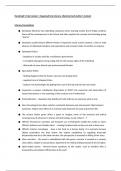
Literary Conventions
● Dystopian literature has underlying cautionary tones warning society that if things continue
there will be consequences in the future and often explore the concept of technology going
"too far"
● Dystopias usually feature different kinds of repressive social control systems, a lack or total
absence of individual freedoms and expressions and constant states of warfare or violence.
● Dystopian fiction:
‐ Depiction of society ruled by a totalitarian government
‐ A complete disregard among ruling elite for the human rights of the individual
‐ Aftermath of some kind of epic environmental Disaster
● Speculative fiction
‐ Nothing happens that the human race has not already done
‐ negative form of Utopian fiction
‐ explore new technologies by getting them out of the lab and into the real world
● Voyeurism as power: totalitarian observation in THMT; the voyeurism and observation of
sexual interactions vs. the watching of the creature over Frankenstein
● Postmodernism – Questions the stability of truth and how to represent what is real.
● Non chronological narrative switches constantly between past and present/ slips between
memories. Makes clear Offred is in a liminal state between her past and present life.
● The science fiction genre offers a space to imagine some of the practical and ethical
consequences of advances in science and technology, to ask ‘what if …?’
● Offred’s first-person narration and frequent use of flashbacks enable the reader to share
Offred’s defiance and ‘double vision’ – viewing locations both as they are and as they were.
● Offred’s interior monologue – How a fact feels to a human being. It is precisely because
Offred remembers the time before the regime established its appalling theocratic
dictatorship that she is the ideal narrator; this perspective is essential to telling of her story.
● Slave narrative – the novel is embellished with this genre, narrator is treated as a second-
class citizen, subject to sexual abuse, deprived of her child and dispossessed of all civil rights.
● Open-ended stories - Atwood leaves questions to the reader, such as whether Nick is
trustworthy and whether Offred alive at the end?
Literary Conventions
● Dystopian literature has underlying cautionary tones warning society that if things continue
there will be consequences in the future and often explore the concept of technology going
"too far"
● Dystopias usually feature different kinds of repressive social control systems, a lack or total
absence of individual freedoms and expressions and constant states of warfare or violence.
● Dystopian fiction:
‐ Depiction of society ruled by a totalitarian government
‐ A complete disregard among ruling elite for the human rights of the individual
‐ Aftermath of some kind of epic environmental Disaster
● Speculative fiction
‐ Nothing happens that the human race has not already done
‐ negative form of Utopian fiction
‐ explore new technologies by getting them out of the lab and into the real world
● Voyeurism as power: totalitarian observation in THMT; the voyeurism and observation of
sexual interactions vs. the watching of the creature over Frankenstein
● Postmodernism – Questions the stability of truth and how to represent what is real.
● Non chronological narrative switches constantly between past and present/ slips between
memories. Makes clear Offred is in a liminal state between her past and present life.
● The science fiction genre offers a space to imagine some of the practical and ethical
consequences of advances in science and technology, to ask ‘what if …?’
● Offred’s first-person narration and frequent use of flashbacks enable the reader to share
Offred’s defiance and ‘double vision’ – viewing locations both as they are and as they were.
● Offred’s interior monologue – How a fact feels to a human being. It is precisely because
Offred remembers the time before the regime established its appalling theocratic
dictatorship that she is the ideal narrator; this perspective is essential to telling of her story.
● Slave narrative – the novel is embellished with this genre, narrator is treated as a second-
class citizen, subject to sexual abuse, deprived of her child and dispossessed of all civil rights.
● Open-ended stories - Atwood leaves questions to the reader, such as whether Nick is
trustworthy and whether Offred alive at the end?