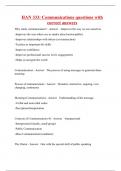
HAN 333: Communications questions with
correct answers
Why study communication? - Answer -Improves the way we see ourselves
-Improves the way others see us (make ideas known/public)
-Improves relationships with others (co-construction)
-Teaches us important life skills
-Improves confidence
-Improves professional success (civic engagement)
-Helps us navigate the world
Communication - Answer The process of using messages to generate/share
meaning
Process (Communication) - Answer Dynamic, interactive, ongoing, ever-
changing, continuous
Meaning (Communication) - Answer Understanding of the message.
-Verbal and nonverbal codes
-Perception/Interpretation
Contexts of Communication (4) - Answer -Intrapersonal
-Interpersonal (dyadic, small group)
-Public Communication
-Mass Communication (mediator)
The Orator - Answer One with the special skill of public speaking
,Public Speaking - Answer -Way of making ideas public, sharing
-Sharing Ideas with other people
-Influencing other people
Public Speaking vs. Conversation (Similarities) - Answer -Organize thoughts
logically
-Tailor message to audience
-Tell stories for maximum impact
-Adapt to feedback
Public Speaking vs. Conversation (Differences) - Answer -P.S. more highly
structured
-P.S. requires:
-formal language
-different method of delivery
-critical thinking
Stage Fright - Answer Anxiety over prospect of speaking in front of audience
Bruskin Report - Answer Americans Report that their greatest fear is the fear of
speaking in front of a group
How do you reduce speech anxiety? - Answer -Practice
-PREPARE
-Think positively
, -Visualization
-Know most nervousness is not visible
-Don't expect perfection
-Use positive nervousness
Parts of the communication process - Answer -Speaker/Sender
-Message (verbal/non-verbal form of idea)
--Code (arrangement of symbols)
---Encoding & Decoding
-Channel
-Listener/Receiver
--Frame of Reference
-Feedback (verbal/non-verbal)
-Interference/Noise (external/internal)
-Situation/Environment (influences tone)
Frame of Reference - Answer Sum of person's knowledge, experience, goals,
values, attitudes
Frame of Reference (Facts) - Answer -Everything filtered through listener's frame
of reference
-No two people have same frame of reference
Ethnocentrism - Answer Believing one's group or culture is superior to all other
groups or cultures
correct answers
Why study communication? - Answer -Improves the way we see ourselves
-Improves the way others see us (make ideas known/public)
-Improves relationships with others (co-construction)
-Teaches us important life skills
-Improves confidence
-Improves professional success (civic engagement)
-Helps us navigate the world
Communication - Answer The process of using messages to generate/share
meaning
Process (Communication) - Answer Dynamic, interactive, ongoing, ever-
changing, continuous
Meaning (Communication) - Answer Understanding of the message.
-Verbal and nonverbal codes
-Perception/Interpretation
Contexts of Communication (4) - Answer -Intrapersonal
-Interpersonal (dyadic, small group)
-Public Communication
-Mass Communication (mediator)
The Orator - Answer One with the special skill of public speaking
,Public Speaking - Answer -Way of making ideas public, sharing
-Sharing Ideas with other people
-Influencing other people
Public Speaking vs. Conversation (Similarities) - Answer -Organize thoughts
logically
-Tailor message to audience
-Tell stories for maximum impact
-Adapt to feedback
Public Speaking vs. Conversation (Differences) - Answer -P.S. more highly
structured
-P.S. requires:
-formal language
-different method of delivery
-critical thinking
Stage Fright - Answer Anxiety over prospect of speaking in front of audience
Bruskin Report - Answer Americans Report that their greatest fear is the fear of
speaking in front of a group
How do you reduce speech anxiety? - Answer -Practice
-PREPARE
-Think positively
, -Visualization
-Know most nervousness is not visible
-Don't expect perfection
-Use positive nervousness
Parts of the communication process - Answer -Speaker/Sender
-Message (verbal/non-verbal form of idea)
--Code (arrangement of symbols)
---Encoding & Decoding
-Channel
-Listener/Receiver
--Frame of Reference
-Feedback (verbal/non-verbal)
-Interference/Noise (external/internal)
-Situation/Environment (influences tone)
Frame of Reference - Answer Sum of person's knowledge, experience, goals,
values, attitudes
Frame of Reference (Facts) - Answer -Everything filtered through listener's frame
of reference
-No two people have same frame of reference
Ethnocentrism - Answer Believing one's group or culture is superior to all other
groups or cultures