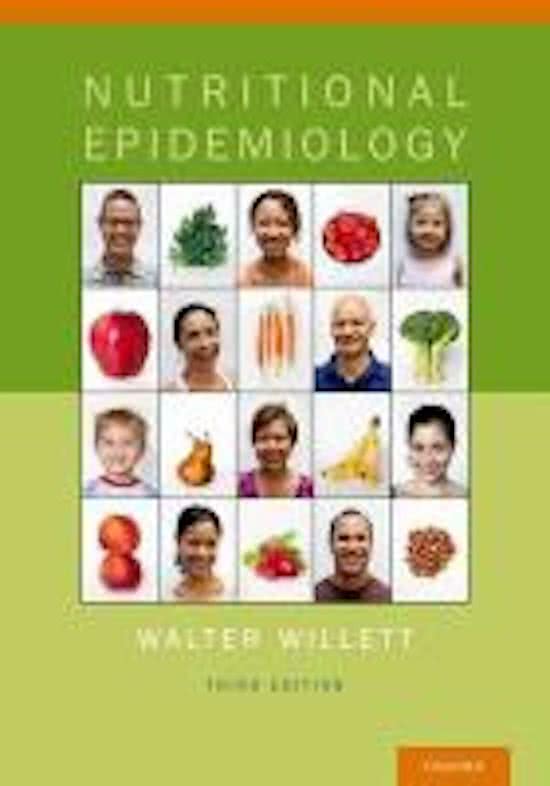
Summary Nutritional Epidemiology Walter Willet
Chapter 1 – Overview of Nutritional Epidemiology
Although much has been learned about diet and health in the last 30 years, our knowledge is still far
from complete regarding the relationships between dietary factors and many major illnesses of our
culture. These illnesses include not only cancer and heart disease, which have received the most
attention, but also congenital malformations, neurodegenerative diseases, conditions of the eye,
fractures, and many infectious diseases that are hypothesized to be influenced by the nutritional status
of the host. Randomized trials may eventually provide definitive answers to some of these questions.
However, in the foreseeable future, our knowledge of many of these relationships will depend largely
on observational epidemiologic data, and for many relationships this may always remain so. For this
reason, it is crucial to refine maximally our methods of data collection, analytic procedures, and
interpretation of findings. The ensuing chapters are intended to promote our progress in this direction.
Chapter 2 – Foods and Nutrients
Diets of human populations are extremely complex. They can be viewed in several ways, including as
intake of constituent chemicals (such as essential nutrients, non-nutritive components of foods, and
contaminants) or as foods, food groups, or dietary patterns. Maximal insight into the relation between
diet and disease will usually be obtained by examining diet both as constituents and as foods.
Calculation of nutrients and other constituents requires a food composition database that should
include a wide range of nutrients with values that are complete and current.
Chapter 3 – Nature of variation in Diet
The day–to–day variation in nutrient intake among free–living subjects has consistently been found to
be large, although the degree of variation differs greatly according to nutrient. Total energy (caloric)
intake is quite well regulated by physiologic mechanisms and thus has the least day-to-day variation
among nutrients. Intakes of macronutrients, because of their large contribution to total energy intake,
are also somewhat constrained and thus have moderate degrees of day-to-day variation. Because
micronutrients tend to be concentrated in certain foods, intakes can be very low or very high
depending on food choices, and thus can have large between-day variation for that day. The ratio of
within-person to between-person variation is usually substantially greater when the nutrient is
expressed in relation to energy intake (energy-adjusted). Measurements of dietary intake based on a
single or small number of 24–hour recalls per subject can provide an accurate (unbiased) estimate of
the mean for a group, but the standard deviation will be greatly overestimated. Furthermore,
measurements of association in epidemiologic studies, such as correlation and regression coefficients
and relative risks, are substantially weakened, possibly to the point of being undetectable.
Chapter 4 – 24-Hour Recall and Diet Record Methods
Diet record and 24-hour recalls, which consist of specific foods consumed by an individual on one or
more days, differ from FFQs, which estimate usual intake over a longer period of time. The short-term
methods allow greater specificity for describing foods and food preparation methods, and flexibility for
analyzing the data. However, due to the extensive effort required to collect and process multiple days
of food records or recalls, these methods are infrequently used as the primary method for estimating
usual intake in large-scale epidemiologic research. As new technology decreases the errors, costs, and
participant burden of these methods, they should become more widely used.
Chapter 5 – Food Frequency Methods
Food frequency questionnaires have become the primary method for measuring dietary intake in
epidemiologic studies and they have been developed for many countries worldwide. Such
questionnaires are directed to the dietary exposure of conceptual interest in most applications, which is
average intake over an extended period of time. Food frequency questionnaires are extremely practical
in epidemiologic applications because they are easy for subjects to complete, often as a self-
administered form. Processing is readily computerized and inexpensive, so that even prospective
studies involving tens of thousands of subjects are feasible. Paper questionnaires can be read
efficiently by optical scanning methods, and web-based questionnaires can provide further advantages
Chapter 1 – Overview of Nutritional Epidemiology
Although much has been learned about diet and health in the last 30 years, our knowledge is still far
from complete regarding the relationships between dietary factors and many major illnesses of our
culture. These illnesses include not only cancer and heart disease, which have received the most
attention, but also congenital malformations, neurodegenerative diseases, conditions of the eye,
fractures, and many infectious diseases that are hypothesized to be influenced by the nutritional status
of the host. Randomized trials may eventually provide definitive answers to some of these questions.
However, in the foreseeable future, our knowledge of many of these relationships will depend largely
on observational epidemiologic data, and for many relationships this may always remain so. For this
reason, it is crucial to refine maximally our methods of data collection, analytic procedures, and
interpretation of findings. The ensuing chapters are intended to promote our progress in this direction.
Chapter 2 – Foods and Nutrients
Diets of human populations are extremely complex. They can be viewed in several ways, including as
intake of constituent chemicals (such as essential nutrients, non-nutritive components of foods, and
contaminants) or as foods, food groups, or dietary patterns. Maximal insight into the relation between
diet and disease will usually be obtained by examining diet both as constituents and as foods.
Calculation of nutrients and other constituents requires a food composition database that should
include a wide range of nutrients with values that are complete and current.
Chapter 3 – Nature of variation in Diet
The day–to–day variation in nutrient intake among free–living subjects has consistently been found to
be large, although the degree of variation differs greatly according to nutrient. Total energy (caloric)
intake is quite well regulated by physiologic mechanisms and thus has the least day-to-day variation
among nutrients. Intakes of macronutrients, because of their large contribution to total energy intake,
are also somewhat constrained and thus have moderate degrees of day-to-day variation. Because
micronutrients tend to be concentrated in certain foods, intakes can be very low or very high
depending on food choices, and thus can have large between-day variation for that day. The ratio of
within-person to between-person variation is usually substantially greater when the nutrient is
expressed in relation to energy intake (energy-adjusted). Measurements of dietary intake based on a
single or small number of 24–hour recalls per subject can provide an accurate (unbiased) estimate of
the mean for a group, but the standard deviation will be greatly overestimated. Furthermore,
measurements of association in epidemiologic studies, such as correlation and regression coefficients
and relative risks, are substantially weakened, possibly to the point of being undetectable.
Chapter 4 – 24-Hour Recall and Diet Record Methods
Diet record and 24-hour recalls, which consist of specific foods consumed by an individual on one or
more days, differ from FFQs, which estimate usual intake over a longer period of time. The short-term
methods allow greater specificity for describing foods and food preparation methods, and flexibility for
analyzing the data. However, due to the extensive effort required to collect and process multiple days
of food records or recalls, these methods are infrequently used as the primary method for estimating
usual intake in large-scale epidemiologic research. As new technology decreases the errors, costs, and
participant burden of these methods, they should become more widely used.
Chapter 5 – Food Frequency Methods
Food frequency questionnaires have become the primary method for measuring dietary intake in
epidemiologic studies and they have been developed for many countries worldwide. Such
questionnaires are directed to the dietary exposure of conceptual interest in most applications, which is
average intake over an extended period of time. Food frequency questionnaires are extremely practical
in epidemiologic applications because they are easy for subjects to complete, often as a self-
administered form. Processing is readily computerized and inexpensive, so that even prospective
studies involving tens of thousands of subjects are feasible. Paper questionnaires can be read
efficiently by optical scanning methods, and web-based questionnaires can provide further advantages