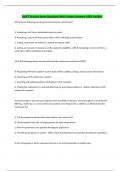
CELLULAR PROCESSES (NCEA Level 2 91156) Questions and Answers 2023
CELLULAR PROCESSES (NCEA Level 2 91156) Questions and Answers 2023 Membrane A semi-permeable phospholipid bi-layer that is the key structural component of the organelles and what surrounds the cells. Mediates what moves in and out of the cell. Chloroplast Organelle that is the site of photosynthsis Vacuole Organelle where water is stored. Mitochondria Organelle that is the site of aerobic respiration Active transport Movement of substances in or out of the cell that requires energy (ATP) at a protein pump because molecules are moving against the concentration gradient. Passive transport Movement of substances in or out of the cell that does not require energy because the substance is moving with the concentration gradient. Diffusion Movement of substances from high to low concentration. Facilitated diffusion Movement of substances, from high to low concentration, across the cell membrane using specialised transport proteins/protein channels With the concentration gradient Movement of substances in the direction of an area of high concentration to an area of low concentration. Against the concentration gradient Movement of substances in the direction of an area of low concentration to an area of high concentration. Osmosis Movement of water molecules across a semi-permeable membrane from an area of low solute concentration to an area of high solute concentration. Flaccid Term used to describe a cell that is limp or loose due to lack of water pressure against the cell membrane Turgid Term used to describe a cell that is filled with water and is pushing against the membrane ATP Molecule used by the cell as an energy source. Made in cellular respiration. Endocytosis Movement of molecules into the cell by the folding of the cell membrane. Exocytosis Movement of molecules out of the cell by the folding of the cell membrane. Respiration The process in which the cell produces usable energy in the form of ATP from oxygen and glucose (water and carbon dioxide a byproducts of this process) Aerobic respiration equation Glucose + Oxygen → Water + Carbon dioxide Aerobic respiration Respiration that requires oxygen to release energy from glucose in the form of high yield of ATP Anaerobic respiration Respiration that does not require oxygen to release energy from glucose in the form of ATP Photosynthesis Process in which energy from sunlight is used to produce glucose from water, carbon dioxide. (Oxygen is a by-product of this process) Photosynthesis equation Water + Carbon dioxide (+light energy) → Glucose and Oxygen Light dependent Phase First phase of photosynthesis in which light energy is used to split water producing oxygen and hydrogen. Light Independent Phase Second phase of photosynthesis in which hydrogen and carbon dioxide are used to produce glucose. ADP Molecule made after phosphate is removed from ATP and energy is released Glucose Sugar that is a source of chemical potential energy. Enzyme A protein that is a biological catalyst that helps increase the rate of reactions in the cell. Catalyst A substance that increases the rate of a chemical reaction without itself undergoing any permanent chemical change. Active site The area of an enzyme which has a very specific shape so that the substrate(s) can bind Substrate Molecule/substance that binds with an enzyme in a chemical reaction. Co-factor/co-enzyme Molecule that binds to an enzymes active site to complete the shape. Non-competitive inhibitor Substance that binds to an enzyme and changes the shape of the active site stopping the substrate from binding. Competitive Inhibitor Molecule that binds to an enzymes active site which blocks that substrate from binding Semi-conservative replication When DNA replication has occurred each molecule has one strand of parental DNA and one strand of newly synthesized DNA nucleotide The subunit of DNA, made of a sugar, phosphate, and a nitrogenous base mitosis Cell division where the replicated chromosomes separate to create two identical cells S phase Synthesis stage, also know as the stage for DNA replication. G1 phase The cell makes the requirements for cell division e.g. the enzymes and the nucleotides Cell cycle the series of events that take place in a cell leading to its division. G2 Phase The cell makes the requirements for mitosis such as growth and production of new proteins. hydrogen bonds weak bonds between the nitrogenous bases that make DNA double stranded sugar-phosphate bonds strong bonds between the molecules that make up the DNA backbone complementary base pairing the way in which the nitrogenous bases of the DNA molecules align with each other, i.e. A binds with T G binds with C
Written for
- Institution
- NCEA
- Course
- NCEA
Document information
- Uploaded on
- July 25, 2023
- Number of pages
- 3
- Written in
- 2022/2023
- Type
- Exam (elaborations)
- Contains
- Questions & answers
Subjects
- fro
-
cellular processes ncea level 2 91156 questions
-
membrane a semi permeable phospholipid bi layer th
-
active transport movement of substances in or out
-
facilitated diffusion movement of substances

Also available in package deal