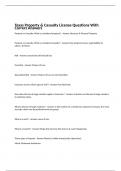
Texas P&C Exam Questions & Answers Latest Updated
HO-2 - Answer Broad Form; owner occupant HO-3 - Answer Special Form; owner occupant. HO-4 - Answer Tenants/Renters contents only HO-5 - Answer Comprehensive Form; owner occupant. HO-6 - Answer Condo owners HO-8 - Answer policy is for OLDER HOMES that have a replacement cost that is much higher than its market value DP-1 - Answer Fire, lightning, internal explosion (Basic Form) DP-2 - Answer BIG AFFECT: Burglary, Ice/sleet/snow, Glass breakage, Accidental discharge of water, Freezing objects, Falling objects, Electrical Current, Collapse, Tearing asunder (Broad) DP-3 - Answer Risks of direct physical loss (Special); open peril Law of large numbers - Answer principle that states that the more examples used to develop any statistic, the more reliable the statistic will be Insurable interest - Answer In order to create a policy which will give you financial gain or loss after the property or subject no longer exist, you must have this Risk - Answer The chance or uncertainty of loss Pure Risk - Answer a risk in which there is no chance of gain, only loss Speculative risk - Answer a risk that may result in a loss or gain Hazard - Answer something that increases the chance of loss Moral Hazard - Answer hazard created by an individual who would be willing to create a loss (lie, cheat, dishonest) situation on purpose just to collect from the insurance company Morale hazard - Answer hazard created by an individual's tendency to contribute to a loss through his own irresponsible, indifferent, careless actions. Physical Hazard - Answer hazard that arises from the condition, occupancy, or use of the property itself Peril - Answer The cause of loss Direct Loss - Answer financial loss resulting directly from a loss to property Indirect loss - Answer loss that is the result or consequence of a direct loss; also called a consequential loss Actual Cash Value (ACV) - Answer the cost to replace an item of property at the time of loss, less an allowance for depreciation; often used to determine the amount of reimbursement for a loss Replacement Cost - Answer the cost to replace a damaged or destroyed item of property without deduction for depreciation; may be the basis of reimbursement for some losses Market Value - Answer the amount property could be sold for at the time of loss. May be used to determine the amount of reimbursement for a loss Agreed value condition - Answer condition found in some property insurance policies that stipulates a certain value that will meet the coinsurance requirement; if the policy limit equals or exceeds this amount, the insured will not be assess a coinsurance penalty Salvage - Answer Damaged property that can be retrieved, reconditioned, and sold to reduce an insured loss Proximate cause - Answer an action that, in a natural and continuous sequence, produces a loss
Written for
- Institution
- Texas P&C
- Course
- Texas P&C
Document information
- Uploaded on
- July 24, 2023
- Number of pages
- 9
- Written in
- 2022/2023
- Type
- Exam (elaborations)
- Contains
- Questions & answers
Subjects
-
texas pampc exam
-
texas pampc exam questions amp answers latest updated
-
ho 2 broad form owner occupant
-
ho 3 special form owner occupant
-
ho 4 tenantsrenters contents only

Also available in package deal