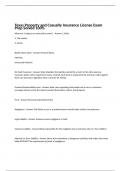
Texas Property and Casualty Insurance License Exam Prep Solved 100%
What are 3 subjects an auto policy covers? - Answer 1. Body 2. The vehicle 3. Assets Bodily Injury Types - Answer Personal Injury Med Pay Uninsured Motorist No Fault Insurance - Answer State stipulates that parties cannot file a claim to the other persons insurance policy unless required in excess. Instead, each party is required to file a primary claim against their own insurance regardless who is at fault. EX. Florida Financial Responsibility Laws - Answer State Laws regulating that people are to carry a minimum coverage amount set by the state to protect themselves, others, and property. P.A.P - Answer Personal Automotive Policy Negligence - Answer The failure to act as a prudent person would under similar circumstances Legal Liability - Answer Involves proven negligence or fault Vicarious Liability - Answer Being responsible for the negligent acts of someone else. Ex. Your children Absolute or Strict Liability - Answer Stems from hazardous or dangerous activities that makes the owner liable WITHOUT the requirement of proof of negligence. Liability - Answer Being responsible for the damages or injury you or someone else you're responsible for has done. The 7 Characteristics of a Contract - Answer 1. Personal Contract 2. Conditional Contract 3. Adhesion 4. Indemnity 5. Aleatory 6. Unilateral 7. Utmost Good Faith Personal Contract - Answer Is stipulation of a contract that says the contract is for the name person and cannot be transferred to another. Conditional Contract - Answer Stipulates set by a contract. "You can do this, but...." Adhesion - Answer A stipulation that the contract and it's language is binding, or "sticks" and the parties agreeing cannot back out so long as the conditions are met. Indemnity - Answer The contract agrees to indemnify, or make whole again the customer. Makes them no better, nor worse, just whole. Aleatory - Answer The stipulation that the contract must include and unequal transfer of money. Ex. The insured signed a contract a month ago and has paid a single payment of $300. The company has only received $300, but it on the hook to pay out $30,000 in the event of a loss. Unilateral - Answer Stipulation that the contract is one-sided. Ex. The customer doesn't HAVE to pay the insurance company, but IF they do, then the insurance company HAS to pay out. Utmost Good Faith - Answer Parties believe that both will deal with eachother honestly and fairly, without misleading or withholding Insurance - Answer A contract by which an Insurance company agrees to compensate an insured for a covered loss in return for a premium payment. Underwriting - Answer Process of evaluating policyholders to determine eligibility for coverage and pricing Law of Large #'s - Answer Principle that the larger the examples of data, the more accurate the information Speculative Risk - Answer Risk of Gain OR Loss Ex. Gambling or Investment Insurance Pure Risk - Answer No chance of gain or benefit. The only kind that insurance deals with. Exposure - Answer An opportunity for risk or loss Risk - Answer Possibility of financial loss Peril - Answer The direct cause of a loss Representation - Answer Statements on an insurance contract that the insured BELIEVES to be true 4 Means of Managing Risk - Answer 1.Reduction 2.Retain 3.Avoid 4.Transfer Reduction - Answer reduce the risk shared by the insured and insurer Ex. Good maintenance Retain - Answer Taking risks by retaining the risk to ones self. Ex. Not reporting an accident to the insurance company, or not getting insurance at all. Avoid - Answer Avoiding risk all together. Ex. Not driving at all Transfer - Answer Transferring risk. Ex. Getting insurance in the first place transfers risk from the insured to the insurer Insurable Interest - Answer To have insurable interest in something it's loss or damage would have to cause you to suffer financial or economic loss. Must have ownership Hazards - Answer Event increases likelyhood of loss. Ex. Texting while driving, weather. Insurance Agreement - Answer Agreement by insurance to provide coverage in exchange for a premium Conditions in an Insurance Contract - Answer Assigns: Duties after a loss Defines Policy Terms Outlines how to cancel Stipulates on multiple contracts (primary & secondary) Insurance Exclusions - Answer Things not covered. Ex. Intentional Acts Coverage - Answer Defines what is covered and what is insured against within an insurance contract Premium - Answer Monetary amount charged by insurer in exchange for coverage Casualty Insurance - Answer A broad term for insurance that covers PROPERTY and LIABILITY losses. Property Insurance - Answer Specifically to protect from financial losses on property that is owned, damaged or destroyed. Ex. Dwelling Insurance Liability Insurance - Answer Protects insured from the risk they might be held legally liable due to injury, harm or negligence Package Policy - Answer A policy that covers both property and liability 5 Parts of an Insurance Policy - Answer 1. Declarations 2. Insuring Agreement 3. Conditions 4. Exclusions 5. Definitions Parties to a policy (3) - Answer The Insured The Insurer Other 5 Parts of a legal contract - Answer Consideration Legal Purpose Offer Acceptance Competent Parties Competent Parties - Answer Having legal capacity to enter into a binding contract Acceptance - Answer Company has accepted an insureds offer to pay a premium in exchange for the company accepting them as a risk and gives them a policy. Offer - Answer Customer wants insurance policy and offers to pay a premium for it. Legal Purpose in a Contract - Answer The contract MUST comply with all the laws Consideration - Answer Value exchange for a service that a buyer is willing to pay Mortgagee Clause - Answer Protection on the policy for the mortgage company on real property Loss Payee Clause - Answer Stipulates how a policy will pay to protect the interests of the lienholder on personal property. Occurance - Answer Loss that occurs as a specific time Coinsurance - Answer Percentage of insurance that a customer must carry in relationship to the value of the property in order to receive full claims payment (80%) Deductibles - Answer AKA S.I.R (Self Insured Retention) is the portion of the loss paid by the insured Agreed Value - Answer Agreed upon value written for a specific amount. Ex. an appraisal on a classic car that is expected to increase in value over time. Salvage Value - Answer Sales value of damaged goods without replacement or exchange Market Value - Answer What the product can be sold for at the time of loss (before damage) Actual Cash Value - Answer The cost to replace minus depreciation. EX. Most home owners policies payout using ACB model. Replacement Cost - Answer What is would cost to repair or replace your item at todays prices without depreciation Direct Loss - Answer A loss where physical hard to tangible property has occurred. Ex. Car is wrecked Indirect Loss - Answer Economic Loss as result of a direct loss. Ex. Rental costs accumulated as result of vehicle being totaled. Unoccupied - Answer No PEOPLE on the premises HO Forms: Basic Perils - Answer Windstorm Civil Commotion Smoke Hail Aircraft Vehicles Volcanoe Explosion Riot Fire/Lightning Theft Vandilism HO Forms: Broad Coverage - Answer Discharge/overflow of water or heat Falling objects Weight of ice/snow or sleet Freezing of systems Accidental discharge Rupture of systems HO-2 - Answer Single-family (not common) Provides broad coverage on Dwelling (A) and structures (B) and broad coverage on personal property (C) HO-8 - Answer Bare-Bones Policy Provides Basic Dwelling/Structures coverage (A)(B) and Basic Personal Property (C) HO-6 - Answer Condo Owner Policy Provides broad coverage on personal property (C) and limited* coverage on dwelling (A)(Most policies will specify exact expectations of owner responsibilities within dwelling) HO-4 - Answer Renters/Tenant Policy Provides broad coverage ONLY for personal property (C) on HO Policy HO-5 - Answer Cadillac Policy for homeowners Provides special coverage for Dwelling (A) and other structures (B) and special coverage for Personal property (C) HO-3 - Answer Most common form of HO Policy for owners/landlords who reside on property Provides special coverage on dwelling (A) and other structures (B) and Broad coverage on personal items (C) Auto liability coverage - Answer -Pays on behalf of insured for damages insured legally responsible to pay to others for bodily injury or property -Pays for defense costs -Pays only to the NOT at fault party Person(s) Covered under Auto Liability - Answer -Named Insured -Family Members using vehicle -Anyone given permission to use the vehicle Texas Auto Liability Minimum - Answer 30/60/25 or CSL or 85k -30k per person -Max 60k per incident -25k property damage Coverage A- Auto Policy - Answer Liability Exclusions to Coverage A- Auto - Answer NOT Covered: -Personal Property -Damage to rented dwellings owned by insured -Intentional Acts -Business use -Theft -Racing -Livery -Auto business (selling, parking, service, storing) Less than 4 wheels -Off road vehicles -Vehicles used regularly without being insured on policy
Written for
- Institution
- Texas Property and Casualty
- Course
- Texas Property and Casualty
Document information
- Uploaded on
- July 24, 2023
- Number of pages
- 34
- Written in
- 2022/2023
- Type
- Exam (elaborations)
- Contains
- Questions & answers
Subjects
-
texas property and casualty
-
texas property and casualty insurance license exam
-
what are 3 subjects an auto policy covers 1 body

Also available in package deal