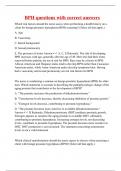
BPH questions with correct answers
Which risk factors should the nurse assess when performing a health history on a client for benign prostatic hyperplasia (BPH) screening? (Select all that apply.) A. Age B. Vasectomy C. Racial background D. Sexual promiscuity E. The presence of testes Answer A, C, E Rationale: The risk of developing BPH increases with age, generally after the age of 40. Men who had their testes removed before puberty are not at risk for BPH. Race may be a factor in BPH: African American and Hispanic males tend to develop BPH earlier than Caucasian American males, while Asian American males develop symptoms later. Having had a vasectomy and sexual promiscuity are not risk factors for BPH The nurse is conducting a seminar on benign prostatic hyperplasia (BPH) for older men. Which statement is accurate in describing the pathophysiologic change of the aging prostate that contributes to the development of BPH? A. "The prostate increases the production of dihydrotestosterone." B. "Testosterone levels decrease, thereby decreasing inhibition of prostate growth." C. "Estrogen levels decrease, contributing to prostatic hyperplasia." D. "The prostate becomes more sensitive to available dihydrotestosterone." Answer D Rationale: Dihydrotestosterone (DHT) mediates prostatic growth. Estrogen appears to sensitize the aging prostate to available DHT, ultimately contributing to prostatic hyperplasia. Increasing estrogen levels, not decreasing levels, contribute to prostatic hyperplasia. The prostate becomes more sensitive to DHT, DHT production is not increased. The statement concerning testosterone levels is not a valid statement
Written for
- Institution
- BPH
- Course
- BPH
Document information
- Uploaded on
- July 24, 2023
- Number of pages
- 19
- Written in
- 2022/2023
- Type
- Exam (elaborations)
- Contains
- Questions & answers
Subjects
-
bph questions with correct answers

Also available in package deal